Last updated: November 19, 2026
Quick Answer: use 5- to 10-minute watering cycles, wait 20 to 30 minutes between passes, and repeat only as needed. That is the core method for how to water a sloped lawn without runoff. A sloped lawn runs off before the soil can drink it. Use cycle-and-soak watering, split the zone, and keep each pass short enough that water sinks in before it moves downhill. The steps below show how to set that up on real grass, not flat-yard theory.
Key Takeaways
- Short watering bursts beat one long soak on a slope.
- Water only until the top layer of soil is damp, then pause so it can absorb.
- Aim spray low and uphill when you can; high arcs waste water.
- If water starts to sheet downhill, stop and restart later.
- Two shorter zones often work better than one long slope zone.
- The point is absorption, not puddles.
Start With the slope, not the timer
Picture this: you’re standing on the low side of your yard, and the sprinkler is sending water downhill faster than the grass can take it. The fix is how to water a sloped lawn without runoff with slope irrigation that matches the soil’s intake speed, not a flat-lawn schedule. If the water can’t soak in within a few minutes, the slope is telling you the cycle is too long.
The truth is, runoff usually starts before the grass looks wet. On a moderate slope, a long soak can send water into the street or a low bed even if the lawn still looks dry on top. The better target is a pass that wets the surface without making water race downhill.
Use this simple check:
- Watch the first 5 to 10 minutes.
- If water starts to move in a sheet, stop the cycle.
- If the soil stays damp and dark, you’ve got the right pace.
- If the surface dries fast, you may need a second short cycle later.
How do I water a sloped lawn without runoff?
You water a sloped lawn without runoff by using short watering cycles, waiting for absorption, and repeating instead of flooding the hill at once. That is the basic method, and it works because soil can only take in water so fast before gravity wins.
Here’s a practical order for how to water a sloped lawn without runoff when you use a sprinkler:
- Set the sprinkler to a low, even pattern so the spray lands on the lawn, not the sidewalk.
- Run it for a short first pass, usually 5 to 10 minutes, and watch the downhill edge.
- Stop when you see water start to move instead of soak.
- Wait about 20 to 30 minutes so the soil has time to absorb what’s already there.
- Repeat with another short pass if the grass still needs water.
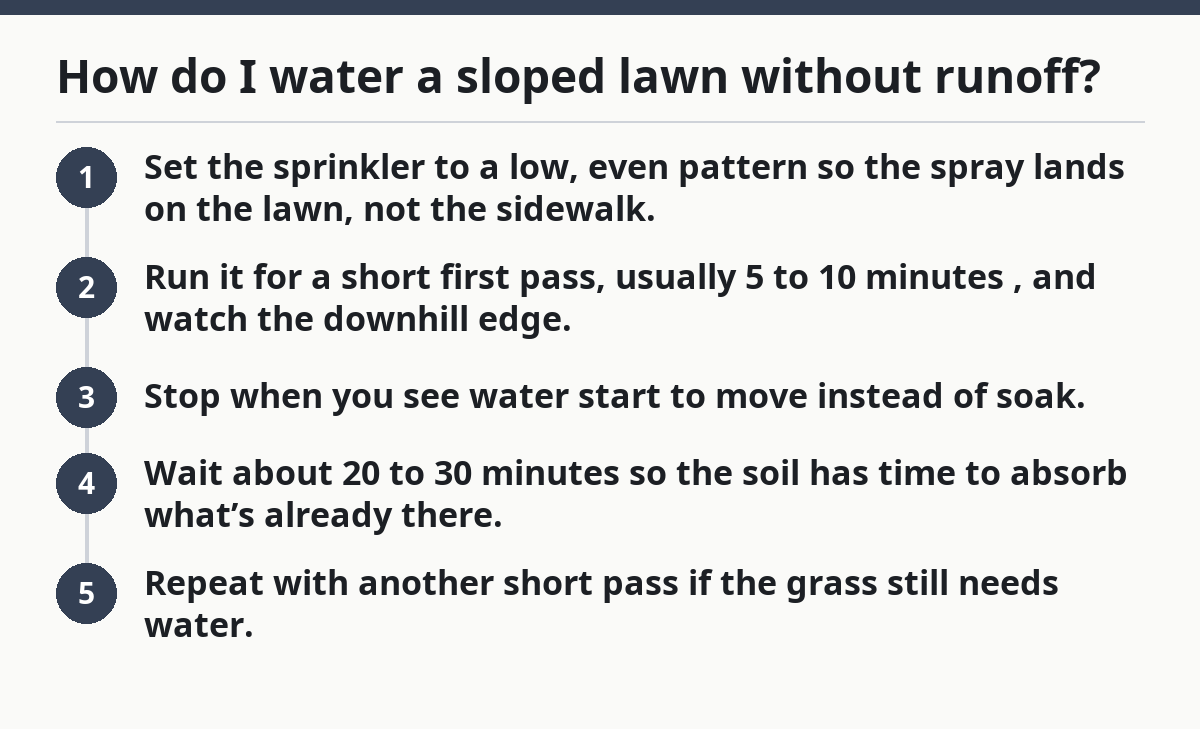
That cycle-and-soak method gives the top layer time to pull water down into the root zone. On a hill, one long blast is usually the wrong shape of watering. Short bursts are often better.
Set up the sprinkler so the slope can catch up
Picture this: you’re placing a sprinkler on a hill, and the first thing to fix is where the water lands. Put the head so the spray pattern covers the dry area evenly and doesn’t hammer the same downhill strip for the full cycle. A poor position creates runoff faster than a poor schedule.
However, angle matters too. If the sprinkler can throw water slightly uphill, do that. The upper part of the slope has a better chance to hold it long enough for the soil to take it in. Keep the output low and steady, not a hard stream that carves channels in the dirt.
Use these placement rules:
- Put the sprinkler where the spray reaches the whole zone without overshooting.
- Keep the pattern even; avoid one hot spot.
- Water from the upper side when the layout allows it.
- Move the head if one section stays dry and another runs off fast.
- For a very uneven lawn, consult a professional if needed, and divide the slope into separate coverage areas instead of treating it like one flat strip. Oregon State University Extension
Split the slope into zones if one pass keeps running off
Picture this: you’re trying to water a long hill in one shot, and the bottom half gets soaked while the top half stays thirsty. Splitting the area into 2 smaller zones is often the cleanest fix because each part gets a shorter, easier soak.
This is where a lot of generic advice misses the point. A sloped lawn is not just a lawn on an incline; it is two water problems at once. The upper section drains one way, the lower section receives extra water from above, and the middle can dry out oddly if you keep blasting the same timer.
Try this approach:
- Water the top section first with a short cycle.
- Pause long enough for absorption.
- Water the lower section second, with an even shorter pass if it already catches runoff.
- If your controller allows it, give the upper zone a little more total time than the lower one.
- Recheck after a few days and adjust by soil response, not by habit.
This keeps you from overwatering the bottom edge while trying to save the top. That edge is where runoff shows up first.
Which watering mistakes make runoff worse?
Runoff gets worse when you water too fast, too long, or too hard for the soil to absorb. The mistake is usually not the lawn itself; it’s the delivery rate. A sprinkler that dumps water faster than the ground can drink it will waste water on any slope, even a mild one.
Three common errors show up again and again:
- One long cycle: the soil gets overloaded and water sheets downhill.
- High, forceful spray: droplets hit hard and push loose soil around.
- Ignoring the first signs of runoff: by the time water reaches the curb, the cycle has already gone too far.
The fix is boring, but it works. Shorten the run time, lower the spray, and give the soil a pause. If the lawn still dries out too fast after a day, add another short cycle instead of making the first one longer.
What soil and absorption time mean on a hillside
Picture this: you’re watching water disappear into one patch of grass and race across another. That difference is absorption time, and it is the reason a sloped lawn needs more patience than a flat one. Same sprinkler, same yard, different intake.
Soil texture changes the pace. Dense soil tends to take water slowly at first, then hold it near the top. Loose soil may drink faster, but it can still shed water if the spray is too heavy. On a slope, the surface often needs a break before the next pass.
Give the soil time to catch up:
- Pause 20 to 30 minutes between short cycles.
- Watch whether the surface is still glossy or already matte.
- Restart only after the first pass has mostly soaked in.
- If the top layer is already saturated, stop and let it drain before adding more.
This is not about forcing the ground to accept more water. It’s about timing the next dose so the slope can actually hold it. USDA NRCS soil basics
When drip irrigation helps, and when it doesn’t
Drip irrigation can help a lawn slope at the edges, but it is not the main answer for a grass lawn. It delivers water slowly, which is good for runoff control, yet turf usually needs broad coverage that drip lines do not give by themselves. University of California Agriculture and Natural Resources
Use drip only where the layout supports it:
- Narrow strips beside the lawn.
- Mixed planting areas that border the slope.
- Spots where a sprinkler may cause washout.
For the turf itself, a well-set sprinkler and cycle-and-soak watering usually fit better. Drip works best as a helper, not a full replacement, unless the lawn area is very small or shaped in a way that lets the tubing cover it evenly. EPA WaterSense
The short version for keeping water on the lawn
Picture this: you’re ready to water, and you just want the simplest plan that won’t waste half the spray. The answer is short cycles, a pause, and a second pass only if the soil is ready for it. That keeps water in the root zone instead of on the sidewalk.
Use this sequence every time:
- Run a short cycle.
- Watch for runoff.
- Pause for absorption.
- Repeat only as needed.
If you want the broader watering picture for the rest of the yard, the lawn watering guide on this site fits right beside this page without repeating the same slope problems.
Why does water run off a slope?
Water runs off a slope because gravity moves it downhill faster than the soil can absorb it. On a steep or compacted area, that happens even faster, especially if the sprinkler throws water faster than the ground can take it in. Shorter cycles slow the supply down enough for absorption.
Should you water slopes in shorter cycles?
Yes, slopes usually do better with shorter cycles than with one long run. Short cycles give the soil time to absorb water before the next pass starts. That reduces sheet flow and helps the water stay where the roots can use it.
Can drip irrigation help a lawn slope?
Drip irrigation can help parts of a sloped yard, but it usually isn’t the main solution for turf. It works well for narrow borders and planted edges where slow delivery matters. For the lawn itself, sprinkler coverage with cycle-and-soak watering is usually the better fit.
How do you keep water from pooling on a hill?
You keep water from pooling on a hill by stopping the cycle as soon as the surface starts to shine or move downhill, then waiting before the next pass. A low spray pattern and a better sprinkler position help too. If pooling keeps happening, the zone is asking for less water per cycle, not more.
Drafted with AI; not yet reviewed by a person.





Leave a Reply