Last updated: November 19, 2026
Quick answer: for a large lawn, start with 2 watering zones or 2 sprinklers if one head cannot cover the far edge cleanly at your actual pressure. In how to choose a sprinkler for a large lawn without wasting water, the right sprinkler is usually a rotary sprinkler or impact sprinkler that matches your water pressure, reaches the far edge without misting, and lets you build overlap with more than one sprinkler zone if needed. The goal is not the widest spray on paper; it is even coverage with the least runoff and wind loss.
Key takeaways
- A large lawn needs reach and control, not just a big spray pattern.
- Rotary and impact models make more sense than quick, fixed fans when distance matters.
- Water pressure changes how far a sprinkler throws and how cleanly it sprays.
- One sprinkler often leaves dry gaps; a second unit can waste less water if the overlap is planned.
- The best choice depends on covering the lawn edge cleanly at the pressure you actually have.
What makes a large-lawn sprinkler different?
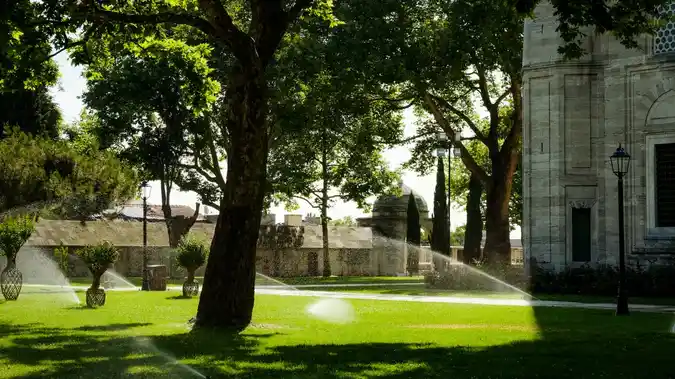
A large-lawn sprinkler has to throw water farther and more evenly than a basic yard sprinkler, and that changes what you should look for first. On a big lawn, a short spray pattern creates dry bands, while an overpowered head can send water into the driveway, the sidewalk, or the street.
The two features that matter most are long throw distance and control over the spray. Long throw distance keeps you from dragging the sprinkler every few minutes, and control keeps you from wasting water on hardscape. That is why rotary sprinkler and impact sprinkler models usually fit large lawns better than a simple fan nozzle.
Water pressure matters here more than style. A head made for higher pressure can spray well on paper and still mist badly if the pressure is too high, while a low-pressure model may never reach the far edge of the lawn. A sprinkler zone with steady pressure gives cleaner coverage than a weak hose line with lots of fittings and kinks.
Therefore, the wrong choice for a large lawn is any sprinkler that looks wide but cannot hold its pattern past the first third of the yard. It may seem cheaper at first, but it usually costs more in water and time because you keep moving it or rerunning the same area.
For a general buying path, the hub guide to how to choose a sprinkler can sit beside this page. This page stays focused on large lawns and the reach-versus-efficiency tradeoff.
Which sprinkler type fits a big yard?
A rotary sprinkler is often the most practical starting point for a large lawn because it sends water in moving streams and tends to handle distance better than a fixed spray head. An impact sprinkler is the older, heavier option, but it still earns a place on large properties because it can throw water a long way and handle rough conditions.
Here is the practical comparison:
| Sprinkler type | Best for | Strength | Trade-off |
|---|---|---|---|
| Rotary sprinkler | Large lawns with a need for even coverage | Good control, smoother watering, better match for a planned sprinkler zone | Usually covers more slowly than a fixed spray |
| Impact sprinkler | Long throws and tough, open spaces | Strong reach and simple design | Noisier, and the stream can be less precise near edges |
| Fixed spray sprinkler | Small or tight areas | Simple and cheap | Often poor for a large lawn because it wastes water at distance |
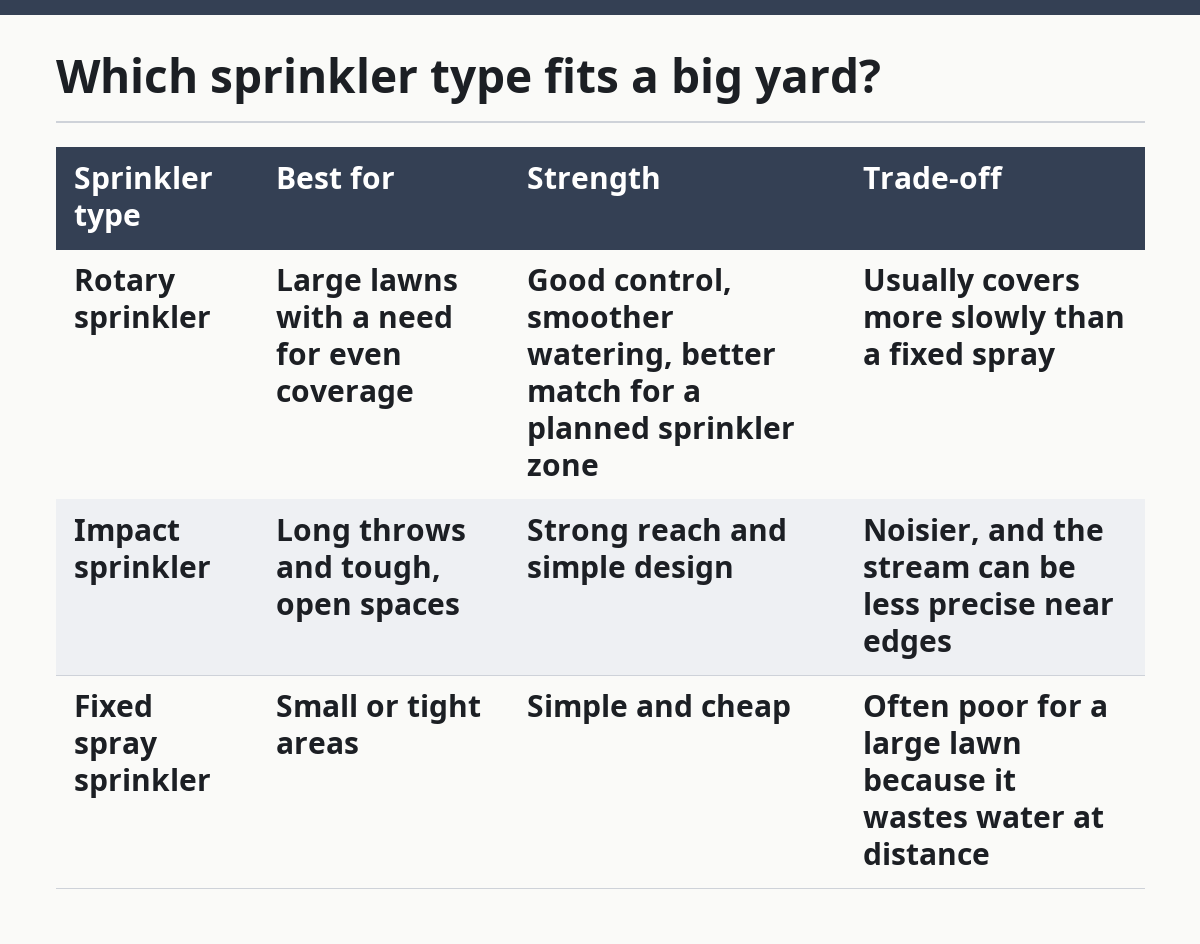
So, a rotary sprinkler is a strong pick if you want a cleaner, more even pattern across a broad lawn. It is often the better match when you care about coverage overlap and want less misting at the edge of the spray. An impact sprinkler makes sense when the lawn is broad, open, and you need reach more than quiet operation.
The trade-off is simple: the more distance you ask for, the more careful you have to be about pressure and placement. A sprinkler that throws the farthest is not always the one that waters the best. If the water breaks into fine mist, wind carries it away before it hits the grass.
How do I judge throw distance without wasting water?
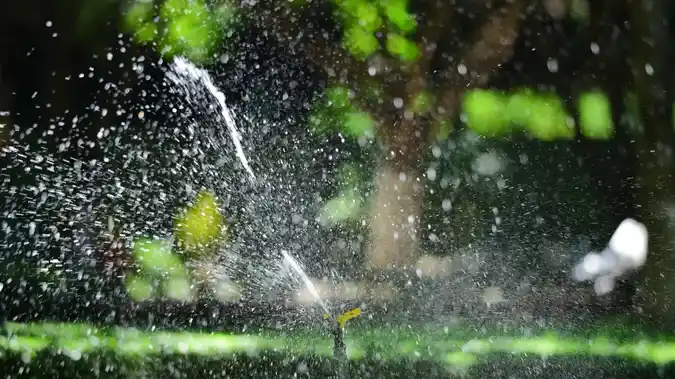
The best way to judge throw distance is to match the sprinkler to the actual size of the lawn edge you need to reach, then choose the model that hits that edge with a solid stream instead of a fine cloud. A sprinkler that reaches the far line by misting is wasting water before it lands.
Start with the longest open span on the lawn. If the nozzle has to cross a driveway, patio, or path, that distance matters because overspray lands where grass cannot use it. A long throw distance is useful only if the spray stays heavy enough to reach the target in the air.
For example, if the pattern looks “foggy” near the middle of the throw, the setting is too aggressive for the pressure. If the outer edge fades weakly before the grass line, the sprinkler is too small for the space or the pressure is too low. Either way, the lawn will get uneven coverage.
A model that advertises a huge reach can still fail on a large lawn if your water pressure is modest or your hose setup creates loss. Hose length, bends, and splitters all steal pressure before the water reaches the head. That is why a large-lawn sprinkler should be chosen for the whole setup, not just the label on the box.
If the lawn is very broad, a single sprinkler with a huge throw is often the wrong answer. Two moderate throws with overlap usually beat one extreme throw because the water falls more evenly and the edge does not dry out.
Should I use one sprinkler or more than one?
More than one sprinkler is often the better choice for a big lawn because it reduces the need for an extreme throw and can improve coverage overlap. One sprinkler is fine only when the shape is simple and the reach is short enough that the spray stays even from center to edge.
The main reason to use multiple sprinkler setup points is to avoid weak corners and dry strips. A single sprinkler can cover a lot of ground, but the middle usually gets wetter than the edges. Two sprinklers can split that job, each with a shorter reach and less risk of mist loss.
That said, more sprinklers are not automatically better. Too many heads or too much overlap can waste water by soaking the same area twice. The goal is not to flood the lawn; it is to let the spray patterns meet without piling up water in one band.
A good rule of thumb for planning is to think in zones rather than in one giant circle. A sprinkler zone is just the part of the lawn that one water setup can cover at one time. On a large lawn, dividing the space into zones usually gives you better control over run time and less waste at the edges.
The wrong move is to use one oversized sprinkler because it feels simpler. That often leads to runoff, puddles, and uneven grass. It is also the common mistake that makes people think they need more water when they really need better coverage.
How does water pressure change the choice?
Water pressure changes the choice because it controls both how far the sprinkler throws and how cleanly it breaks the water into a useful pattern. If the pressure is too low, the sprinkler may not reach the edge of the lawn. If it is too high for the head, the spray can turn into mist and drift away.
A large-lawn sprinkler should be matched to the pressure you actually have, not the pressure you wish you had. This matters even more with rotary sprinkler and impact sprinkler models, because both depend on strong, steady flow to do their job well. A model that works beautifully on one property may waste water on another.
So, buyers often make a bad guess when they buy the largest head they can find and assume more reach means better coverage. In practice, a head that is too large for the pressure often sprays unevenly and spends more time turning into a cloud than watering grass.
Simple hose setup details also matter. Long hoses, sharp bends, and splitters can all drag pressure down before the water reaches the sprinkler. If the pressure is already modest, a shorter hose path and fewer fittings can make a bigger difference than changing the sprinkler model.
For large lawns, the best fit is usually the sprinkler that gives a stable pattern at your real pressure, even if that means choosing a less dramatic label on the package. Clean coverage beats a flashy throw every time. For more setup guidance, see sprinkler water pressure basics and how to set up sprinkler zones.
What setup wastes the least water on a large lawn?
The least waste comes from using the smallest throw that still reaches the target area and arranging the lawn in sprinkler zones with enough coverage overlap to avoid dry strips. That means the sprinkler should just clear the far edge, not shoot far beyond it.
A practical setup follows a simple order:
-
Measure the longest open stretch of grass that needs water.
The result you want is a reach target that keeps the spray off pavement and fences. -
Check your water pressure at the hose or line feeding the sprinkler.
The result you want is a sprinkler class that fits that pressure instead of fighting it. -
Choose rotary sprinkler or impact sprinkler based on reach and control.
The result you want is a steady pattern, not a foggy arc. -
Place the sprinklers so their spray patterns overlap at the edges, not in the middle of the lawn.
The result you want is even wetting without standing water. -
Run one sprinkler zone at a time if the lawn is large enough to need separate areas.
The result you want is better control over how much water each section gets. -
Watch the outer edge of the spray on the first run.
The result you want is a clean landing zone at the grass line, not a visible cloud blowing past it.
The biggest waste comes from overreaching. A sprinkler that throws too far often sends some water into wind, some onto hard surfaces, and some into a fine mist that never settles where it should. The smarter choice is usually a shorter, cleaner throw with planned overlap.
For more on keeping runoff down, smart irrigation tips and watering schedule basics can help you keep run time aligned with the lawn.
What mistakes should I avoid?
The most common mistake is choosing the farthest-throwing sprinkler and calling it good. That can waste water fast if the pattern turns misty or overshoots the lawn edge. The fix is to match the sprinkler to the yard width and your water pressure, not to the biggest number on the package.
Another mistake is ignoring rotation speed. A sprinkler that moves too quickly can under-water one pass and overwater another if the pattern is uneven. A very slow turn can soak one strip while leaving another dry if the overlap is poor. The right speed is the one that keeps the grass evenly damp without puddles.
A third mistake is treating one large sprinkler as a cure for a big lawn. That may seem simpler, but it often leads to runoff and patchy growth. Two smaller throws in a sprinkler zone usually waste less water than one oversized head cranked to its limit. If the layout is complex, it can help to consult a local irrigation professional.
A fourth mistake is skipping coverage overlap. If the spray edges do not meet, the lawn shows dry seams. If they meet too much, water pools. The goal is a light overlap that fills gaps without doubling the soak. For technical guidance, the EPA WaterSense program has practical irrigation advice: EPA WaterSense.
Where does this fit in the bigger sprinkler choice?
This choice sits inside the larger guide to how to choose a sprinkler, but the large-lawn version has a narrower job. Here the main question is not whether the sprinkler is easy to move or cheap to buy. It is whether it can cover a broad space at your pressure without wasting water on mist, runoff, or overspray.
For a large lawn, the best answer is usually a rotary sprinkler or impact sprinkler set up in one or more zones, with enough overlap to cover the edges and enough restraint to keep water on the grass. That is the balance that matters. A model that cannot hold that balance is wrong for this job, even if it looks powerful.
What sprinkler covers a large yard?
A rotary sprinkler usually covers a large yard well because it gives more control over distance and spray shape. An impact sprinkler can also cover a large yard, especially when you need a longer throw and a simple design.
The better choice is the one that matches your water pressure and keeps the spray from turning to mist. If the lawn is broad but not simple, more than one sprinkler in separate sprinkler zones can work better than one oversized unit. The University of California Agriculture and Natural Resources has practical irrigation guidance for matching water application to landscape needs: UC ANR irrigation.
Do i need more than one sprinkler for a big lawn?
Yes, more than one sprinkler is often the better choice for a big lawn. A single unit can leave dry edges or force you into a long throw that wastes water.
Two sprinklers with planned coverage overlap usually give more even results. That approach also lets you keep each sprinkler’s throw shorter, which can reduce misting and runoff.
Which sprinkler throws the farthest?
An impact sprinkler often throws the farthest, especially in open spaces with enough water pressure. That reach is useful on a large lawn, but it is not the same as efficient watering.
A rotary sprinkler may throw a little less far, yet it often waters more evenly. If the farthest throw is also foggy or drifts in the wind, it is the wrong choice for saving water.
Drafted with AI; not yet reviewed by a person.





Leave a Reply