
Last updated: November 27, 2026
Choose a sprinkler that throws larger drops, covers evenly, and lets you water early in the morning. In hot, dry weather, a rotary sprinkler usually wastes less water than a spray nozzle, while an oscillating sprinkler can work well if your lawn is small and square. Add a hose timer and you can keep watering steady without overdoing it.
Key takeaways
- Pick the sprinkler that matches your yard shape first, not the one with the widest throw.
- In heat, slower and steadier watering usually beats fast misting because fine spray disappears sooner.
- A hose timer helps you water at the same time each day, which matters when dry weather raises evaporation.
- Oscillating heads suit neat rectangles; rotary heads handle odd shapes and wind better.
- A spray nozzle is the least forgiving choice for hot weather because it can put out water too quickly and too finely.
What should I choose for hot, dry weather?
Choose a sprinkler that puts water down in a steady, even layer, not one that makes a lot of mist. That is the simplest rule for hot, dry weather, because fine droplets lose more water to evaporation before they reach the soil.
A rotary sprinkler is the safer default for many dry-season lawns because it turns slowly and sends out larger drops. An oscillating sprinkler can still be a good fit for a flat, rectangular area, especially if you want simple setup. A spray nozzle works for spot jobs and beds, but it is easier to waste water with it when the air is hot and dry.
The yard shape matters as much as the weather. A square or narrow lawn often suits an oscillating head. Curved edges, corners, and mixed beds are usually easier to cover with a rotary model. If you already own a hose timer, it becomes easier to stick with one schedule instead of guessing each day.
This is not the page for anyone trying to solve drought damage, lawn rescue, or whole-yard redesign. It is for choosing the right watering tool for seasonal use, where the main problem is heat stress and evaporation, not a broken irrigation system.
For background on broader sprinkler selection, see the main guide to how to choose a sprinkler on this site. For outdoor watering basics, the EPA WaterSense outdoor water use guidance is a solid place to start.
Which sprinkler type handles heat best?
A rotary sprinkler usually handles heat best because it tends to throw heavier drops and cover more evenly than a fine spray. That does not make it perfect for every yard, but it is often the most forgiving option when the weather is dry and the sun is strong.
Here is the plain comparison:
| Type | Best for | Strength in hot weather | Weak point |
|---|---|---|---|
| Oscillating sprinkler | Small, rectangular lawns | Easy, even coverage when placed well | Less flexible on odd shapes |
| Rotary sprinkler | Mixed shapes, wider coverage | Larger drops and steadier coverage | Can take longer to cover a full area |
| Spray nozzle | Beds, small patches, quick touch-ups | Handy for targeted watering | More waste from fine spray and fast output |
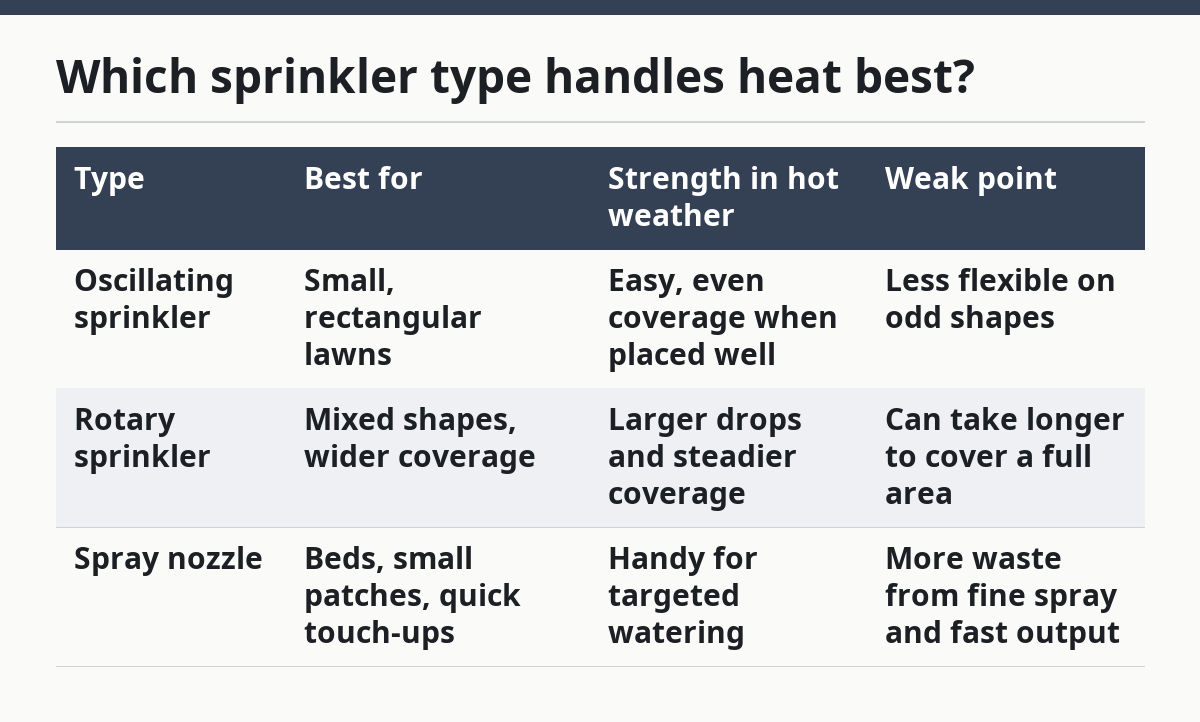
If the lawn is laid out in a clean rectangle, an oscillating sprinkler can still do a fine job. The problem starts when the spray misses edges or overlaps too much, because hot weather magnifies both dry spots and puddling. Rotary heads are better at adapting to shape changes and mild wind.
A spray nozzle should be a last choice for large seasonal watering. It is useful when you need to water a small patch near a path or foundation, but it is harder to keep consistent for longer runs. In hot weather, consistency matters more than speed.
One simple rule helps: if you have to move the sprinkler often to cover the same patch twice, you are probably using the wrong type for the yard.
How do I keep evaporation down?
Keep evaporation down by watering early, using a hose timer, and aiming for slower coverage rather than a mist. Early morning is the best time in hot, dry weather because the sun is lower and the wind is often calmer.
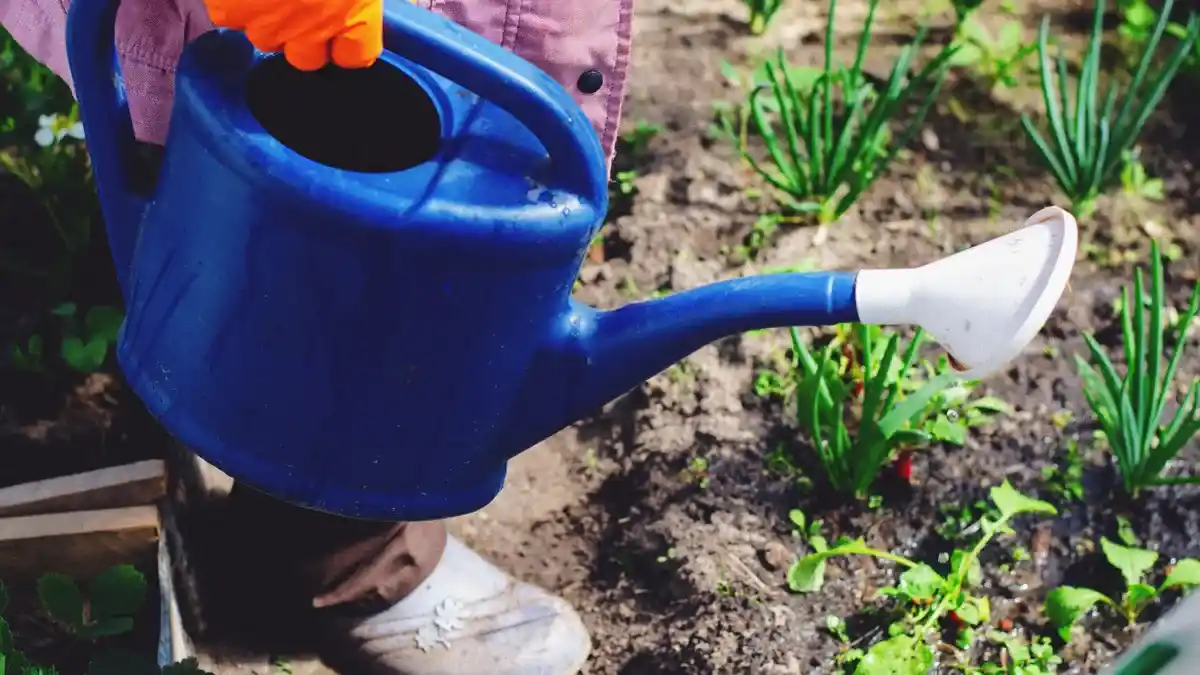
Set the hose timer so the watering starts before the day heats up. A timer is useful even for small yards because it removes guesswork and keeps the schedule steady. If you water by hand, try to do it in one planned run rather than stopping and starting several times.
Aim the sprinkler so it lands on the turf or planting bed, not on pavement. Water on hot concrete disappears fast and can also run into the street. That is wasted water, and it does nothing for heat stress.
A few practical habits help more than people expect:
- Place the sprinkler close enough to the target area that water falls where roots can use it, not out on hard surfaces.
- Run it early in the morning, before the day’s heat builds, so less water flashes off into the air.
- Use a hose timer to keep the schedule repeatable instead of watering whenever the day feels hot.
- Check the spray shape after 5 to 10 minutes so you can spot drift, overlap, or dry stripes before a full cycle is wasted.
The goal is not to blast the lawn. The goal is to let water soak in where it helps. A slower setting is usually better than a fast one in July or August, especially when the ground is already dry.
For people who want a standards-based reference on water use, the EPA WaterSense program is worth reading because it focuses on practical conservation, not just equipment labels.
How do I pick the right sprinkler for my yard?
Pick the sprinkler by matching the spray shape to the yard shape, then check how evenly it covers a test area. That is the decision that saves the most frustration later.
Start with your ground shape. A rectangular patch usually favors an oscillating sprinkler. A yard with curves, narrow edges, or a few separate beds usually suits a rotary sprinkler better. If you only need to water a small flower strip or a tight corner, a spray nozzle may be enough.
Then think about water distribution. Hot, dry weather exposes weak coverage fast. If one side of the area gets soaked while the far edge stays dry, the sprinkler is the wrong fit even if it looks fine at first glance. Even coverage matters more than throw distance.
Next, think about control. A hose timer is a smart match for either oscillating or rotary use because it keeps the schedule steady. It also helps if you tend to forget when you started watering. That is a common way to overwater, especially when the weather stays hot for several days.
A quick field check helps. Put a few shallow containers across the area and run the sprinkler long enough to see whether the water lands evenly. You do not need a scientific setup. You only need to know whether the center, edges, and corners are getting similar coverage.
Choose the tool that fits the shape and the schedule. Do not buy for maximum throw alone. In hot weather, a sprinkler that matches the yard is more valuable than one that looks powerful.
What mistakes waste water fast?
The biggest mistake is choosing a fine spray for a job that needs slower, heavier drops. That mistake costs water twice: once through evaporation and once through uneven coverage that forces you to run the sprinkler longer.
Another common mistake is watering at the hottest part of the day. Midday watering sends more water into the air and onto hard surfaces. A hose timer makes it easier to avoid that, because you can set a morning run and stop thinking about it.
A third mistake is using the wrong sprinkler shape for the area. An oscillating sprinkler in a curved bed, or a rotary head pointed at a narrow strip, wastes water because the spray misses target spots. The result is either dry patches or extra run time.
Here is the cost of each mistake, in plain terms:
- Too much mist: more evaporation and less water reaching the roots.
- Wrong time of day: more loss to heat and wind.
- Wrong coverage shape: more overlap, runoff, or missed edges.
- No timer: more forgetful overwatering and less consistent seasonal care.
The fix is not complicated. Match the sprinkler to the yard shape, use the hose timer, and water early. If one part of the lawn keeps drying out, adjust the setup before increasing runtime. More minutes are not always the answer.
When is a sprinkler the wrong choice?
A sprinkler is the wrong choice when you only need a tiny area watered, when the wind is strong, or when the spray keeps landing on pavement instead of soil. In those cases, a hose nozzle or hand watering may be more sensible for the day.
It is also the wrong choice if you need a very precise watering pattern around delicate plants and small beds. A spray nozzle can be useful there, but it is easy to overdo. Hot, dry weather makes that problem worse because the water seems to disappear, so people keep adding more.
If the yard has major dry spots, compacted soil, or a larger watering problem, this page is not the fix. It is about choosing the right sprinkler for seasonal watering, not solving every lawn issue tied to drought or heat stress.
One final caution: do not assume that a stronger spray means better watering. In hot weather, the best choice is often the calmer one. A rotary sprinkler or a well-placed oscillating sprinkler, used early with a hose timer, usually does more useful work than a fast spray nozzle.
Is one sprinkler type better in hot weather?
A rotary sprinkler is often the better bet in hot weather because it tends to water more evenly and with less fine mist. An oscillating sprinkler can still work well on a small rectangular area, but it needs careful placement. A spray nozzle is usually the weakest choice for seasonal watering in heat.
How can I reduce evaporation when watering?
Water early in the morning, use a hose timer, and choose a sprinkler that sends out larger drops instead of a fine mist. Keep the spray on soil and turf, not pavement. A slower, steadier run usually loses less water than a quick blast in the middle of the day.
Should I water more often in dry weather?
Not automatically. Dry weather does not always mean more frequent watering; it often means smarter timing and better coverage. A hose timer can help you keep the schedule consistent, but the key is to water in a way that reaches the root zone without wasting water to heat and evaporation.
Drafted with AI; not yet reviewed by a person.




Leave a Reply