Last updated: November 20, 2026
Quick answer: choose a nozzle with the right arc first; a 90-degree, 180-degree, or 360-degree spray pattern is the key number to match to the area. In What to look for in a sprinkler nozzle and spray pattern, the nozzle decides where the water goes, how wide it spreads, and how fine the droplets are. If you pick the wrong pattern, you waste water on sidewalks, leave dry strips in the bed, or turn a small zone into mist.
Key takeaways
- The nozzle matters because it shapes the water, not just the flow.
- Fan spray works best when you want a flat sheet of water across a set arc.
- Full-circle spray fits round coverage, while adjustable nozzles help when the shape is odd.
- Fine mist can look gentle, but it often blows off target more easily.
- The best nozzle is the one that matches the area, the arc, and the amount of control you need for the job.
What does a sprinkler nozzle control?
A sprinkler nozzle controls the water shape, the arc, and the edge of the spray. It is the part that turns water from a stream into a fan, a full circle, or an adjustable pattern, which is why nozzle choice matters more than many first-time buyers expect.
The nozzle also changes how the water feels in the air. A finer spray breaks into smaller droplets, while a tighter pattern sends water in a more defined band. That trade-off matters because fine mist can drift more in wind, while a heavier spray usually stays closer to the target. The EPA WaterSense program and irrigation guidance from the Irrigation Association both emphasize matching application to the area, not just increasing output. EPA WaterSense | Irrigation Association
A generic sprinkler guide often talks about the whole sprinkler head and skips the nozzle. That leaves out the part you actually notice when a lawn edge stays dry or a walkway gets soaked. If the nozzle is wrong, the rest of the setup can still miss the job.
Think of the nozzle as the water-shaping piece on the front. The body holds it, but the nozzle decides whether the area gets a fan spray, a full-circle spray, or a pattern you can change by hand.
What should I look for in a spray pattern?
A spray pattern should match the shape of the area, cover the full target, and avoid throwing water where it is not needed. If the nozzle pattern does not fit the space, the sprinkler can look busy while still missing strips of soil.
Start with the arc. A 90-degree pattern fits a corner, 180 degrees fits a straight edge, and 360 degrees fits a full ring around the head. Those numbers are simple, but they matter because a mismatch usually means overlap in one spot and a dry patch in another.
Then look at droplet size. A fine mist spreads quickly and can look smooth, but it is the easiest to push around with wind. A heavier fan spray keeps its shape better and is usually the safer pick when overspray would land on paths, walls, or windows.
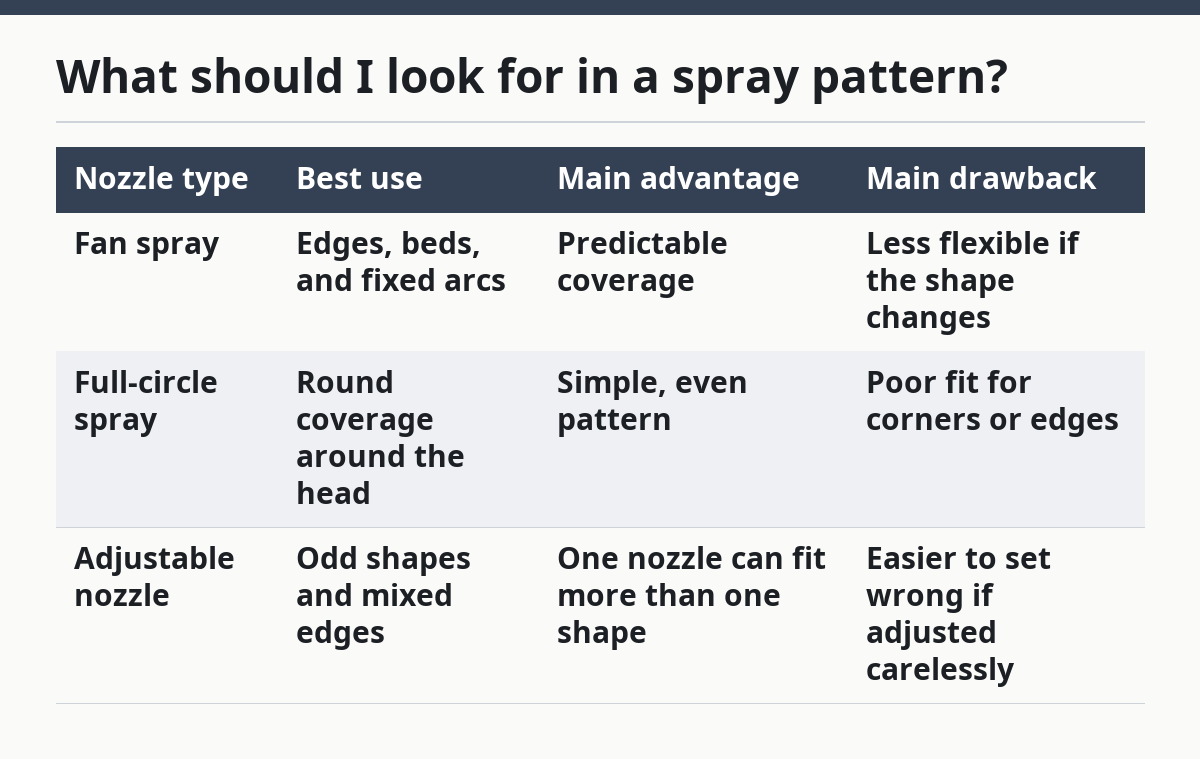
Here is the short version of the main options:
| Nozzle type | Best use | Main advantage | Main drawback |
|---|---|---|---|
| Fan spray | Edges, beds, and fixed arcs | Predictable coverage | Less flexible if the shape changes |
| Full-circle spray | Round coverage around the head | Simple, even pattern | Poor fit for corners or edges |
| Adjustable nozzle | Odd shapes and mixed edges | One nozzle can fit more than one shape | Easier to set wrong if adjusted carelessly |
A reader who wants one clean answer should choose the pattern first and the nozzle second. That order saves time because the pattern tells you what the water will do before you worry about model names or package labels. For planning around coverage, our sprinkler coverage guide can help.
Fan spray, full-circle spray, or adjustable nozzle?
A fan spray is often the safest choice when you know the arc you need, while a full-circle spray fits open, round coverage, and an adjustable nozzle is useful when the shape is not clean. Each has a place, but none is right for every zone.
A fan spray usually gives the most controlled look. It sends water in a flat sheet across a set arc, which makes it easier to cover a bed edge or a narrow strip without flooding the wrong side. The trade-off is simple: it works well only if the area really matches that arc.
A full-circle spray is the simplest pattern to understand. It sends water all the way around the head, which makes sense in open areas with space on every side. The drawback is just as clear: if the head sits near a border, half the spray may miss the target.
An adjustable nozzle gives flexibility, which is why many people start there. It can be useful on a patch with odd corners or when one area needs a shape that is not a neat 90 degrees or 180 degrees. The trade-off is that it depends on careful setting, and a loose adjustment can leave you with overlap or a gap.
A quick rule helps here: choose fixed spray for simple, repeatable coverage; choose adjustable when the area shape forces a compromise. If the space is straightforward, a fixed nozzle is usually less fussy. If the space is awkward, the adjustable style can save you from buying the wrong fixed pattern.
How do I read the nozzle markings?
You read the nozzle markings by checking the arc, the pattern type, and any adjustment range before you install it. The label is not decoration; it tells you whether the nozzle is meant for a 90-degree corner, a 180-degree edge, or a 360-degree circle.
Many nozzles use numbers or symbols to show the pattern. A fixed pattern is easier to trust because what you buy is what you get. An adjustable model may show a range, which means you still need to set the arc by hand instead of assuming it is correct out of the box.
This is where people often miss the fine print. A nozzle that says “adjustable” is not automatically a good fit for every job. It may cover a wider range of shapes, but it can also be harder to set cleanly than a fixed 180-degree fan spray.
Follow a simple order when you compare labels:
- Match the arc to the shape of the area. A 90-degree corner should not get a 360-degree nozzle.
- Check whether the spray is fixed or adjustable. Fixed patterns are simpler; adjustable ones need more care.
- Look for the nozzle type, such as fan spray or full-circle spray. The pattern tells you where the water will go.
- Notice whether the spray looks fine or heavy. Fine mist can drift more, especially in wind.
- Pick the simplest nozzle that still covers the area without obvious waste.
That last point matters. The most flexible nozzle is not always the best one. A simple fixed pattern often does a better job because it leaves less room for setting errors.
What mistakes cost water?
The biggest mistake is choosing a nozzle pattern that does not match the space, and that usually costs water in the form of overspray, drift, or dry patches. A wrong nozzle can still spray, but it can waste time and leave the area uneven.
A common error is using a fine mist where a fan spray would hold better. Mist can look delicate, but it also moves easily. If the air is even a little windy, more of that spray can end up outside the planting area.
Another mistake is using a full-circle spray near an edge or walkway. That choice often puts water where it is not needed, which means runoff on hard surfaces and less water in the soil. The fix is simple: switch to a partial arc or an adjustable nozzle that can be set to the right angle.
People also overvalue adjustability. An adjustable nozzle sounds useful, but if the setting is vague or easy to bump, it can be more trouble than a fixed 180-degree pattern. The extra control is only worth it when the area shape really needs it.
The cleanest choice is often the least flashy one. If the area is a straight edge, a fixed fan spray usually wins. If the area is round, a full-circle spray makes more sense. If the shape is awkward, use the adjustable nozzle only because it solves a real problem, not because it sounds convenient.
How I chose what matters most
I chose the features that change spray quality, not the features that sound technical and do little for coverage. For this topic, that means arc, pattern type, droplet feel, and adjustability matter more than brand language or package claims.
I also kept the scope tight so this page stays on one question: what to look for in a sprinkler nozzle and spray pattern. That means I did not try to answer sprinkler placement, spacing, timer settings, or full lawn system design here. Those belong on other pages, and mixing them in would blur the decision. For setup basics, see our sprinkler system basics page.
The most useful sources for this kind of topic are the ones that explain nozzle terms clearly and show how arc and pattern work in practice. A useful starting point is the EPA WaterSense program, which covers water-saving irrigation ideas, and the Irrigation Association, which publishes terminology and industry guidance on irrigation parts. In practice, many sprinkler nozzles are marked in 90-degree, 180-degree, and 360-degree arcs, so those numbers are worth checking before you buy. EPA WaterSense | Irrigation Association
The point of a good nozzle is not to look precise on the shelf. It is to send water where the area actually needs it, with as little waste as possible. If a nozzle cannot do that cleanly, it is the wrong nozzle no matter how adjustable it sounds.
What is the best sprinkler nozzle pattern for grass?
The sprinkler nozzle pattern for grass that works best is the one that matches the shape of the area and keeps water on the target, not on hard surfaces. A 180-degree or 360-degree pattern may be right for grass if the layout fits that arc. If wind or overspray is a concern, a fan spray is usually easier to control.
How do I choose a sprinkler nozzle?
Choose a sprinkler nozzle by matching the arc, the spray shape, and the amount of control you need. Start with the area shape, then decide whether a fixed fan spray, a full-circle spray, or an adjustable nozzle fits it best. If the space is simple, fixed is usually easier. If the shape is awkward, adjustable can help.
Are adjustable sprinkler nozzles worth it?
Adjustable sprinkler nozzles are worth it when the area shape is irregular or changes from one side to the next. They are less useful when the space is simple, because a fixed pattern is easier to set and less likely to drift out of adjustment. The trade-off is control versus simplicity.
Drafted with AI; not yet reviewed by a person.





Leave a Reply