Last updated: November 20, 2026
Quick answer: For most lawns, start by sizing the sprinkler to the farthest grass point, then choose the spray pattern that matches the shape. In practice, that usually means a 90-degree, 180-degree, or 360-degree pattern.
How to size a sprinkler for your lawn shape and coverage needs starts with the lawn’s widest coverage need, then matches the spray pattern and water pressure to that area. If the lawn is long and narrow, a wide-throw head wastes water. If the lawn is a broad rectangle or curve, a small head leaves dry strips unless the coverage radius and spray pattern fit the shape.
Key takeaways
- Measure the lawn first, not the sprinkler box.
- Match the sprinkler’s coverage radius to the farthest spot you need to water.
- Pick a spray pattern that fits the lawn shape: 90, 180, or 360 degrees are common examples.
- Check water pressure before you trust any stated coverage.
- One sprinkler can cover only a certain shape well; odd corners usually need their own zone layout.
How do you size a sprinkler for your lawn?
You size a sprinkler by matching its coverage radius, spray pattern, and water pressure to the exact lawn area you need to water. That means measuring the lawn shape, finding the farthest point from the planned sprinkler spot, and then choosing a nozzle that reaches that area without soaking the sidewalk or driveway. The EPA WaterSense irrigation guidance and University of California Agriculture and Natural Resources both stress matching irrigation to the site and setup, not just the label.
The wrong mistake is to shop by “small,” “medium,” or “large” lawn labels. A 1,000-square-foot lawn that is a clean square behaves very differently from a 1,000-square-foot lawn with a narrow side strip and two corners. Shape matters as much as size.
This is a sizing guide, not a “best sprinkler types” page. If the real question is which style to buy, the hub on how to choose a sprinkler is the better next stop. This page stays on coverage area, spray pattern, zone layout, and water pressure basics.
What do you measure first?
Measure the lawn’s longest and widest watering distances first, then note the shape that controls the coverage radius you need. A tape measure, a sketch, and a simple 90-degree, 180-degree, or 360-degree pattern decision are enough to start.
Use this order:
-
Measure the lawn with a tape measure from the planned sprinkler spot to the far edge of the grass.
The result is the longest throw the sprinkler must cover. -
Sketch the lawn shape on paper and mark curves, narrow strips, and corners.
The result is a simple map that shows where a round spray would miss. -
Compare the lawn shape to a spray pattern.
A 90-degree pattern fits a corner, 180 degrees fits an edge, and 360 degrees fits a center spot. -
Check the planned coverage radius against the farthest grass point.
The result is a sprinkler that reaches the lawn instead of the concrete. -
Review the plan with a local irrigation pro if the shape is unusual or the pressure seems inconsistent.
The result is fewer layout mistakes before you buy.
A common shortcut is to size for area only. That can work on a plain rectangle, but it fails on L-shapes and long strips because a circle of water does not fill a sharp angle cleanly. The shape tells you whether one sprinkler can do the job or whether the lawn needs more than one zone.
Which spray pattern fits your lawn shape?
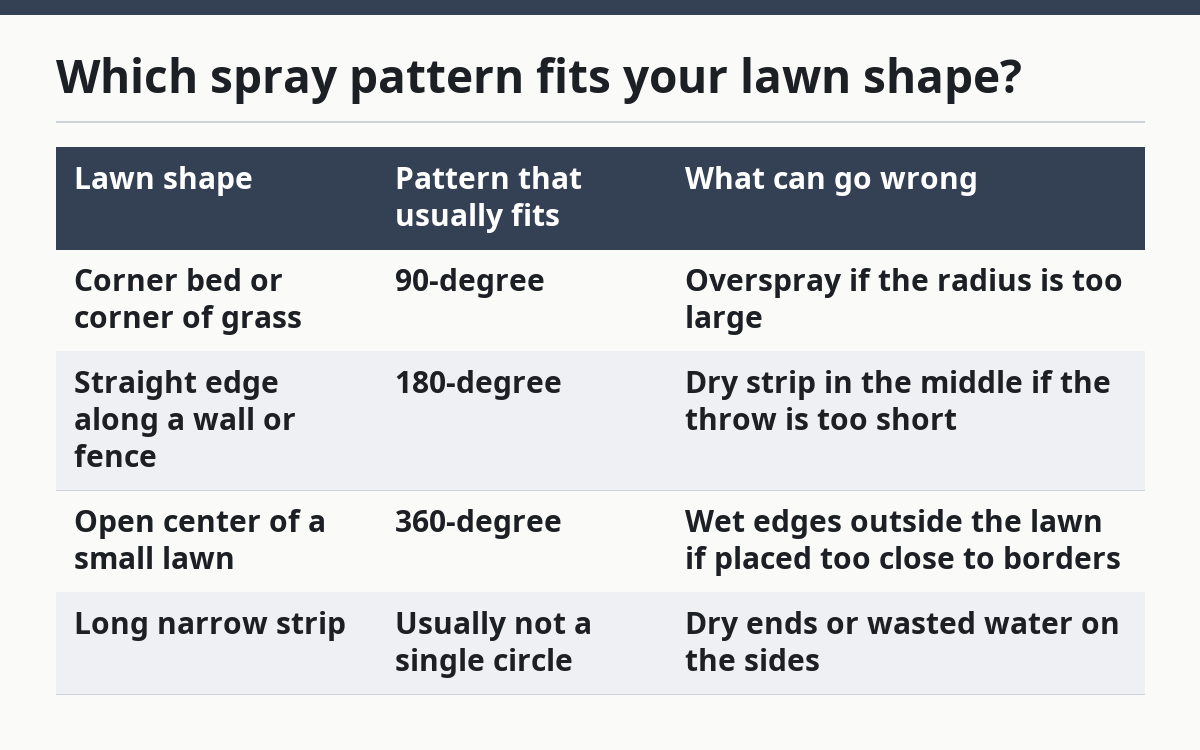
The spray pattern should match the lawn’s geometry, because a sprinkler head does not water every shape equally well. A 90-degree, 180-degree, or 360-degree pattern is a layout tool, not a decoration. The Irrigation Association also points users toward matching head choice and layout to the application area.
Here is the practical comparison:
| Lawn shape | Pattern that usually fits | What can go wrong |
|---|---|---|
| Corner bed or corner of grass | 90-degree | Overspray if the radius is too large |
| Straight edge along a wall or fence | 180-degree | Dry strip in the middle if the throw is too short |
| Open center of a small lawn | 360-degree | Wet edges outside the lawn if placed too close to borders |
| Long narrow strip | Usually not a single circle | Dry ends or wasted water on the sides |
If the lawn is irregular, the answer is rarely “one bigger sprinkler.” A bigger head may throw water farther, but it also makes the wet zone wider and harder to control. For odd shapes, a smaller head with a better pattern often wastes less water than one oversized head.
This is why a wide front yard, a side yard, and a back corner often need different sprinkler sizes or separate zones. The goal is not to blast the whole lawn with one nozzle. The goal is to keep the coverage radius inside the grass line.
How does water pressure change sprinkler size?
Water pressure changes how far a sprinkler can throw water, so a nozzle that looks right on paper may underperform if the pressure is off. Coverage radius depends on the pressure the sprinkler actually receives, not just the shape stamped on the package.
Low pressure usually means a shorter throw and thinner coverage. That can leave dry patches even when the lawn shape is simple. High pressure can push water too hard, which may mist the spray and overshoot the lawn edge.
A quick pressure check matters because a sprinkler sized for one setup may not fit another. The same lawn can need a different spray nozzle if the water pressure is low at the hose bib or uneven across a zone. That is why pressure belongs in the sizing step, not after the purchase.
If the coverage radius seems right but the lawn still dries out in bands, pressure is one of the first things to question. The nozzle may be fine; the supply may not be. A sprinkler only performs as well as the pressure feeding it.
How do you build zones around coverage needs?
You build zones by grouping lawn areas with similar size, shape, and water needs, then giving each zone a sprinkler that fits that zone’s coverage radius. One zone should not try to do everything.
Use this simple rule: if two areas need very different spray patterns, they should not share the same sprinkler setup. A narrow strip beside a driveway and a broad backyard rectangle do not need the same throw. Put them in different zones if possible, so each area gets the right pattern without overwatering the rest.
Zone layout matters most when the lawn has a mix of curves and straight edges. A center lawn might accept a 360-degree head, while a border strip needs a 180-degree head. If the yard has a corner, that corner usually needs its own 90-degree coverage plan.
A frequent mistake is forcing one sprinkler to reach “just a little farther” to save money or time. That often creates a dry strip at the far edge and a flooded strip near the head. In coverage work, a close fit is better than a hopeful fit.
What mistakes waste the most water?
The biggest sizing mistakes are choosing too much radius, ignoring lawn shape, and forgetting pressure. Each one wastes water in a different way, and each one is easy to avoid with a tape measure and a sketch.
A sprinkler with too much radius sprays beyond the lawn. That wastes water on pavement and can make the yard feel soggy near the source. A sprinkler with too little radius leaves the far edge dry, which leads to patchy growth and repeated watering.
Another mistake is treating the spray pattern like an afterthought. If the pattern is unclear, it is safest to consult a professional irrigation contractor or a local extension office before buying. A 360-degree head in a corner is the wrong tool. A 90-degree pattern in the middle of a lawn is also the wrong tool, because it waters only part of the area.
The last common mistake is skipping water pressure checks. Pressure changes coverage radius enough to matter, especially when the lawn is already an odd shape. If pressure is low, the “right” sprinkler may still miss the target.
How do you know if one sprinkler is enough?
One sprinkler is enough only when its coverage radius reaches the whole target area without soaking anything outside the lawn. That usually means a clean shape, a clear border, and a spray pattern that matches the area.
If the lawn has a simple rectangle, a single zone may work. If the lawn bends, narrows, or wraps around a patio, one sprinkler often falls short. In that case, the lawn needs more than one coverage point or a different zone layout.
A simple check helps: stand at the planned sprinkler spot and look to the farthest grass edge. If that distance is larger than the sprinkler’s reliable coverage radius, the sprinkler is too small. If the spray would hit a fence, sidewalk, or driveway before it reaches the grass, the sprinkler is too large or placed poorly.
This is where a plain “square footage” number can mislead. Two lawns can have the same area and still need different sprinkler sizes because one has a clean block shape and the other has a long arm or sharp corner.
How was this guide built?
This guide is based on sprinkler coverage terms, common spray patterns, and layout basics rather than product claims or brand promises. The focus stays on the user’s shape, coverage radius, spray nozzle choice, and water pressure, because those are the parts that decide whether a sprinkler actually fits the lawn.
The method here is simple: compare the lawn shape to the spray pattern, then check the farthest watering distance against the coverage radius. That approach is more useful than listing sprinkler types in the abstract, because the lawn’s shape is what decides the right fit. For broader buying context, the companion hub on how to choose a sprinkler belongs before brand shopping starts.
How do I know what size sprinkler I need?
You know what size sprinkler you need by measuring the farthest part of the lawn from the planned sprinkler spot and matching that distance to the sprinkler’s coverage radius. Then check whether the lawn calls for a 90-degree, 180-degree, or 360-degree spray pattern.
If the lawn has corners, curves, or narrow strips, size for the shape first and the area second. The wrong size often looks fine on a box and wrong on the ground.
How much area does one sprinkler cover?
One sprinkler covers only the area its spray pattern and coverage radius can reach without overspraying the border. A 360-degree pattern suits a center spot, while a 90-degree or 180-degree pattern suits an edge or corner.
The exact area depends on water pressure, nozzle choice, and the lawn’s shape. A neat rectangle is easier to cover than an L-shape, so the same sprinkler can seem to cover more or less depending on where it is placed.
Does water pressure affect sprinkler coverage?
Yes, water pressure affects sprinkler coverage because it changes how far and how evenly the spray travels. If pressure is too low, the radius shrinks and dry patches appear. If pressure is too high, the spray can mist or overshoot the grass.
That is why pressure belongs in the sizing check, not as an afterthought. A sprinkler that fits the lawn on paper may still miss the mark if the pressure is not right.
Drafted with AI; not yet reviewed by a person.
Leave a Reply