Last updated: November 19, 2026
Quick answer: for how high should you mow cool-season grass in summer, aim for 2.5 to 4 inches, with many lawns doing best around 3 inches. Cool-season grass usually needs a taller summer cut—high enough to shade the crown and roots, not so high that the mower starts folding the blades over. The right height depends on the grass type, but 2.5 to 4 inches is the range most homeowners should work in. This guide settles the exact height, the trade-off with heat stress, and when to change your mowing rhythm.
Key Takeaways
- Keep cool-season grass in the 2.5 to 4-inch range, with taller cuts in summer.
- Higher mowing leaves more leaf area and shades the soil better.
- Set the mower deck to a real height, then check the cut with your eyes and a ruler if needed.
- Shaded cool-season grass usually does best near the upper end of the 2.5 to 4-inch range.
What mowing height should you use in summer?
Mow cool-season grass higher than spring, and keep the mower deck set in the 2.5 to 4-inch range. That’s the short answer for most lawns with fescue, bluegrass, or ryegrass.
The best height depends on the grass, the shade, and how hard summer is hitting the lawn.
- Tall fescue: often handles the upper end well, around 3 to 4 inches
- Kentucky bluegrass: usually does well around 2.5 to 3.5 inches
- Perennial ryegrass: often fits the middle of that range, around 2.5 to 3 inches
The point is simple. A taller leaf blade gives the plant more surface to make food and more cover over the soil. Short grass heats up faster. Big problem.
Why mowing higher helps cool-season grass in heat
Mowing higher helps because it leaves more leaf area on the plant and more shade on the soil surface. That matters in summer, when cool-season grasses already get pushed by heat and dry air.
Picture this: you’re looking at a lawn in 90-degree weather, and the mower has been taking off too much at each cut. The turf starts to look thin, pale, and tired after just a few passes. A taller cut slows that slide.
Here’s the catch: mowing high does not fix every summer problem. It helps the grass cope, but it does not replace water, soil health, or a mower blade that cuts cleanly. For broader care, see the main lawn mowing guide and the related summer lawn care tips in this hub.
- Taller blades shade the crown and soil
- More leaf area means the plant can recover faster after each cut
- The lawn is less likely to show brown stress from a sudden scalp
That last part matters most on slopes, at driveway edges, and near sprinkler heads where the mower deck dips. A taller setting gives you a little margin for error.
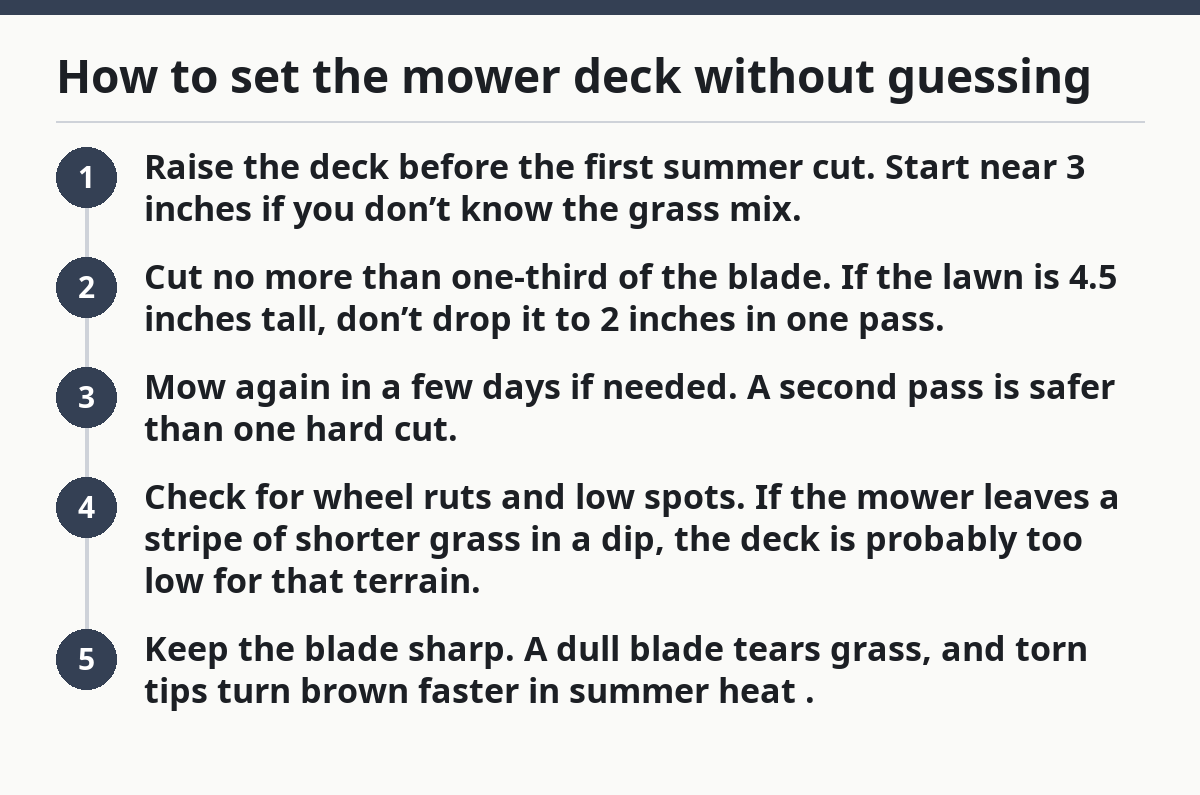
How to set the mower deck without guessing
Set the mower deck to a real height, then check the cut with your eyes and a ruler if you need to. Many mower decks have numbered notches, but the numbers are not all equal from brand to brand. For a quick check, the University of Minnesota Extension recommends measuring the cut, not trusting the deck label alone.
Picture this: you’re standing beside a mower in July, and the turf has gotten shaggy after a wet week. You want the cleanest cut without stripping the lawn bare. The deck setting is the first decision that decides the rest.
- Raise the deck before the first summer cut. Start near 3 inches if you don’t know the grass mix.
- Cut no more than one-third of the blade. If the lawn is 4.5 inches tall, don’t drop it to 2 inches in one pass.
- Mow again in a few days if needed. A second pass is safer than one hard cut.
- Check for wheel ruts and low spots. If the mower leaves a stripe of shorter grass in a dip, the deck is probably too low for that terrain.
- Keep the blade sharp. A dull blade tears grass, and torn tips turn brown faster in summer heat.
The result you want is a lawn that looks evenly trimmed, not clipped to the dirt. If you see tan tips all over the yard, the blade may be dull or the deck may be set too low for the grass length.
How does shade change the mowing height?
Because shaded cool-season grass gets less light, it usually does better with a slightly taller mow, often near the upper end of the 2.5 to 4-inch range. Shade slows growth, but it also makes grass stretch toward the light, which means a short cut can weaken it fast.
Picture this: you have a side yard under trees, and the same mower setting you use in full sun leaves that spot thin by August. The grass in shade needs more leaf surface, not less, because it already has less light to work with.
Use these shade rules:
- Keep the mower deck closer to 3 to 4 inches in moderate shade
- Don’t scalp under tree lines or fence shadows
- Mow when the grass is dry enough to stand up, not flattened by dew
- Trim tree limbs if the area is so dark that grass thins every year
Shade also changes how you judge height. A shady strip can look “too long” even when it is set correctly. That’s normal. The grass is not failing because it looks looser; it is often surviving better because it has more blade left.
How often should you mow cool-season grass in summer?
Mow cool-season grass as often as needed to follow the one-third rule, which usually means every 5 to 10 days in active growth and less often when heat slows the lawn down. The calendar matters less than the blade length.
Picture this: the lawn stopped racing upward after a hot spell, then jumped again after rain. If you mow by habit every Saturday, you’ll either cut too much or waste time cutting too soon. The grass tells you when to mow.
A simple summer rhythm looks like this:
- Measure the tallest grass in the yard
- Mow before it gets more than about one-third above your target height
- Slow down mowing when growth drops in hot, dry weather
- Pick up clumps if the mower leaves them behind
That last point helps more than people think. Clumps block light and can mat down the turf. If the mower is leaving piles, the grass was too tall for one pass, or the deck was set too low for the amount being cut.
The truth is, summer mowing is about restraint. Cool-season grass often needs less frequent mowing in heat, not more aggressive cutting.
Common mowing mistakes that can burn out cool-season turf
Mowing too short can make cool-season grass look tired in summer. A low cut removes the plant’s energy source, exposes the soil, and makes the lawn more likely to dry out.
Picture this: you want the yard to look neat, so you drop the deck a notch or two. It looks crisp for a day, then the lawn starts showing stress after the next warm afternoon. That short-term tidy look can cost you weeks of recovery.
Watch for these mistakes:
- Scalping on turns or slopes. Cost: bare streaks and thin spots. Better move: raise the deck and slow down around edges.
- Cutting off too much at once. Cost: yellowing tips and slow recovery. Better move: mow more often until the lawn is back in range.
- Mowing when the grass is wet and bent over. Cost: uneven cuts and clumps. Better move: wait until the blades stand up dry.
- Ignoring a dull blade. Cost: ragged leaf tips that brown quickly. Better move: sharpen or replace the blade before summer stress peaks.
Scalping is the big one. A single low pass can undo the benefit of a good summer height for a month or more. The USDA and university extension services both warn that stressed turf needs careful mowing, not a close cut.
What height is wrong for your lawn?
A height below 2.5 inches is usually too short for cool-season grass in summer, especially if the lawn gets full sun, heat, or foot traffic. Short mowing can work briefly in cooler weather, but summer is not the time for a close cut.
Picture this: you inherit a lawn that has been clipped low for years, and you’re wondering if a neat, golf-green look is the goal. For most home lawns, it isn’t. The goal is staying alive and staying dense through the hottest stretch.
A lower cut is especially wrong for:
- Slopes where the mower deck dips
- Thin lawns that already show bare soil
- Yards with hot afternoon sun
- Lawns that dry out quickly between waterings
If the lawn is already stressed, lowering the deck is the wrong move. It removes the grass’s built-in shade and makes the surface hotter. That is the opposite of what summer turf needs.
For more on the bigger mowing system, see the main lawn mowing guide in this hub.
What is the best mowing height for fescue?
Tall fescue is usually happiest in summer around 3 to 4 inches. That taller cut helps it shade the soil and stand up better to heat, especially in full sun or on slopes.
If your mower is cutting fescue closer to 2 inches, that is usually too low for hot weather. The lawn may look short for a day, then lose color and density as summer stress builds.
Should you mow shorter in hot weather?
No, mowing shorter in hot weather usually makes cool-season grass struggle more. A shorter cut exposes the crown and soil, which makes the lawn heat up faster and dry out sooner.
A better move is to keep the deck higher, often near 3 inches or more, and mow less aggressively. If the lawn gets away from you, take it down in stages instead of one hard cut.
How often should cool-season grass be cut in summer?
Cool-season grass should be cut only when it grows enough to need it, which is often every 5 to 10 days during active summer growth. In hot, dry stretches, mowing can slow down because the grass itself slows down.
The one-third rule still holds. If the lawn is too tall for one safe pass, mow it twice over a few days instead of forcing a single deep cut.
Does mowing higher help grass survive heat?
Yes, mowing higher helps cool-season grass handle heat better because it leaves more leaf area and more shade over the soil. That reduces stress on the crown and helps the plant keep going through summer.
It is not a cure-all, and you should consult a local extension office or lawn care professional if the grass keeps declining. A higher cut works best with a sharp blade, steady mowing, and a deck setting that does not scalp low spots.
Drafted with AI; not yet reviewed by a person.





Leave a Reply