
Last updated: November 28, 2026
Quick answer: start with 3 choices—a spot sprinkler, a rotary sprinkler, or an oscillating sprinkler—and match the spray shape to the dry zone. For hand-me-down lawns and patchy coverage, a patchy lawn sprinkler that reaches only the missed area is usually the cleanest fix. For small fill-in areas, a spot sprinkler or a flexible sprinkler head is usually the closest match. For wider bands of uneven coverage, a rotary sprinkler or an oscillating sprinkler can work better if you can aim them precisely.
Key takeaways
- Patchy lawns need targeted watering, not a bigger blast over the whole yard.
- A spot sprinkler works best when the problem is one dry corner, one strip, or a few missed zones.
- Rotary sprinkler and oscillating sprinkler styles suit different kinds of fill-in watering, and neither is best for every lawn.
- The right choice depends on how controlled the spray is, not just how far it throws water.
- A simple test of the dry areas saves more time than guessing from the label on the box.
What makes patchy coverage different?
Patchy coverage needs a sprinkler that can cover dry spots without adding water to healthy turf. A full-yard setup can hide the problem for a while, but the real issue is uneven distribution, not total watering time.
This is why a patchy lawn sprinkler is different from a general lawn sprinkler. You are not trying to water every square foot the same way. You are trying to fill in missed zones, edge strips, and awkward corners without turning the rest of the lawn soggy.
The first clue is where the lawn dries out. If one spot always looks thin, a small, aimed spray can be enough. If the problem is a long band along a walkway or fence line, a wider pattern makes more sense. That difference matters more than brand names or flashy packaging.
A reader looking for a sprinkler for patchy areas often does not need a new irrigation system. A single sprinkler head, set for partial lawn watering, can solve the problem when the main system leaves gaps. The trick is to match the spray pattern to the exact weak area, not to the whole yard.
Which sprinkler type fits the job?
The best type often depends on whether the dry area is small, narrow, or spread out. A spot sprinkler is a good fit for one-off dry patches, a rotary sprinkler is better for controlled coverage over a broader area, and an oscillating sprinkler suits rectangular fill-in watering when the pattern lines up with the grass.
| Type | Best use | Why it helps | Main drawback |
|---|---|---|---|
| Spot sprinkler | One dry patch or missed zone | Puts water where it is needed | Easy to overwater a tiny area |
| Rotary sprinkler | Partial lawn watering with better control | Slower, more focused spray | Can be too slow for large bare areas |
| Oscillating sprinkler | Rectangular sections and straight strips | Covers a wide band evenly | Poor fit for odd edges or small gaps |
| Sprinkler head | Built-in or replacement coverage | Can correct a weak area in an existing system | Needs the right placement |
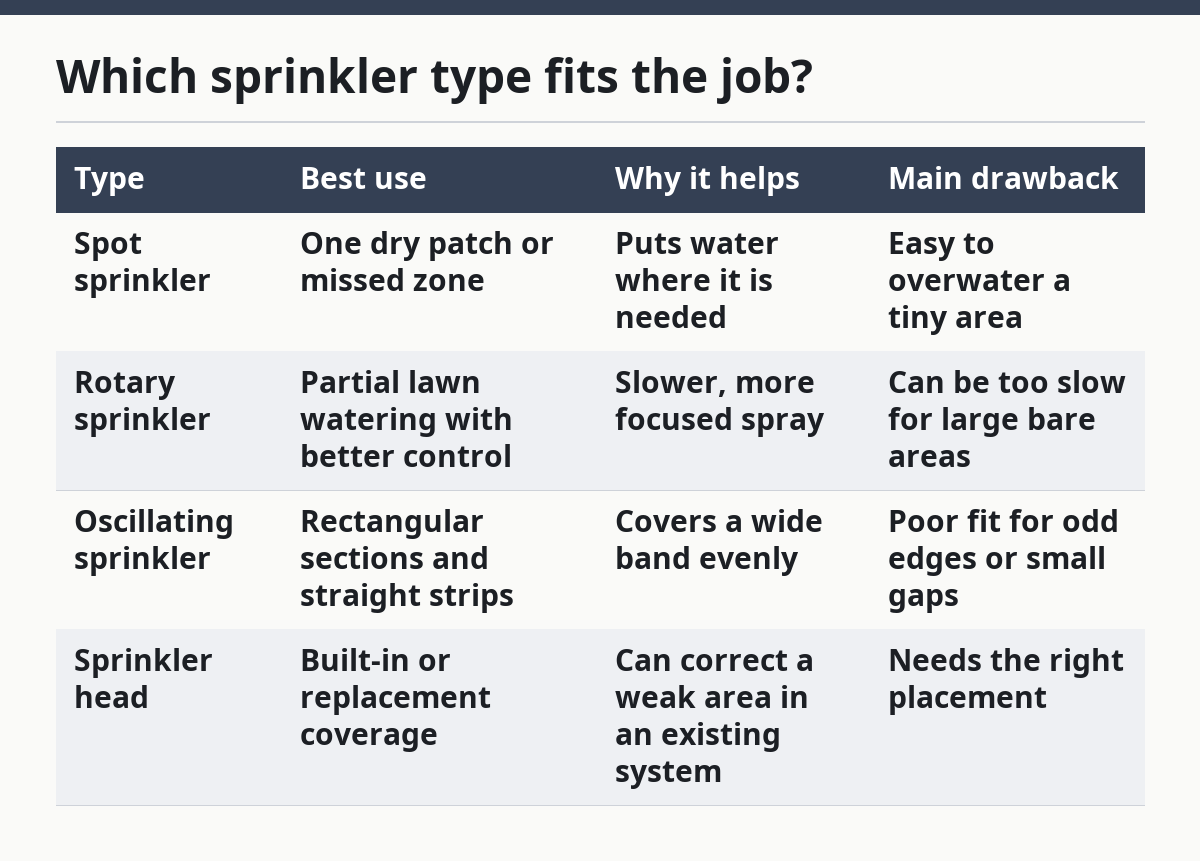
A spot sprinkler is a strong bet when the lawn has just a few hand-me-down problem areas from the old setup. It keeps the fix narrow. A rotary sprinkler is usually stronger when the dry area is part of a larger uneven run, because the rotating stream can be aimed more deliberately than a wide fan. See also sprinkler head replacement basics.
An oscillating sprinkler is useful when the missed zone has clean edges, such as a rectangle between two healthy sections. It is less useful when the lawn bends around beds, trees, or paths. In that case, the water often hits places that were not the problem.
How do I choose for a patchy lawn?
Choose the sprinkler by the shape of the dry area first, then by how tightly you need to control the spray. If the weak zone is small and isolated, go for a spot sprinkler. If the lawn is mostly fine but a strip keeps drying out, a rotary sprinkler or oscillating sprinkler may cover it better.
Use this simple order:
- Mark the dry area with something visible. Use string, flags, or even a hose laid on the ground for 10 minutes. The result should be a clear outline of the problem zone, not a guess.
- Measure the shape, not the whole lawn. Focus on the dry patch, missed strip, or uneven corner. A patchy lawn sprinkler should match the problem area, not the entire yard.
- Pick the most controlled spray style. Choose a spot sprinkler for the smallest fixes, a rotary sprinkler for more deliberate fill-in watering, or an oscillating sprinkler for straight-edged sections.
- Check where overspray would land. If the spray hits pavement, mulch, or a flower bed, move to a more focused sprinkler head or a tighter spray pattern.
- Run the sprinkler briefly and inspect the edge. The goal is even coverage across the patch, not puddles at the center and dry grass at the border.
This is the step most people skip. They buy a broad spray because it seems simpler, then spend the next 2 weeks correcting overspray and dry edges. A narrower tool often works better, even if it looks less powerful.
What does uneven coverage actually need?
Uneven coverage needs control more than range. A lawn with missed zones is usually telling you that one part gets too much water and another part gets too little, so the fix is to separate the problem areas instead of flooding everything together.
That is where a sprinkler head can be more useful than a free-standing sprinkler. A replacement head or a better-aimed head can direct water into the weak spot without adding more water to the already wet section. This matters when the lawn is patchy because of old coverage gaps, not because the whole area is dry.
A rotary sprinkler is often the middle ground. It does not throw a wide sheet the way an oscillating sprinkler does, and it is not as tiny as a spot sprinkler. For a lawn with two or three uneven zones, that middle ground can be a practical fit.
The trade-off is speed. A more focused pattern usually takes longer to fill the same space, and that is the cost of better control. If the problem area is large, a narrow spray can become tedious. If the problem area is small, a broad spray wastes water and worsens the patchiness.
Common mistakes that make patchy lawns worse
Using the wrong spray pattern usually makes uneven coverage worse, not better. The biggest mistake is buying a sprinkler for range when the real need is control.
A second mistake is trying to fix one dry patch by watering the whole lawn longer. That often turns healthy grass into a damp mess while the dry zone still lags behind. The result is the same problem, just spread out over a larger area.
A third mistake is placing the sprinkler where it looks convenient instead of where the missed zone actually sits. A shift of a few feet can leave the original patch dry and create a new wet spot on the edge. That is common with oscillating sprinklers, which work best when the layout is neat and rectangular.
A fourth mistake is ignoring the sprinkler head itself. In some cases, the right answer is not a new portable sprinkler at all. It is a better head that matches the existing watering pattern. That is especially true when the lawn is mostly fine and only one section keeps missing water.
For patchy coverage, it often helps to fix one problem zone at a time. That keeps the lawn easier to read and makes it obvious whether the new setup actually helped.
When is a spot sprinkler the wrong choice?
A spot sprinkler is the wrong choice when the dry area is too large or the shape is too spread out. It can also be the wrong choice when the only way to cover the patch is to leave the rest of the lawn wet for too long.
That drawback matters because spot watering is precise, not fast. A very small dry circle benefits from that precision. A long strip, a broad edge, or two separated dry zones usually does not.
If the lawn has several uneven areas, a rotary sprinkler or oscillating sprinkler may be better because it covers more ground in one placement. The goal is not to pick the smallest tool possible. The goal is to pick the one that gives the right coverage with the least waste.
The same logic applies to a sprinkler head in an existing system. If one head cannot cover the gap without overspraying nearby turf, it is the wrong head for that spot. A smaller, better aimed option is more useful than forcing a broad pattern into a narrow problem.
What should a beginner compare before buying?
Compare control, coverage shape, and fit for the problem area before comparing anything else. A patchy lawn sprinkler is not chosen for style; it is chosen for where the water lands.
The most useful comparison is simple:
- Spot sprinkler: best for one missing piece of lawn
- Rotary sprinkler: best for steady, targeted coverage over a broader patch
- Oscillating sprinkler: best for straight, rectangular fill-in areas
- Sprinkler head: best when the fix belongs inside an existing watering setup
The order matters. A buyer who starts with price or throw distance can end up with the wrong pattern. A buyer who starts with the dry shape usually gets a better match on the first try. For more detail, see how to choose a sprinkler.
This guide sits under the wider how to choose a sprinkler hub because patchy coverage is only one decision. The bigger topic covers other lawn problems, but this page stays focused on missed zones, uneven coverage, and partial lawn watering. For watering targets, the EPA WaterSense program recommends watering less often but more deeply, and it notes that many lawns need about 1 inch of water per week, including rainfall: EPA WaterSense.
Which sprinkler should I start with?
Start with the smallest sprinkler that can fully cover the dry area. For many patchy lawns, that means a spot sprinkler first, then a rotary sprinkler if the dry zone is wider than it looks.
That choice keeps watering tighter and easier to adjust. If the area is a clean strip, an oscillating sprinkler can be the better first try. If the problem is tied to the existing system, a different sprinkler head may solve it without adding another device to the yard.
The wrong choice is the one that waters healthy grass just to reach the patch. Patchy lawns usually need precision, not force. University extension guides on lawns and irrigation stress the same point: match the watering pattern to the site, then adjust as needed, not the other way around. See University of Minnesota Extension and California Department of Water Resources.
What sprinkler is good for patchy areas?
A spot sprinkler is usually good for patchy areas because it targets one dry zone without watering the whole lawn. A rotary sprinkler is the next step up when the patch is larger or you need better control over a wider section. The best choice depends on whether the gap is small, long, or spread out.
How do I water only part of a lawn?
Water only part of a lawn by aiming the spray at the dry zone and limiting overspray into healthy grass. A spot sprinkler or a tightly aimed sprinkler head is the easiest way to do that. If the area is rectangular, an oscillating sprinkler can work as long as the edges line up cleanly.
Can I use one sprinkler for uneven coverage?
Yes, one sprinkler can handle uneven coverage if the dry area is simple enough and the spray pattern matches it. A rotary sprinkler often works best for this kind of fill-in watering. If the lawn has several missed zones with different shapes, one unit may not be enough.
Drafted with AI; not yet reviewed by a person.
Leave a Reply