Last updated: November 27, 2026
Quick answer: choose the sprinkler that matches the shape, plant type, and hard surface around it in 4 main ways: a stationary sprinkler for tight spots, a micro-sprinkler for beds and container groups, an oscillating sprinkler for wider mixed areas, and drip irrigation when water must stay off patios and walkways. This guide on how to choose a sprinkler for watering gardens, patios, and non-lawn spaces focuses on the option that wets the target area without flooding pavers, leaves, or roots.
Key takeaways
- Shape matters more than brand for non-lawn watering.
- Patios and walkways need tight control, not broad spray.
- Micro-sprinklers suit small beds and container clusters better than wide throw patterns.
- Oscillating sprinklers fit mixed rectangles better than round or irregular spaces.
- Drip systems make the most sense when the goal is to keep water low and targeted.
How do I choose a sprinkler for outdoor spaces?
Choose a sprinkler for outdoor spaces by matching the spray pattern to the surface you want to wet, then narrowing the throw so water stays off stone, wood, and paths. For gardens, patios, and non-lawn spaces, that usually means a micro-sprinkler, stationary sprinkler, oscillating sprinkler, or drip irrigation system rather than a broad lawn-style setup.
Therefore, start with the space, not the tool. A rectangular patio edge wants a different pattern than a bed along a walkway, and a mixed area with pots and gravel may need two methods in one zone. A generic sprinkler often wastes water on hard surfaces and leaves dry corners in the planting area.
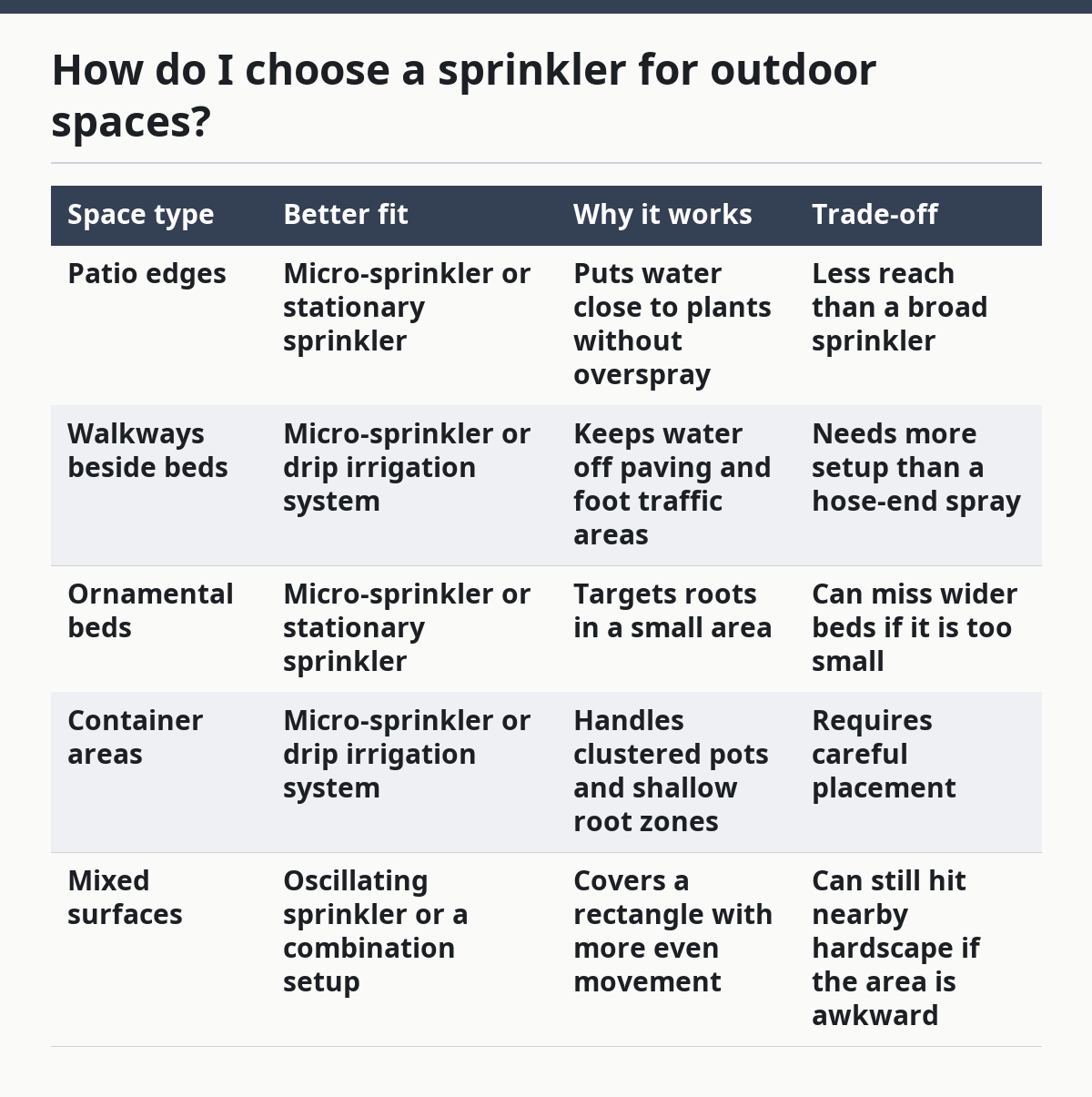
Use this quick comparison before buying:
| Space type | Better fit | Why it works | Trade-off |
|---|---|---|---|
| Patio edges | Micro-sprinkler or stationary sprinkler | Puts water close to plants without overspray | Less reach than a broad sprinkler |
| Walkways beside beds | Micro-sprinkler or drip irrigation system | Keeps water off paving and foot traffic areas | Needs more setup than a hose-end spray |
| Ornamental beds | Micro-sprinkler or stationary sprinkler | Targets roots in a small area | Can miss wider beds if it is too small |
| Container areas | Micro-sprinkler or drip irrigation system | Handles clustered pots and shallow root zones | Requires careful placement |
| Mixed surfaces | Oscillating sprinkler or a combination setup | Covers a rectangle with more even movement | Can still hit nearby hardscape if the area is awkward |
The wrong choice is usually a sprinkler that throws water farther than the space can hold. That is not just messy. It also leaves slick patios, wet mulch on paths, and puddles where containers sit.
What sprinkler works best on patios and walkways?
A micro-sprinkler or stationary sprinkler usually works best on patios and walkways because both can keep water tight to the planting edge. A drip irrigation system is even better when the space has pots, raised planters, or bed lines that should stay dry on top.
Patios and walkways punish overspray. Pavers, concrete, and decking do not need the same soak as soil, so a wide spray pattern often wastes water and creates slippery patches. A micro-sprinkler can serve a small planting strip beside a patio edge, while a stationary sprinkler works when the area is small and fixed in shape.
Specifically, a drip irrigation system is the cleanest option when the watering target is a set of containers or a line of plants beside hardscape. It moves water slowly to the root zone and keeps the surface of the patio mostly dry. That makes it a strong choice for spaces where hose spray would splash onto furniture, walls, or walking areas.
The downside is reach. A drip setup takes more planning than a simple hose-end sprinkler, and a stationary sprinkler can miss the edge of a wider bed if it is placed too close to the center. For this reason, a small tool that still covers the planted area in one pass is often the best patio choice.
Which sprinkler fits ornamental beds and container areas?
A micro-sprinkler is often the best fit for ornamental beds and container areas because it gives small, controlled coverage without blasting roots or oversaturating one corner. A stationary sprinkler can work too, but only when the bed is compact and the shape is simple.
Ornamental beds often hold mixed plant sizes, mulch, edging, and small gaps. That makes a broad sprinkler less useful than it looks. A micro-sprinkler can wet a defined patch while leaving stone borders and adjacent walkways dry. For container areas, the same logic applies: pots need water where the soil is, not over the rim and onto the floor.
Meanwhile, a drip irrigation system is the strongest option when containers are grouped in one place. It gives each pot a direct water line and reduces the chance that the outer pots get soaked while the inner pots stay dry. That matters in tight spaces where one hose spray can overshoot the whole group.
A common mistake is choosing a sprinkler because it looks gentle. Gentle spray is not the same as controlled spray. A soft, wide pattern can still wet the wrong surface if the area is compact. For beds and pots, the shape of the spray matters more than how hard it seems.
When should I pick an oscillating sprinkler?
Pick an oscillating sprinkler when the space is a broader rectangle and you need even coverage across mixed surfaces, not just one small planting pocket. It is a practical fit of the common hose-end options for larger patio-adjacent areas, rectangular garden sections, and spaces that combine soil, edging, and a bit of hardscape.
An oscillating sprinkler sweeps back and forth, so it works best where the target area has straight sides and a predictable width. That makes it useful for long rectangular sections beside a patio or a run of mixed surfaces where the planted area is wider than a micro-sprinkler can handle. It can also be a practical choice when a single watering tool must cover more than one kind of surface in one setup.
The drawback is control. An oscillating sprinkler is broader than a micro-sprinkler or stationary sprinkler, so it is more likely to wet nearby paving if the area is irregular. It can also be too much sprinkler for a small bed or a tight container group.
A good rule is simple: if the space can be described as a rectangle and the planted section is large enough to justify a sweeping pattern, oscillating is worth considering. If the area is small, curved, or packed with hard edges, a more targeted tool is usually better.
How do I handle mixed surfaces without wasting water?
Handle mixed surfaces by dividing the area into wettable and non-wettable zones, then choosing the narrowest sprinkler that still reaches the plants. In mixed outdoor spaces, that usually means using a micro-sprinkler or drip irrigation system for the planted sections and avoiding broad spray over stone, wood, or paved strips.
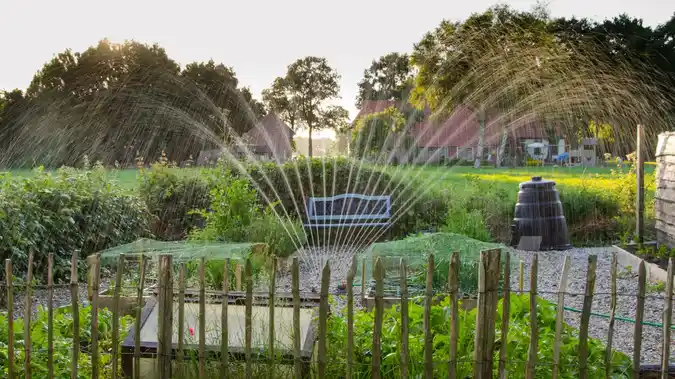
Mixed surfaces are the hardest case because the watering target is not one thing. A patio edge may include a narrow strip of soil, a row of containers, a walkway, and a bed all in one view. A single broad sprinkler often over-waters one part and under-waters another.
For example, the better approach is to think in zones. Use a stationary sprinkler for one tight corner, a micro-sprinkler for a cluster of plants, or an oscillating sprinkler only when the whole area truly behaves like one rectangle. If the space has both containers and hard paving, drip irrigation often wins because it avoids spraying the non-plant surfaces entirely.
This is the one place where a “good enough” sprinkler can become expensive in time. Repositioning after every watering session wastes minutes and still leaves dry edges or wet stone. A slightly more targeted setup usually saves more effort than a broad one that seems flexible on day one.
How was this guide chosen?
This guide was shaped around the questions a reader asks before buying or setting up watering gear for non-lawn spaces, then narrowed to the four tools named in the brief: micro-sprinkler, oscillating sprinkler, stationary sprinkler, and drip irrigation system. It focuses on patio edges, walkways, ornamental beds, container areas, and mixed surfaces because those are the places where lawn-style advice breaks down.
The advice follows practical irrigation guidance from organizations such as the U.S. Environmental Protection Agency’s WaterSense program and the Irrigation Association, which both emphasize matching water delivery to plant needs and avoiding waste from overspray. The point here is not to pick the fanciest tool. It is to pick the one that keeps water where the plants can use it.
A generic sprinkler guide often talks about grass coverage and broad spray radius. That misses the real problem in non-lawn spaces: hard edges, tight corners, and surfaces that should stay dry. This guide keeps the choice tied to shape, control, and surface type, because those are the three details that decide whether the setup works or becomes a nuisance.
What mistakes cost the most?
The biggest mistakes are using a lawn-style sprinkler on a patio edge, choosing too much reach for a small bed, and assuming one sprinkler can handle every mixed surface. Those errors usually lead to overspray, wet paving, uneven watering, and more time spent moving the sprinkler than watering the space.
A wide spray on a narrow patio border is the clearest mistake. It looks efficient until water lands on walkways and furniture. A better choice is a small, targeted tool that fits the actual planting area, even if it looks less powerful.
Another mistake is ignoring containers. Pots dry out differently than in-ground plants, so a sprinkler that works for one bed may miss the group of containers nearby. That is where a drip irrigation system or a micro-sprinkler does better than a broad spray.
The third mistake is buying for the largest part of the space and hoping it will also suit the smallest. A sprinkler that can cover a rectangle may still be the wrong tool for a corner bed or a walkway edge. For non-lawn spaces, precision usually beats reach.
Should I choose a sprinkler or drip irrigation?
Choose drip irrigation when the goal is to water plants without spraying surrounding surfaces, and choose a sprinkler when the space needs a wider wet pattern. For patios, containers, and narrow planting strips, drip often makes the cleanest sense. For larger rectangular mixed areas, an oscillating sprinkler or stationary sprinkler may be simpler.
Drip irrigation is the better fit when water needs to go straight to the root zone. That is why it works so well for containers, bed edges, and spots near paving. It keeps the surface tidy and reduces overspray.
A sprinkler still has a place when the planting area is broader or when the setup needs quick repositioning. A micro-sprinkler gives a middle ground between direct drip lines and broad spray. A stationary sprinkler suits compact spaces, while oscillating is the better option when the zone stretches wider.
The best choice is not always the most expensive one. It is the one that matches the shape of the space. A simple, lower-tech setup that fits the area often performs better than a larger system that does not.
Can I use a lawn sprinkler in a garden?
Yes, but only if the spray pattern stays inside the planted area and off the hard surfaces. A lawn sprinkler often throws water farther than a garden, patio edge, or container area can use. For non-lawn spaces, a more controlled tool such as a micro-sprinkler, stationary sprinkler, or drip irrigation system usually makes more sense.
What sprinkler is best for patios and beds?
A micro-sprinkler is often the best all-around choice for patios and beds because it gives controlled coverage near edges. A stationary sprinkler is better for very small, fixed areas, and drip irrigation is better when the bed includes containers or needs the patio to stay dry. The right answer depends on how close the plants sit to hard surfaces.
How do I water mixed outdoor spaces?
Break the space into zones and use the least broad sprinkler that still covers each zone. Mixed outdoor spaces usually work better with more than one method, such as drip for containers and a micro-sprinkler for a nearby bed. If the area is one clean rectangle, an oscillating sprinkler can handle more of it at once.
Drafted with AI; not yet reviewed by a person.





Leave a Reply