Last updated: November 20, 2026
Quick answer: portable sprinklers usually make sense when the yard may change, while in-ground sprinkler systems usually make sense when the yard is staying put and consistent coverage matters more. Portable vs in-ground sprinkler systems is mostly a choice about installation effort, control, and how long the yard will be managed the same way.
This guide assumes the reader is comparing a portable sprinkler, a hose-end sprinkler, a pop-up sprinkler setup, and an in-ground sprinkler system with an irrigation controller. For irrigation basics and system fit, the EPA WaterSense program and the Irrigation Association are useful starting points: EPA WaterSense and Irrigation Association. Portable vs in-ground sprinkler systems is the topic here, and the comparison stays focused on that choice.
Key takeaways
- Portable sprinklers fit yards that change shape, move seasonally, or only need temporary watering.
- In-ground sprinkler systems fit yards that need repeatable coverage and a fixed watering plan.
- Portable gear usually wins on flexibility; in-ground systems usually win on consistency.
- Installation effort is the biggest divider: a hose-end sprinkler needs little setup, while a buried system needs real planning.
- Maintenance is different too: portable gear is simpler to replace, but it has more manual handling; in-ground systems need fewer daily steps but are harder to change.
How do these two sprinkler systems differ?
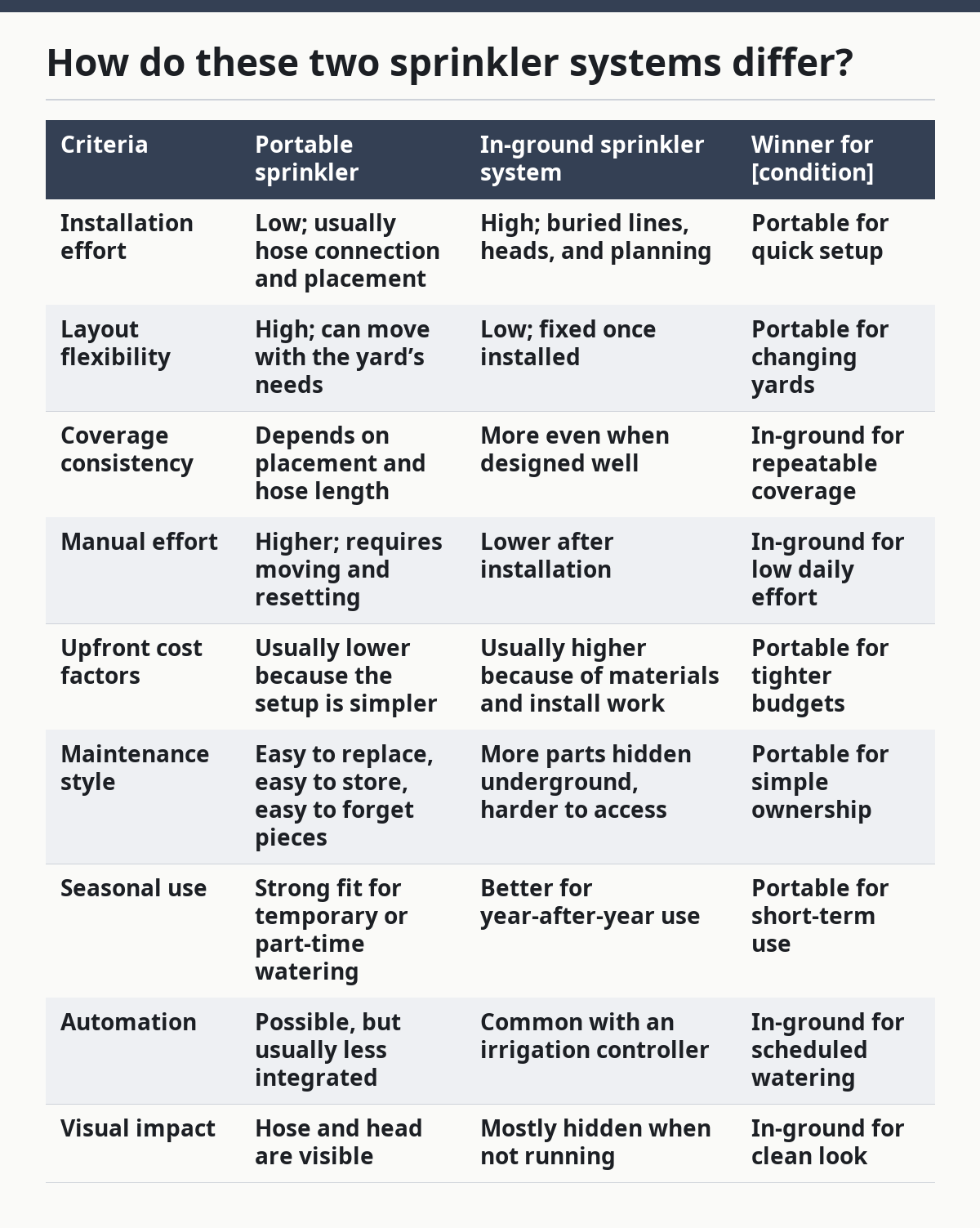
Portable sprinklers differ from in-ground sprinkler systems in one main way: one moves, the other stays buried. A portable sprinkler connects to a hose and can be placed where needed, while an in-ground system uses buried piping, pop-up sprinkler heads, and usually an irrigation controller to run on a schedule.
That difference changes almost everything a homeowner feels day to day. A portable hose-end sprinkler can be shifted around the yard, aimed at a dry patch, and packed away. An in-ground system asks for more upfront work, but it turns watering into a fixed routine with less dragging, moving, and resetting.
| Criteria | Portable sprinkler | In-ground sprinkler system | Winner for [condition] |
|---|---|---|---|
| Installation effort | Low; usually hose connection and placement | High; buried lines, heads, and planning | Portable for quick setup |
| Layout flexibility | High; can move with the yard’s needs | Low; fixed once installed | Portable for changing yards |
| Coverage consistency | Depends on placement and hose length | More even when designed well | In-ground for repeatable coverage |
| Manual effort | Higher; requires moving and resetting | Lower after installation | In-ground for low daily effort |
| Upfront cost factors | Usually lower because the setup is simpler | Usually higher because of materials and install work | Portable for tighter budgets |
| Maintenance style | Easy to replace, easy to store, easy to forget pieces | More parts hidden underground, harder to access | Portable for simple ownership |
| Seasonal use | Strong fit for temporary or part-time watering | Better for year-after-year use | Portable for short-term use |
| Automation | Possible, but usually less integrated | Common with an irrigation controller | In-ground for scheduled watering |
| Visual impact | Hose and head are visible | Mostly hidden when not running | In-ground for clean look |
Which sprinkler system is easier to install?
Therefore, portable sprinklers are easier to install because many of them only need a hose, a spigot, and a place to sit. A hose-end sprinkler can be put to work in minutes, which matters if the yard is small, rented, or likely to change next year.
An in-ground sprinkler system is a different project. It needs layout planning, buried pipes, sprinkler heads, and usually an irrigation controller if the goal is timed watering. That extra work pays off later, but it is not a casual weekend change for most yards.
The practical split is simple: portable works when the goal is watering, not construction. In-ground works when the yard is staying in place long enough to justify the build. A reader who wants a quick, low-commitment fix should not pay for a buried system just to avoid moving a hose.
When does a portable sprinkler make more sense?
Because flexibility matters more than polish, a portable sprinkler makes more sense when the yard has odd corners, a temporary lawn patch, garden beds that change, or a household that wants to water one area now and a different area next week.
That flexibility is the main strength of a hose-end sprinkler. It can be aimed at a dry strip, moved after mowing, and stored when the season ends. A portable setup also keeps the user from committing to one layout before the yard has settled.
The weak side is coverage consistency. A portable sprinkler only performs as well as its placement, hose reach, and attention from the person using it. If it sits a few feet off, the wet pattern can miss a corner or soak a walkway. It is also a poor fit for someone who wants to set a schedule once and stop thinking about it.
Portable is a good match for renters, first-year homeowners, and anyone who still changes the yard plan often. It is not the right pick for a homeowner who wants a clean landscape look and predictable watering across the same zones every week.
When does an in-ground sprinkler system win?
Meanwhile, an in-ground sprinkler system wins when the yard is permanent and the watering pattern should be repeatable. It is the stronger choice for a homeowner who wants pop-up sprinkler heads to cover the same zones the same way each time, with an irrigation controller handling the schedule.
The biggest advantage is consistency. Buried lines and fixed heads make coverage easier to plan around beds, turf, and edges. The system also removes a lot of daily handling. There is no dragging a hose across the lawn and no remembering where the head was left last time.
That strength comes with a drawback: once the system is installed, changes are harder. If the yard layout shifts, if a bed expands, or if a new tree goes in, the system may need adjustment. Maintenance is also less casual. A broken head or line is not as simple to swap as a loose portable unit, because the problem is under the surface.
This option fits owners who plan to stay put, care about even watering, and want less hands-on work after setup. It is a bad fit for a small yard that changes often, a short-term residence, or anyone who is not ready for the higher installation effort.
What does the honest side-by-side look like?
Portable sprinklers usually win on upfront simplicity, while in-ground sprinkler systems usually win on long-term convenience and consistency. That is the core trade-off, and it matters more than brand names or spray style.
The following table shows the decision in plain terms for the parts that actually change ownership:
| Decision factor | Portable sprinkler | In-ground sprinkler system | Better choice when… |
|---|---|---|---|
| First setup | Fast and light | Requires planning and install work | The yard needs water now |
| Ongoing routine | Needs more manual handling | Can be automated with a controller | Convenience matters more than portability |
| Coverage quality | Depends on where it is placed | More stable across zones | The same areas need repeat watering |
| Layout changes | Easy to adapt | Harder to rework | The yard is still evolving |
| Storage and clutter | Must be stored or moved around | Mostly hidden when idle | A clean yard look matters |
| Repair visibility | Problems are easy to see | Problems may be buried | Simple diagnosis matters |
| Use case | Seasonal, temporary, or small-scale watering | Year-after-year whole-yard watering | The yard has a stable long-term plan |
The table points to the same conclusion from another angle: portable is a better fit for change, while in-ground is a better fit for routine. A reader who values flexibility more than neatness should lean portable. A reader who values even coverage and less manual work should lean in-ground.
What are the hidden costs and maintenance trade-offs?
Portable sprinklers often look cheaper because the system is simpler, but they can cost more in attention. The owner has to move them, store them, and keep track of hoses, fittings, and placement. When one part fails, replacement is usually easy, but the setup still depends on the user showing up every time.
An in-ground sprinkler system usually asks for more upfront cost factors because it involves materials, planning, and installation effort. The upside is that the daily process gets easier after the system is in place. The downside is that repairs can become more involved, especially if the issue sits underground or ties into the irrigation controller.
Maintenance is not just about fixing parts. It is also about how often the system demands a human hand. A portable hose-end sprinkler can be the simpler ownership model, but it also asks for more frequent handling. An in-ground system asks for less day-to-day work, yet when something goes wrong, the fix is often less convenient.
The reader who hates yard chores may prefer in-ground. The reader who hates buried complexity may prefer portable. That difference is often more important than the spray head itself.
Which one should you choose?
Ultimately, choose a portable sprinkler if the yard is temporary, the layout still changes, or the goal is to keep setup simple. Choose an in-ground sprinkler system if the yard is permanent, the watering pattern needs to stay consistent, and lower daily effort matters more than installation work. Neither is right if the property is likely to change soon or if the owner does not want to pay for the setup that a buried system requires.
The cleanest rule is this: portable is the better first choice for flexibility, and in-ground is the better long-term choice for a settled yard. A homeowner who is still figuring out the landscape should not lock in a buried plan too early. A homeowner who already knows the zones and wants stable coverage should not keep dragging hoses for years.
That is also why this decision sits near the center of how to choose a sprinkler. Once the yard’s shape, time horizon, and maintenance tolerance are clear, the right system stops being mysterious.
When should the answer flip?
The answer flips if the yard is tiny and the hose can reach every corner without strain. In that case, a portable hose-end sprinkler can be enough, even if the owner originally thought an in-ground system was needed. The lower setup burden can matter more than a permanent installation.
The answer also flips if the yard will be landscaped again soon. A portable sprinkler can bridge a season without locking in a design that may change in six months or a year. That is the right move when the lawn is not the final version.
A third flip happens when the owner wants zone control but does not want a buried system. Some portable setups can still be positioned with enough care to cover separate areas, although that works best when the yard is simple. It is not a cure for poor planning; if the yard has layout, drainage, or pressure issues, consult a landscape or irrigation professional and review EPA WaterSense guidance first.
A fourth flip happens when the real issue is not watering style at all, but willingness to maintain the system. If the owner will not move a portable sprinkler or will not service an in-ground system, the better technology will still fail in practice. The honest choice is the one that matches the person, not just the yard.
Drafted with AI; not yet reviewed by a person.





Leave a Reply