
Last updated: November 20, 2026
The right sprinkler is the one that matches your yard size, water pressure, and plant type. If those three things do not line up, the system wastes water, leaves dry spots, or sprays where it should not. I am focusing on the choices that actually change results: spray, rotor, and drip-style watering, plus the pressure and layout details that decide which one fits.
Key takeaways
- Match the sprinkler to the area first, not to the brand or the nozzle color.
- Small, tight spaces usually favor spray heads; larger open areas usually favor rotors.
- Drip wins for beds and shrubs when you want water at the root zone, not on the leaves.
- Pressure matters as much as the head type, because poor pressure wrecks pattern and coverage.
- A good choice is a coverage choice: the goal is even wetting, not the biggest throw.
What should I choose first?

Start with the shape of the area, because that decides the sprinkler family before anything else. A narrow strip, a square lawn, a sloped bed, and a tree ring do not need the same hardware, and trying to force one type into every zone is where bad designs begin.
For turf, the basic split is spray versus rotor. Spray heads fit smaller zones and corners because they throw water in a fixed pattern, such as 90°, 180°, or 360°. Rotors suit larger areas because they sweep water across a wider arc and usually need more spacing between heads than a spray layout.
For planting beds, the better choice is often drip irrigation rather than pop-up heads. Drip puts water near the roots and keeps the rest of the surface drier, which matters for shrubs, perennials, and mixed beds. That is one reason WaterSense from the U.S. Environmental Protection Agency treats landscape irrigation efficiency as a design issue, not just a controller issue; the head type matters as much as the schedule. EPA WaterSense: https://www.epa.gov/watersense
The hard mistake is choosing by habit. A lot of people buy the same head for every zone because it is familiar, then spend seasons fixing dry edges and overwatered corners. I would not choose that approach for any yard with mixed sun exposure, mixed plant types, or irregular borders.
Spray heads or rotor heads?
Spray heads win for small, fixed shapes; rotor heads win for bigger turf areas that need longer throw and fewer heads. That is the cleanest rule, and it is the one that prevents most beginner mistakes.
Spray heads are simple. They apply water over a short radius, so they work well in compact lawns, side yards, and small rectangles where multiple heads can overlap cleanly. Their weakness is that they do poorly when the area is large or when wind pushes the spray off target. In those cases, the pattern breaks up and the edges dry out.
Rotor heads are slower and more forgiving across bigger spaces. Their rotating streams cover more distance, which helps in open lawns where a short-range spray would need too many heads. The trade-off is that rotors are a poor fit for tight corners and little islands of grass because they can overshoot the target or leave awkward gaps.
The comparison below is the practical one. It is not about which type is “better” in the abstract. It is about which type is better for a specific zone shape, pressure condition, and plant layout.
| Criteria | Spray heads | Rotor heads | Winner for this condition |
|---|---|---|---|
| Best area size | Small to medium zones | Medium to large open areas | Spray for compact spaces |
| Coverage pattern | Fixed arc such as 90°, 180°, 360° | Moving stream across a broader area | Spray for corners and edges |
| Number of heads needed | More heads, closer spacing | Fewer heads, wider spacing | Rotor for large lawns |
| Wind tolerance | Lower | Higher | Rotor in exposed yards |
| Water application speed | Faster | Slower | Spray when short run times matter |
| Fit for irregular shapes | Better in tight or broken shapes | Better in broad, simple shapes | Spray for odd corners |
| Maintenance tolerance | Easier to understand | More dependent on correct setup | Spray for simple DIY work |
| Risk of overspray | Higher if poorly aimed | Lower in open space | Rotor for paved edges |
| Pressure sensitivity | Needs proper pressure to avoid misting | Needs proper pressure to turn correctly | Tie if the supply is matched |
| Best use case | Small turf patches, edges, side yards | Open lawns, larger rectangles | Depends on area size |
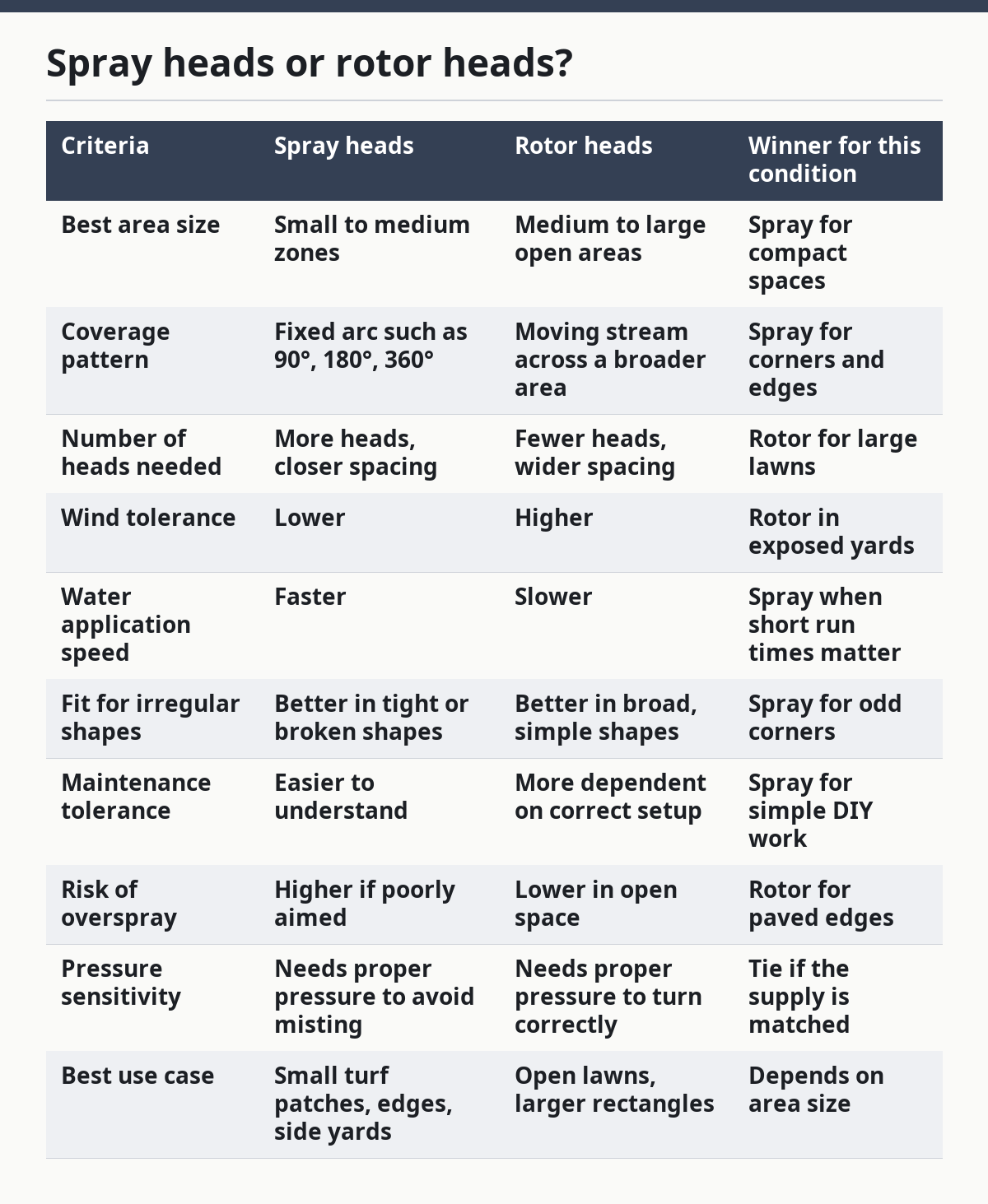
Spray heads are the right pick for a reader who has a small yard, a short run, or a zone with sharp corners. They are not the right pick for a broad front lawn where coverage distance matters more than simplicity. Rotor heads are the right pick when the area is large enough that many short-throw heads would be clumsy and costly in time, water, and layout.
Is drip irrigation the better choice for beds?

Drip irrigation is the better choice for most beds, shrubs, and root-zone watering because it puts water where the plant actually uses it. It is not the right answer for turf, and that is the main line you need to remember.
Drip works through emitters or tubing that release water slowly into the soil. That lowers surface runoff and keeps foliage drier, which can matter in dense plantings or around plants that do not like wet leaves. For mixed beds, it is often easier to control than a pop-up head because the watering line can follow the shape of the planting area instead of forcing a spray pattern onto it.
The drawback is that drip is less forgiving if the layout changes. If you move plants often, dig in the bed, or need to water a broad groundcover patch, drip can become fussy. Clogged emitters are also a real maintenance issue, so the design needs filtration and periodic checks. That makes drip a poor fit for someone who wants a low-attention lawn solution but a strong fit for someone who wants precise, root-level watering in beds.
I would choose drip when the area is planted, not turfed, and when the goal is to water directly at the base of the plants. I would skip it when the zone is mostly grass or when the bed layout is still changing every season. Irrigation Association resources on landscape irrigation design are a good starting point for the terminology and layout logic: https://www.irrigation.org/
How does pressure change the choice?
Pressure changes the choice because the same head can perform well or badly depending on whether the water supply matches its design. A sprinkler that is too pressure-starved may not throw far enough; one that is over-pressurized may mist, fog, or break its pattern.
This is why “what type do I need?” is not enough. A spray head, rotor, or drip line only works properly when the pressure and nozzle choice fit the zone. In practical terms, that means the supply, the pipe size, and the head family all need to agree. If they do not, the visible symptom is usually bad coverage: dry stripes, wet pavement, or a patch that always looks thirsty.
The mistake beginners make is assuming more pressure is always better. It is not. Too much pressure can create fine droplets that drift away in the wind instead of landing where they belong. Too little pressure can leave the outer edge of the zone dry no matter how carefully the timer is set.
This is also where a lot of generic articles go wrong: they talk about “sprinkler heads” as if all heads behave the same. They do not. A well-matched nozzle on a well-sized zone can do more for lawn health than a fancier controller. For technical background on watering efficiency, the EPA WaterSense program is the right public reference point: https://www.epa.gov/watersense
How do I compare the main choices side by side?
Compare them by area shape, plant type, pressure fit, and how much control you want over where the water lands. That four-part check is enough to sort most beginner decisions without overcomplicating the job.
The right comparison is not “Which one is newest?” It is “Which one covers my zone evenly with the least waste and the least correction work?” That is the real selection problem, and it is why a simple side-by-side check is more useful than a long list of features.
For a typical lawn, spray is the cleaner answer in a small or broken-up zone, while rotor is the cleaner answer in a larger open one. For beds, drip usually beats both because it keeps water low and targeted. That does not make drip universally superior; it just makes it the right tool for a different job.
The Honest Side-by-Side
Choose based on the zone, not the sprinkler catalog. A reader with three different zone types will usually need more than one sprinkler family, and that is normal.
| Criteria | Spray heads | Rotor heads | Winner for this condition |
|---|---|---|---|
| Turf area under modest size | Strong fit | Often too much throw | Spray |
| Large open lawn | Can require many heads | Better spacing and reach | Rotor |
| Beds and shrubs | Not ideal | Not ideal | Neither; use drip |
| Wind exposure | More drift risk | Better stream control | Rotor |
| Simple DIY setup | Easier to picture and place | More setup-sensitive | Spray |
| Watering precision near paving | Can overspray | Usually easier to aim at distance | Rotor |
| Small corner zones | Very good | Usually awkward | Spray |
| Large rectangular zones | Works, but may use more heads | Usually the cleaner layout | Rotor |
| Root-zone watering in planting beds | Poor fit | Poor fit | Neither |
| Best overall use case | Tight turf zones | Broad turf zones | Depends on area size |
Spray heads are the better choice for a reader whose lawn is broken into smaller pieces and whose main concern is simple coverage. Rotor heads are the better choice for a reader with a bigger open lawn and a desire to reduce the number of heads in the ground. Neither is the right choice for a shrub bed that needs water at the roots; that is drip territory.
The weakness of spray is coverage waste in larger or windy areas. The weakness of rotor is poor fit in tiny zones where its throw works against the shape. That trade-off is not a flaw in the product family; it is the point of selection fundamentals.
How do I avoid the biggest selection mistakes?
Avoid the biggest mistakes by checking zone shape, pressure, and plant type before you buy a single head. Most bad sprinkler choices come from ignoring one of those three things.
The first mistake is mixing head types in the same zone without a reason. If one part of a zone gets spray and another gets rotor, the water distribution usually becomes uneven. The second mistake is using a lawn sprinkler in a bed simply because the bed is “small.” Small does not mean spray-friendly; many small beds are better served by drip.
The third mistake is choosing a head without thinking about overspray. If water hits sidewalks, driveways, or fences, you are paying to water hard surfaces. That is wasted water and a sign that the head type or the arc setting is wrong.
The fourth mistake is treating controller settings as the fix for poor hardware. A timer cannot repair a bad match between the sprinkler type and the zone. It can only make the wrong choice run longer or shorter. If a zone is always too dry at the edge, the head family may be wrong, not the schedule.
A fifth mistake is ignoring local water restrictions or irrigation standards if they apply to the site. WaterSense is one useful public reference for efficient irrigation practices, and the Irrigation Association is a useful professional reference for design language and setup terms. Those two sources will not choose the head for you, but they will keep the selection grounded in real irrigation practice rather than guesswork.
How I made this comparison?
I made this comparison by looking at the decision points that change irrigation performance, not the ones that sound impressive in packaging. The useful questions were: is the zone small or large, is it turf or planting bed, does the pressure support the head, and does the shape allow even overlap. That is the same logic a good installer uses before choosing between a 90° spray corner, a 180° side strip, a 360° full circle, or a rotor layout.
I also kept the scope on beginner choices, because that is where most confusion starts. Advanced details like nozzle families, precipitation matching, and controller features matter later, but they do not come first if the basic head type is wrong. If the first choice is off, every other setting has to work harder to compensate.
That is why I am not treating this as a one-head-fits-all decision. The real answer is more practical: match the head to the zone, then fine-tune the pattern and pressure. The Irrigation Association and EPA WaterSense are the two public references I would point a beginner to before making a final layout decision.
When should I change the plan entirely?
Change the plan entirely when the area is not a single sprinkler problem anymore. If the yard has a lawn, a shrub bed, a narrow side strip, and a sloped edge, one sprinkler family will not solve all four zones well.
The first exception is mixed-use landscaping. A yard with turf and beds usually needs more than one watering method, because a rotor that is right for a lawn is wrong for a bed, and drip that is right for a bed is wrong for turf. The second exception is a very windy site. In that case, a spray-heavy plan can lose too much water to drift, and the choice may lean toward rotors or toward redesigning the zone geometry.
The third exception is a site with obvious pressure problems. If pressure is too high or too low for the planned heads, the better move is to fix the supply or redesign the zone rather than force the wrong sprinkler family to work. The fourth exception is a bed that is temporary. If the planting will change again soon, a fixed drip layout may be too much commitment for the site.
This is the point where a lot of readers want a single product answer, but the honest answer is that some layouts need two or three methods. That is not a failure of planning. It is normal irrigation design, especially when the site is not a simple rectangle.
What is the final choice?
Choose spray heads if the zone is small, tightly shaped, or full of corners. Choose rotor heads if the zone is larger, more open, and needs longer throw with fewer heads. Neither if the area is a planting bed, because drip is the better tool there and forcing turf heads into beds usually creates waste and uneven watering.
That is the clean recommendation. The wrong move is to choose by name, price, or habit instead of by zone shape and plant type. A 90° corner, a 180° side strip, and a 360° full circle do not ask for the same hardware, and a lawn does not ask for the same hardware as a shrub bed.
The best sprinkler choice is the one that matches the job with the least compromise. If the zone is turf and compact, spray usually wins. If the zone is turf and broad, rotor usually wins. If the zone is planted, drip usually wins.
What should I ask before I buy?
Ask what the zone is, how big it is, and whether the water can reach it evenly without hitting hardscape. Those three questions do more than a long product list.
Ask whether the area is turf, shrubs, or a mixed bed. Ask whether the shape is simple or broken into corners and strips. Ask whether the available pressure can support the head family you are considering, because pressure mismatch is one of the fastest ways to ruin coverage.
Ask whether a single sprinkler family makes sense at all. In many yards, the answer is no. The smartest layout is often a mix: spray for small turf areas, rotor for larger turf areas, and drip for beds. That combination sounds less tidy than buying one type for everything, but it is usually the more accurate answer.
What is the difference between spray and rotor sprinklers?
Spray sprinklers put water down in a fixed pattern, while rotor sprinklers move a stream across a wider area. Spray is usually better for smaller zones and corners, while rotor is usually better for larger open lawns.
When is drip irrigation the better option?
Drip is the better option for planting beds, shrubs, and other root-zone watering. It is not the right tool for turf because turf usually needs broader surface coverage.
Why does pressure matter so much?
Pressure controls how well the sprinkler throws, shapes, and distributes water. Too much pressure can create mist and drift; too little can leave the outer edge of the zone dry.
Can I use one sprinkler type for the whole yard?
You can, but it is usually a compromise. Mixed yards often need more than one type because turf, beds, corners, and open areas do not have the same watering needs.
What is the biggest beginner mistake?
The biggest beginner mistake is choosing the sprinkler before checking the zone shape and plant type. That leads to overspray, dry edges, and a timer that cannot fix the real problem.
Drafted with AI; not yet reviewed by a person.





Leave a Reply