Last updated: November 19, 2026
Key Takeaways
- Watering and irrigation both move water to plants; irrigation is the managed system, while watering is the act.
- Check moisture below the surface; dry topsoil alone does not always mean plants need water.
- Drip irrigation often works well for beds, shrubs, trees, and vegetable rows because it delivers water at the roots with little waste.
- Deep, infrequent watering usually beats shallow, frequent watering because it pushes roots down and cuts waste.
Dry soil, overwatered roots, and a yard that still looks thirsty usually mean the watering plan is wrong. In Watering and irrigation: The Complete Guide, the goal is to match water delivery to what plants can actually use, not just what a hose can dump on them. The sections below explain when to hand-water, when to use sprinklers or drip, and how to avoid the mistakes that waste water and rot roots.
What does watering and irrigation really mean?
Watering and irrigation are both about getting water to plants, but irrigation is the controlled system; watering is the act. If you want healthy roots and less waste, the goal is even moisture in the root zone, not wet leaves or puddles on the surface.
Picture this: you’re standing in a yard at 7 a.m., one corner soggy, another bone-dry, and the hose has already been moved twice. A good watering plan fixes that split. It sends water where roots live, at a pace the soil can absorb.
- Watering is the action: hose, can, bucket, or timer.
- Irrigation is the setup: drip lines, spray heads, rotors, or soaker hoses.
- The target is the root zone, usually the top 6 to 12 inches for most landscape plants.
- The risk is simple: too little water slows growth; too much water cuts off air at the roots.
The truth is, most bad results come from bad timing and bad delivery, not from “not enough effort.” A short, daily sprinkle often does less good than a slower soak every few days. That’s because roots follow moisture downward. Shallow watering trains shallow roots. Shallow roots. Bad trade.
How do I know when my plants actually need water?
Your plants need water when the soil below the surface is drying, not when the top dust looks pale. For many beds and lawns, a finger test, a trowel, or a soil probe is a fast check; if the soil is dry 2 to 4 inches down, it’s time to water.
Picture this: the top inch of mulch looks dry, but a shovel blade slides into damp soil underneath. That means the plant may be fine for now. On the flip side, a glossy wet surface can hide a dry root zone if the water never got deep enough.
Use these checks before you water:
- Finger test: Push a finger into the soil near the plant.
- Trowel test: Open a small slot and look at moisture at 2 to 4 inches.
- Weight test: A potted plant feels much lighter when dry.
- Leaf clue: Some plants droop in heat and recover in the evening; that does not always mean drought.
A simple rule helps. Water less often, but water deeper. That usually means soaking until moisture reaches the main roots, then waiting until the soil starts to dry again. Containers are different. Pots can dry in a day in hot wind because there is little soil mass to buffer heat.
Which irrigation method should I use?
Drip irrigation often works best for beds, shrubs, trees, and vegetable rows because it puts water at the roots with very little waste. Sprinklers are better for lawns and broad ground covers. Hand watering still wins for a few pots, a new plant, or a tiny garden, but it gets inefficient fast.
Picture this: you’ve got a mixed yard—lawn in front, shrubs along the house, tomatoes in raised beds, and a maple tree near the curb. One method won’t fit all four jobs well. That’s the catch. The right system depends on plant type, soil, slope, and how much of the yard you want covered at once.
Drip irrigation
Drip wins for shrubs, perennials, vegetable beds, and young trees. It releases water slowly through emitters or tubing, so less water blows away in wind or lands on paths. It also keeps foliage drier, which helps reduce some disease pressure.
Still, drip has trade-offs. Emitters clog if filters are ignored, tubing can be cut by tools or roots, and you need a plan for pressure and layout. A lazy install leaves dry spots.
Best for: gardeners with mixed beds, water-conscious yards, and anyone who wants less runoff.
Skip this if: you need quick coverage over a large lawn and have no patience for layout or maintenance.
Sprinklers
Sprinklers fit lawns because grass wants broad, even coverage across a flat area. Rotor heads and spray heads can cover large spaces fast, but wind steals water and overspray can hit sidewalks, fences, and cars. Some heads also wet leaves heavily, which is not ideal for disease-prone plants.
Sprinklers can be the wrong tool for narrow beds or irregular corners. They often water the street more than the root zone if the spacing is sloppy. Big mistake.
Best for: turfgrass and open areas with simple geometry.
Skip this if: your garden has lots of shrubs, raised beds, or sloped ground that sends water downhill.
Soaker hoses
Soaker hoses sit between drip and sprinklers. They seep water along their length, so they are useful for straight rows and simple beds. They cost less to set up than a full drip system, but they are less precise and can wet too much soil in one place if left on too long.
They also age poorly in sun and can clog or leak unevenly. On short beds, though, they are a practical middle ground.
Best for: straight vegetable rows and simple border beds.
Skip this if: you want exact control, long service life, or a system you can expand cleanly.
How deep and how often should I water?
Deep, infrequent watering is usually better than shallow, frequent watering because it drives roots down and reduces waste. The exact schedule depends on soil type, heat, wind, and plant size, but the principle stays the same: soak the root zone, then let the top layer dry a bit.
Picture this: you water a flower bed every day for 5 minutes, and the plants still droop at noon. That often means the water never got past the top layer. The soil surface may look handled, but the deeper root zone is still underfed.
A better pattern looks like this:
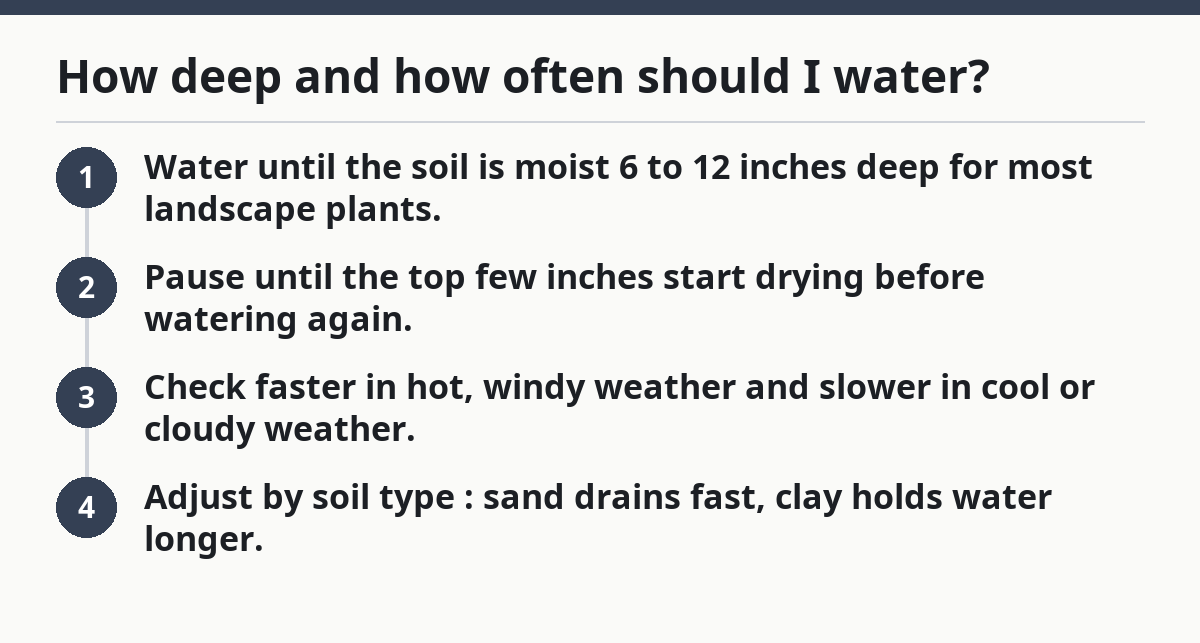
- Water until the soil is moist 6 to 12 inches deep for most landscape plants.
- Pause until the top few inches start drying before watering again.
- Check faster in hot, windy weather and slower in cool or cloudy weather.
- Adjust by soil type: sand drains fast, clay holds water longer.
Clay soil is the trap here. It takes water slowly, so fast application runs off before soaking in. Sandy soil is the opposite; it may need shorter, more frequent cycles because water drains through it quickly. That means the same sprinkler timer can be wrong in two different yards on the same street.
Potted plants are their own category. Small containers may need water every day in summer, while large pots and self-watering containers can go longer. The pot, the sun, and the wind matter more than the calendar.
What is the best way to water a lawn without wasting water?
A lawn is usually best watered with matched sprinkler heads, proper spacing, and a schedule that lets water soak in before runoff starts. The system should match the lawn’s shape and pressure so each area gets similar coverage, not a striped patchwork of wet and dry zones.
Picture this: your sprinkler hits the driveway as hard as it hits the grass. That means the layout is wrong or the heads are set poorly. Lawns need uniform coverage more than brute force. A strong spray does not fix poor distribution.
Use these lawn rules:
- Water early in the morning to reduce evaporation and wind drift.
- Run longer, not harder so water can soak in.
- Watch for runoff on slopes, then split the run into two or three shorter cycles.
- Keep heads level and unobstructed so the spray pattern stays even.
A common mistake is watering every day for a short burst. That keeps the top inch damp and the roots lazy. Another is watering after the sun is high, when more water leaves as vapor or lands off target. Morning is still the cleanest window for most homes.
If the lawn has brown spots, don’t assume the whole yard is thirsty. The issue may be poor head spacing, a blocked nozzle, compacted soil, or a leak. The pattern tells the story. Random dry circles usually point to hardware, not hunger.
How do I build a water-saving irrigation setup?
A water-saving setup starts with zones, pressure, and soil, not with the timer. Group plants by water need, use the right emitter or nozzle for each zone, and keep the delivery slow enough that the soil can absorb it.
Picture this: the same line feeds thirsty annuals and drought-tolerant shrubs. One side gets drowned, the other side barely survives. That’s the wrong zone plan. Split the yard by plant type and sun exposure first. Then pick the hardware.
A practical setup order
- Map the yard by sun, shade, slope, and plant type.
- Group plants into zones with similar water needs.
- Choose the method: drip for beds, sprinklers for turf, soaker for simple rows.
- Add filtration and pressure control where drip lines need it.
- Test coverage before you bury or mulch over lines.
Mulch helps more than people think. A 2- to 3-inch layer of organic mulch slows surface evaporation and keeps soil temperature steadier. It won’t replace irrigation, but it can cut waste and reduce how often you need to water. Keep mulch a few inches away from trunks and crowns so you don’t trap moisture where it causes rot.
Timers help, but they’re not magic. A timer can only repeat the bad plan you give it. Smart controllers can adjust based on weather or soil data, but even a basic timer works if the zones and run times are right. The machine is not the fix. The layout is.
What mistakes ruin watering and irrigation most often?
The worst mistakes are watering too often, watering the wrong place, and using one schedule for every plant. Those errors waste water and hurt roots faster than “forgetting once in a while.”
Picture this: the garden looks wet, the hose is put away, and the basil still wilts by afternoon. That can happen when the surface is wet but the root zone is still dry, or when the roots have been damaged by constant wet soil. The surface can lie.
Common failures include:
- Shallow watering: roots stay near the top and suffer fast in heat.
- Overwatering: roots lose access to air and can decline.
- Bad timing: midday watering wastes more through evaporation and wind.
- Poor spacing: sprinklers miss corners and overlap badly.
- Ignoring leaks: a small drip can hide under mulch or a hose run.
There’s also the “one-size-fits-all” problem. A mature tree, a tomato plant, and a patch of Kentucky bluegrass do not drink the same way. Trees want deep soakings less often. Tomatoes want even moisture and hate swings. Lawns need broad coverage, but not constant sogginess.
One more thing: a garden can look stressed from heat even when it has enough moisture. Wilting at noon, especially in strong sun, is not always a water emergency. Check the soil first. Guessing by leaf posture alone causes overwatering more often than people admit.
When should I choose drip, sprinklers, or hand watering?
Choose drip when precision matters, sprinklers when area coverage matters, and hand watering when the space is too small or too awkward for hardware to pay off. The right answer depends on plant type, yard size, and how much work you want to do each week.
Picture this: you’ve got a 20-by-30-foot lawn, three raised beds, and a row of new shrubs. One method can’t serve all three equally well. A yard can have sprinklers for turf and drip for beds, with each doing the job it handles best.
The honest split
- Drip: best for beds, shrubs, trees, and vegetable plots.
- Sprinklers: best for lawns and wide, open ground.
- Hand watering: best for containers, new transplants, and tiny spaces.
Drip wins on control. Sprinklers win on speed. Hand watering wins on flexibility. The wrong choice is usually the one that looks easiest on day one but creates more waste or more repairs later.
If your yard is small and full of pots, a can or hose nozzle may be enough. If your lawn is large and uniform, a sprinkler setup saves time. If your space has mixed planting and slopes, drip often gives the cleanest result because water stays where it belongs.
What should I do first if my plants already look stressed?
Start with the soil, not the leaves, and then fix the delivery method if the soil is either too dry or too wet. A plant that looks stressed may need water, drainage, or a change in schedule—not just more of the same.
Picture this: a shrub droops after a hot afternoon, then perks up by evening, while the soil around it stays damp. That points away from drought and toward heat stress or root issues. The sign matters. Not every wilt means “more water.”
First-response checklist
- Check the soil 2 to 4 inches down.
- Look for runoff or puddles after watering.
- Inspect emitters, hoses, and sprinkler heads for clogs or leaks.
- Feel the pot or bed edges if roots are crowded or dry at the rim.
- Adjust the schedule before adding more time.
If the soil is dry deep down, water slowly enough for it to soak in. If the soil is wet and roots are still unhappy, cut back and look at drainage, compaction, or a broken line. Plants don’t always need more water. Sometimes they need less, or they need water delivered in a way the soil can handle.
The best part? Once the setup matches the plant, watering gets boring in a good way. Boring means consistent. Consistent means roots can do their job.
The verdict: what should a beginner choose?
Choose drip irrigation if you’re watering beds, shrubs, vegetables, or young trees and want the cleanest control over where the water goes. Choose sprinklers if your main job is a lawn or a broad open area that needs even surface coverage. Choose hand watering only if the space is small, temporary, or full of containers that need individual attention.
Choose drip if your yard has mixed planting and you care about lower waste. Choose sprinklers if you need to cover grass fast and the area is simple. Neither if your yard is too compacted, the drainage is broken, or the plants are failing for reasons watering cannot fix.
FAQ
How often should I water plants in summer?
Water plants when the soil starts drying below the surface, not on a fixed daily calendar. In hot, windy weather, that can mean every day for pots and less often for beds and shrubs. The soil check matters more than the date.
Is it better to water in the morning or at night?
Morning is usually better because less water is lost to evaporation and leaves dry sooner. Night watering can leave foliage and soil wet longer, which can invite some disease problems. If morning isn’t possible, late afternoon is usually a better fallback than full evening.
Can I use the same irrigation schedule for all my plants?
No, because lawns, shrubs, vegetables, and containers need different water depth and timing. A single schedule often overwaters some plants and underwaters others. Grouping plants by need is the fix.
How do I know if I’m overwatering?
Overwatering often shows up as soil that stays wet, roots that struggle, yellowing leaves, and weak growth. The clearest check is the soil itself: if it’s still damp several inches down long after watering, the schedule is too heavy or the drainage is poor.
Does mulch really help with watering?
Yes, mulch helps by reducing surface evaporation and keeping soil temperature steadier. A 2- to 3-inch layer around beds can make watering more efficient. Keep it away from trunks and crowns so you don’t trap moisture where it can cause problems.
Drafted with AI; not yet reviewed by a person.





Leave a Reply