Last updated: November 28, 2026
Quick answer: for most setups, choose a hose-end sprinkler that matches your hose thread, uses a good hose washer, and connects cleanly to your garden tap or outside tap. If the fit is wrong, the sprinkler can leak at the tap, wobble on the hose, or refuse to screw on at all.
Key takeaways
- The right choice starts with fit, not spray pattern.
- Check the hose thread at both ends before buying anything.
- A plain hose washer does a lot of the sealing work.
- Quick-connect fittings can save time, but only if the parts match.
- A small leak is usually a connector problem, not a sprinkler problem.
What exactly are you trying to connect?
A hose-end sprinkler is the easiest choice when the job is to attach one sprinkler to a garden hose and then screw that hose onto a garden tap. The basic setup is simple: tap on one end, hose in the middle, sprinkler on the other end. For a broader overview, see how to choose a sprinkler.
The two connections matter more than the sprinkler shape. One end must match the garden tap, and the other must match the hose thread on the sprinkler side. If the threads do not match, no amount of tightening will make the connection right.
Many homes use hose fittings with a threaded end and a hose washer inside the coupling. That washer is a flat rubber or fibre ring that helps stop water from escaping around the joint. Without it, even a well-threaded connection can drip.
A reader who only wants an easier way to water a lawn or bed usually needs a hose-end sprinkler, not an in-ground system. This guide fits the simple case: one hose, one tap, one sprinkler, and the fittings that hold them together. For broader buying advice, the hub guide to how to choose a sprinkler can sit alongside this one.
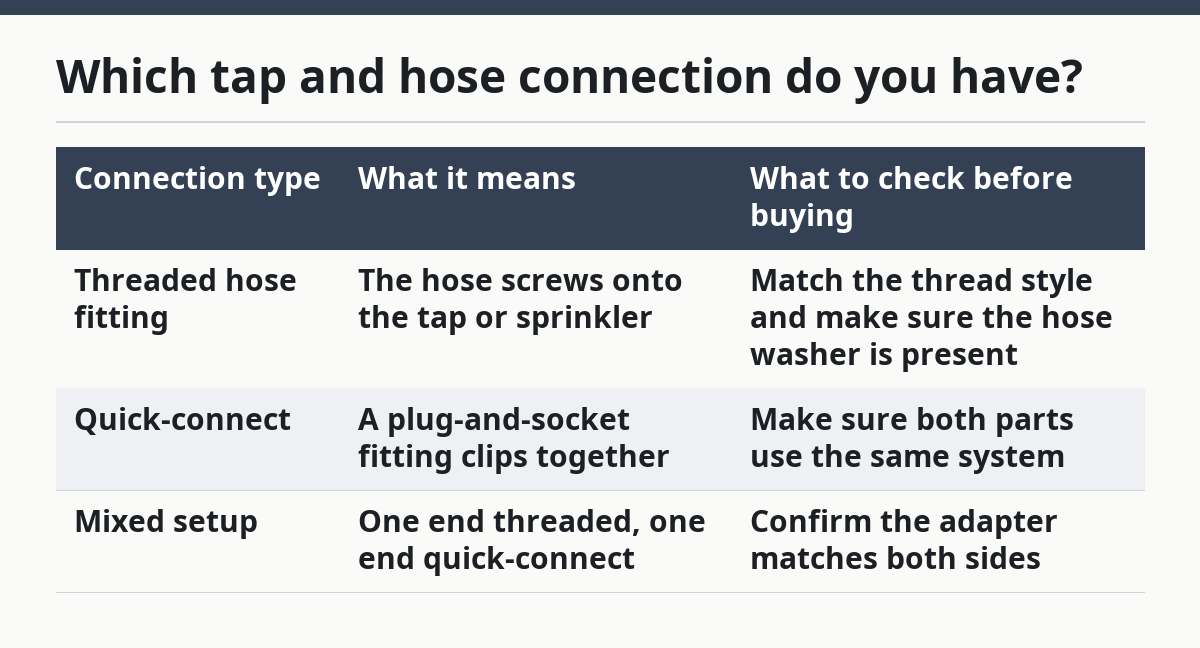
Which tap and hose connection do you have?
The right sprinkler starts with the thread on the garden tap and the thread on the hose fitting. Most mistakes happen here, because the sprinkler itself may be fine while the connector is wrong.
Before buying, look at the end of the hose and the outside tap. Check whether the hose fitting screws on, clips on with quick-connect parts, or uses a different adapter. If the thread looks worn, bent, or cracked, replace that fitting first.
| Connection type | What it means | What to check before buying |
|---|---|---|
| Threaded hose fitting | The hose screws onto the tap or sprinkler | Match the thread style and make sure the hose washer is present |
| Quick-connect | A plug-and-socket fitting clips together | Make sure both parts use the same system |
| Mixed setup | One end threaded, one end quick-connect | Confirm the adapter matches both sides |
A lot of readers only need a standard hose thread and a washer, not a special adapter. That is often the simplest path and usually means fewer loose parts to keep track of. It is not the right choice if the tap already uses a quick-connect system, because forcing a mismatch can damage the fitting.
If the tap is the wrong style, an adapter may solve it. The trade-off is one more joint to leak. That can work for many gardens, but it is not the best choice if you want the fewest parts between the tap and the sprinkler.
How do you choose the hose-end sprinkler itself?
Choose the hose-end sprinkler by the area you want to cover, the fit of the connector, and how much fiddling you want to do each time you move it. The sprinkler is the last piece you buy, but it should still match the hose and tap setup you already have.
A basic hose-end sprinkler is good for a simple lawn edge, a small bed, or a short watering run from one tap. If the sprinkler comes with a built-in connector, check that it matches your hose thread before you pay. If it needs a separate adapter, add that to the cart too.
Here is the practical short list:
- Check the connection type first. A standard threaded hose-end sprinkler is easiest if your hose already uses a screw-on fitting.
- Look for a hose washer in the coupling. The washer is a cheap part, but it is often the difference between a dry joint and a drip.
- Prefer a simple layout over extra adapters. Fewer parts usually means fewer leaks.
- Match the sprinkler to the tap access point. If the tap sits in a tight corner, a bulky fitting can make the hose harder to turn.
- Decide if quick-connect is worth it. Quick-connect fittings are helpful when the sprinkler gets moved often, but they only work well when every part of the system is the same style.
A hose-end sprinkler with the correct thread and a good seal is more useful than a clever-looking one that needs three extra adapters. It is also not the right choice for someone who wants a permanent underground layout.
One useful external reference for hose and tap compatibility is the garden hose fitting guidance from hose-fittings makers and irrigation suppliers, such as GARDENA’s hose connector guidance at gardena.com and Hozelock’s fitting information at hozelock.com. For general water-saving advice, the U.S. Environmental Protection Agency’s WaterSense program is a solid reference point on efficient watering habits, and it includes a 60 psi maximum water pressure reference for standard hose-end watering systems on epa.gov/watersense.
What fittings do you need to make it fit?
You need the fitting that matches the hose thread, the tap thread, and any quick-connect parts already on the hose. That usually means one of three things: a threaded hose fitting, a quick-connect adapter, or both.
The most overlooked part is the hose washer. It sits inside the threaded coupling and helps seal the joint when the nut is tightened by hand. If the washer is missing, cracked, or flattened, the fit may drip even when the threads look correct.
Common fitting jobs include these:
- Tap to hose: screw-on connector if the tap is threaded.
- Hose to sprinkler: threaded coupling that matches the sprinkler inlet.
- Hose to quick-connect plug: clip-on parts that match the same system on both ends.
- Tap adapter: a helper part when the tap and hose do not share the same thread style.
A reader should avoid guessing here. If the connector looks close but not exact, the threads can bind. That usually leaves the joint loose, damaged, or impossible to undo later.
Quick-connect parts are handy when the hose-end sprinkler is moved often. The downside is cost and part count. There are more pieces to lose, and one worn ring can cause a leak just as fast as a bad thread can.
How do you stop a hose sprinkler from leaking?
A hose-end sprinkler stops leaking when the washer is in place, the thread is not cross-threaded, and the joint is tightened by hand without forcing it. Most leaks come from the connection, not the spray head itself.
Start with the washer. Open the coupling and look for the flat ring inside. If it is missing, dry, split, or misshapen, replace it before trying anything else. A fresh washer is a small fix that often solves the problem.
Use this sequence:
- Clean the threads. Wipe off grit from the tap, hose fitting, and sprinkler inlet.
- Check the washer. Replace it if the ring is damaged or absent.
- Start the thread by hand. Turn the fitting gently until it catches cleanly.
- Tighten until snug. Stop when the joint feels firm, not forced.
- Turn the water on and watch the joint for 30 seconds. A dry seam means the seal is working.
If the leak continues, remove the fitting and look for damage to the thread. A cracked nut or bent thread often needs replacement rather than another turn of the hand. Extra force rarely helps and can make the leak worse.
Thread seal tape is not the first answer for every hose joint. On many garden hose fittings, the washer is the real seal. Tape can help in some threaded setups, but it should not be used to cover up a missing washer or a bad fit.
What mistakes cause the most trouble?
The biggest mistakes are buying the wrong thread, skipping the washer, and adding too many adapters. Each one costs time, and the first two usually cost water as well.
A mismatch between hose thread and tap thread creates a connection that never feels quite right. People often keep tightening it, which can wear the fitting and still leave a drip. The better move is to stop, identify the fitting type, and swap in the correct connector.
Missing washers cause a different kind of frustration. The joint may feel tight but still leak in a thin stream or a slow drip. That is a seal problem, not a pressure problem, and the fix is usually a washer or a fresh coupling.
Too many adapters make the setup bulky. That matters when the tap is near a wall or when the hose is coiled tightly after use. A simple hose-end sprinkler with one clean connection is easier to store and less likely to snag.
One more mistake is buying the sprinkler before checking the hose fitting. The sprinkler may be perfectly fine and still be the wrong match for the existing hose. For this topic, the connector comes first and the spray pattern comes second.
When is a hose-end sprinkler the wrong choice?
A hose-end sprinkler is the wrong choice when the hose and tap setup needs more than a simple connector fix. If the garden needs a permanent underground system, a basic hose-end sprinkler will not solve that job.
It is also the wrong fit when the tap thread and hose fitting are so different that the setup would need several adapters. At that point, the part count becomes the problem. Because of that, more joints mean more places for drips and more time spent assembling the same watering run.
This option is also not ideal for someone who wants to set a timer, leave the hose in place for long periods, or build a fixed layout around several zones. In those cases, another irrigation setup may make more sense, but that belongs on a different page.
For a straightforward tap-to-hose setup, though, the hose-end sprinkler is still the simplest answer. It is easy to understand, easy to move, and less annoying to maintain than a stack of mixed fittings.
FAQ
Will this sprinkler fit my hose?
It will fit if the hose thread and connector match and the hose washer is in place. A hose-end sprinkler is usually a simple screw-on part, but the exact fit depends on the fitting already on the hose and the tap. If the threads look different, use an adapter rather than forcing the joint.
What hose connector do I need for a sprinkler?
You need the connector that matches both the hose thread and the sprinkler inlet, plus the tap side if that end is also changing. In many cases, that means a standard threaded hose fitting with a washer, or a quick-connect adapter if the rest of the setup already uses that system. Check both ends before buying.
How do I stop a hose sprinkler from leaking?
Start with the hose washer, because that is the usual seal. If the washer is missing, worn, or pinched, replace it and then screw the fitting on by hand until snug. If it still leaks, check for damaged threads or a cracked coupling instead of tightening harder.
Drafted with AI; not yet reviewed by a person.
Leave a Reply