Last updated: November 29, 2026
Quick Answer: choose a rotating sprinkler for medium to large lawn coverage if you want slower, more even watering across roughly 2 or more zones of turf, and skip it if your space is a narrow strip or a very small patch. How to choose a rotating sprinkler for medium to large lawn coverage starts with the yard’s shape, not the package claim. A rotating sprinkler fits lawns that need water spread farther across the yard, not blasted in one short burst. In many cases, a gear-driven sprinkler works well for calm, even coverage, while an impact sprinkler can suit wider areas if you can tolerate a louder, more mechanical pattern.
Key takeaways
- Rotating heads suit medium to large lawns because they throw water in moving streams instead of a fan-shaped spray.
- A gear-driven sprinkler usually gives a quieter, more controlled pattern; an impact sprinkler is often better when you want a tougher, broader throw.
- Oscillating sprinklers are easier to understand, but they are not the same tool as a rotating head and often fit different lawn shapes.
- Water efficiency depends on matching the arc, throw, and run time to the lawn, not just buying a “more efficient” head.
- The wrong choice usually shows up as runoff, dry edges, or wet sidewalks, not as a broken sprinkler.
What does a rotating sprinkler do?
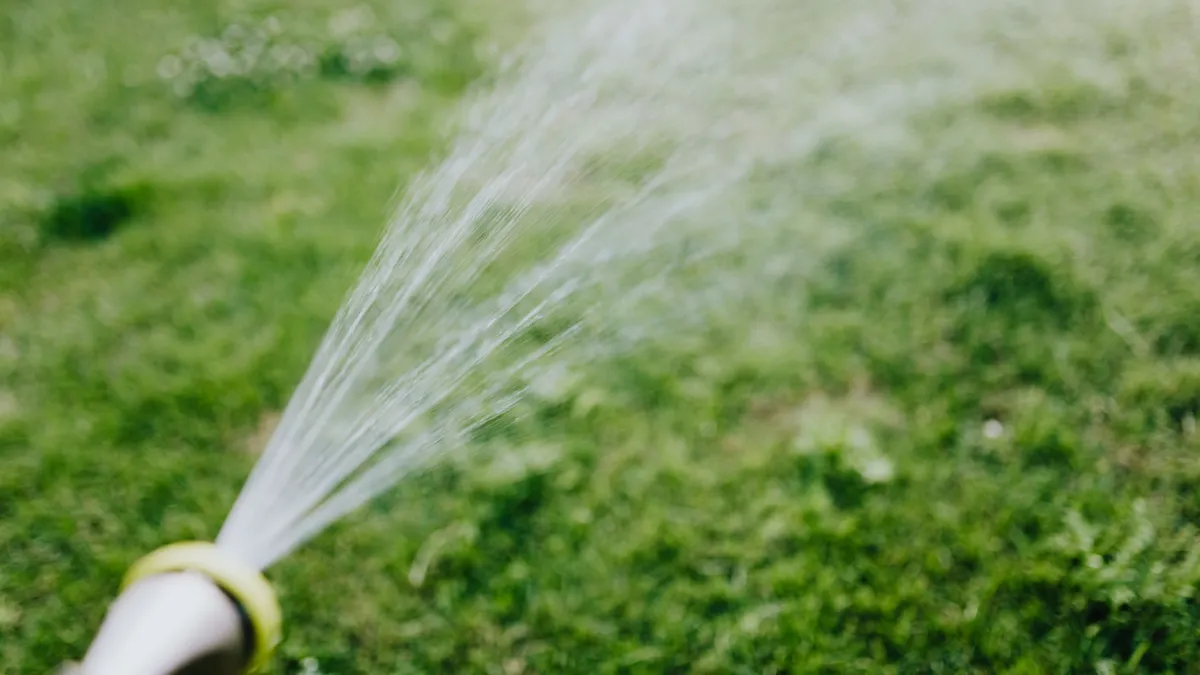
A rotating sprinkler spreads water through moving streams that sweep across a set arc, which makes it a better fit for medium to large coverage than a fixed spray head. Instead of misting one area all at once, it sends water farther and lets the pattern move across the lawn in steps.
That slower delivery matters. A fixed spray head can dump water quickly, which is useful for compact beds or tiny lawn sections, but it can waste water if the soil cannot soak it in fast enough. Rotating heads are commonly chosen when the lawn needs more reach and less surface runoff, especially on standard turf areas that are too large for a small static nozzle.
The main trade-off is time. A rotating pattern often needs longer run times than a spray nozzle because it applies water more gradually. That is not a flaw; it is the point. The drawback shows up when someone wants quick soaking for a tight zone or a shape with many short edges, because the moving streams may overshoot hardscape or miss corners.
For a general irrigation overview, the EPA WaterSense program is a useful reference on outdoor water use and efficient watering habits, and the Irrigation Association publishes standards and education for irrigation products and setup. Those sources help frame why coverage pattern matters more than brand hype.
Which type should you buy?
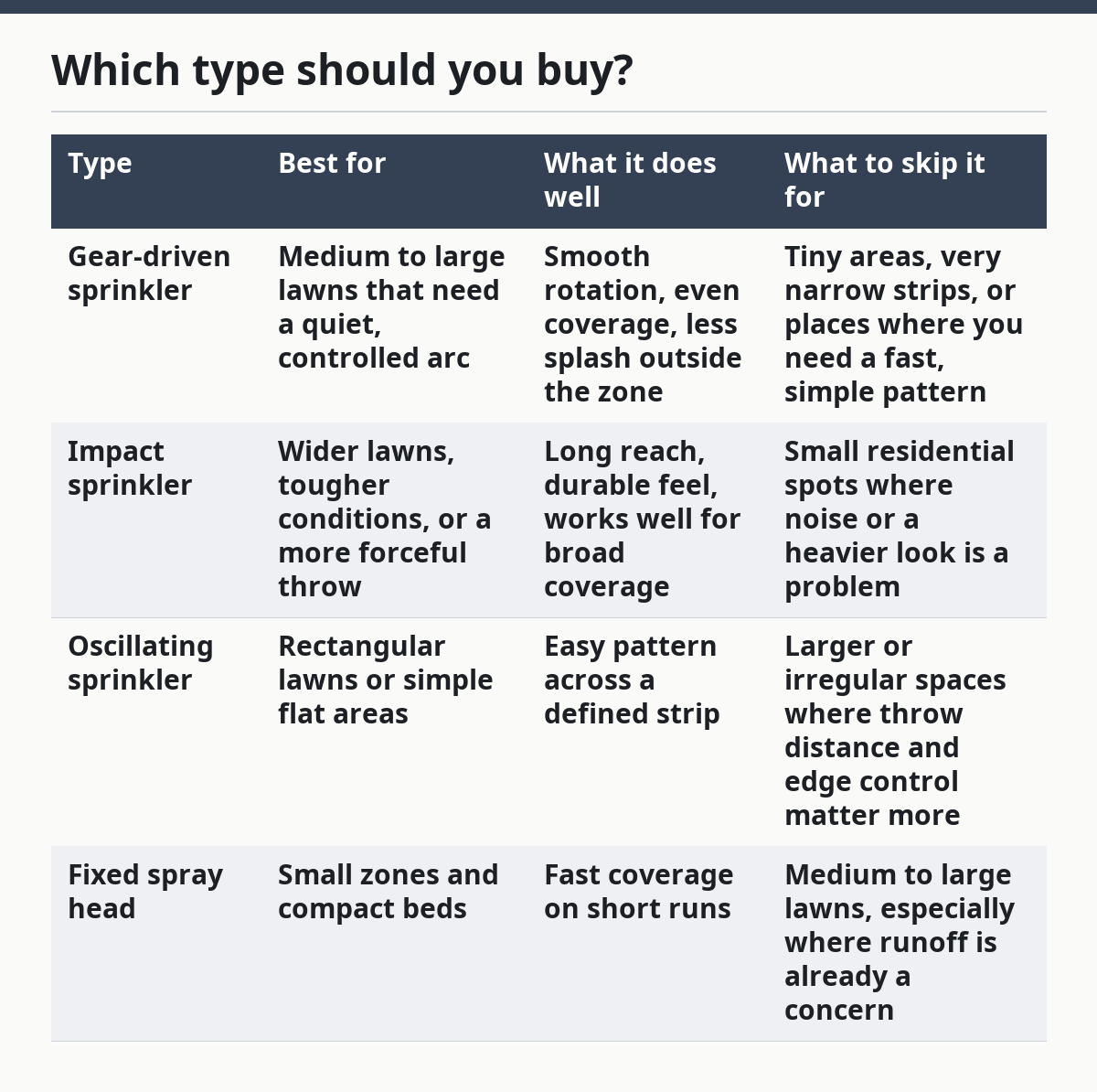
A rotating sprinkler should be chosen by the lawn’s coverage needs and the kind of water pattern you want, not by the loudest claim on the package. The three common names that matter here are rotating, gear-driven, and impact. Oscillating is the main comparison point because it serves a different coverage style.
| Type | Best for | What it does well | What to skip it for |
|---|---|---|---|
| Gear-driven sprinkler | Medium to large lawns that need a quiet, controlled arc | Smooth rotation, even coverage, less splash outside the zone | Tiny areas, very narrow strips, or places where you need a fast, simple pattern |
| Impact sprinkler | Wider lawns, tougher conditions, or a more forceful throw | Long reach, durable feel, works well for broad coverage | Small residential spots where noise or a heavier look is a problem |
| Oscillating sprinkler | Rectangular lawns or simple flat areas | Easy pattern across a defined strip | Larger or irregular spaces where throw distance and edge control matter more |
| Fixed spray head | Small zones and compact beds | Fast coverage on short runs | Medium to large lawns, especially where runoff is already a concern |
Gear-driven models usually make sense when control matters. The internal gears create a steady sweep, which helps keep the pattern consistent. Impact models are more old-school and usually more audible, but they can be a smart choice when the lawn is broad and the user wants a rugged pattern that reaches farther.
What should be skipped is the idea that “bigger” automatically means “better.” A large rotating head can still be the wrong match if the lawn has lots of short edges, tight curves, or places that must stay dry. In those cases, the pattern matters more than the name on the box.
How do I pick the right coverage pattern?
Pick the right coverage pattern by matching the arc, throw, and edge control to the lawn’s shape and the area you actually need watered. A good rotating sprinkler should water the grass, not the driveway, fence, or sidewalk.
Start with the arc. Full-circle heads fit open areas better, while part-circle settings work when the lawn borders a path or building. Then look at throw distance. The stream should reach the far edge of the turf without overshooting it by a large margin, because overshoot turns into waste. Last, check how the head behaves at the edges of the pattern. A clean stop at the border is often more useful than extra reach.
One common mistake is buying based on maximum reach alone. That can cost you in overspray, wet hardscape, and uneven watering near the nozzle. Another mistake is choosing an oscillating sprinkler when the lawn is not a neat rectangle. That often leaves corners dry or creates overlap that soaks one strip while the next stays pale.
A simple field check helps. Place the head where it would sit in the yard, run it briefly, and look at where the moving streams land. If the pattern constantly hits hardscape or misses a strip of turf, the coverage style is wrong even if the model is well reviewed.
The working rule is plain: for medium to large coverage, choose the head that can sweep the space with the least waste, not the one with the biggest number printed on the package.
How does water use efficiency fit into the choice?
Water use efficiency matters because a rotating sprinkler can waste less water than a fast spray pattern, but only when the output matches the lawn and run time. The goal is not “less water at all costs.” The goal is water that gets into the soil instead of running off.
Rotating heads usually apply water more slowly, which gives the soil more time to absorb it. That can help on lawns where runoff is a problem, especially if the ground is sloped or the soil takes water slowly. The trade-off is runtime: a slower pattern may need longer sessions to give the lawn enough moisture.
This is where a generic article often goes wrong. It treats efficiency as a model feature instead of a setup result, so it is wise to consult a professional or follow guidance from a source such as EPA WaterSense when you are matching a head to a specific yard. A gear-driven head with a smart arc can still waste water if it sprays pavement. An impact sprinkler can still be a sensible choice if it fits the area and is aimed correctly.
A useful standard to keep in mind is the irrigation industry’s focus on matched precipitation and even distribution. That phrase is jargon, but the idea is simple: the lawn should get water at a similar rate across the zone. If one side gets soaked while the other side barely turns dark, efficiency drops even if the nozzle itself is “efficient.”
The best purchase choice is usually the one that reduces correction work later. Less patching, less runoff, and fewer dry spots usually beat a flashy spec sheet.
How to choose a rotating sprinkler for medium to large lawn coverage
Choose a rotating sprinkler for medium to large lawn coverage by following a short buying sequence that starts with the zone, not the product. The right head is the one that fits the space, the pattern, and the way the lawn absorbs water.
-
Measure the main watering zone in simple terms. Note whether the area is open, partly blocked, or long and narrow. A broad, open lawn points toward a rotating head; a tight strip usually does not.
-
Decide whether the arc needs to be full-circle or part-circle. A full-circle setting suits open turf, while part-circle coverage is better when one side borders a walk, patio, or building. The result should be water only where grass grows.
-
Choose gear-driven or impact based on control versus throw. Gear-driven heads are the quieter, more controlled choice. Impact heads suit wider coverage and a tougher feel, but they are usually less discreet.
-
Match the stream reach to the far edge of the turf. The water should reach the edge without spraying far past it. Overshoot is a sign the head is too strong or badly positioned.
-
Check how the lawn handles slower watering. If water tends to run off or pool, a rotating pattern is often a better fit than a fast spray. If the lawn is tiny or dries too quickly in one spot, rotating may be more than you need.
-
Compare the model against your actual use case, not just the label. A head marketed for “large coverage” may still be wrong if the yard has many corners, narrow bands, or hard edges.
That sequence helps because it keeps the decision tied to the yard’s shape and the lawn’s needs. It also prevents a common mistake: buying for a phrase like “long-range” and then discovering the pattern is too broad for the space, so it is worth consulting a professional or checking a source such as EPA WaterSense. A rotating sprinkler is a coverage tool, not a one-size answer.
When is a rotating sprinkler the wrong choice?
A rotating sprinkler is the wrong choice when the lawn is small, oddly chopped up, or already easy to overwater. In those cases, a fixed spray head or another pattern may be simpler and less wasteful.
It also loses value when the job is a narrow strip along a walkway or fence line. Rotating streams are built to sweep, so they can overshoot the border unless the arc and placement are carefully matched. That means more water on pavement and less on roots.
Oscillating models can also beat rotating heads on simple rectangular lawns where the width is predictable and the edges are clean. They are not always the more efficient choice, but they can be easier to place and understand. The point is not that oscillating is better overall; it is that the coverage style should fit the yard before anything else.
One more limitation matters: a rotating sprinkler can be a poor fit if the buyer wants instant visual feedback. Because it waters more slowly, it can look as if it is doing less even when it is the better match. That makes patience part of the decision. If the lawn needs a quick burst and the area is small, rotating heads are usually the wrong tool.
What should I compare before I buy?
Compare the pattern, control, and fit before you compare brand names. Those three things decide whether the head will help or frustrate you.
The first comparison is coverage style. Rotating heads win when the lawn is medium to large and needs a measured sweep. Oscillating heads work better when the space is simple and box-shaped. Fixed spray heads should be reserved for smaller zones where quick output matters more than reach.
The second comparison is control. Gear-driven models usually give finer control over the sweep. Impact models can handle more rugged use and broader coverage, but they bring more noise and a more mechanical feel.
The third comparison is fit to the yard. A good match keeps water on turf and off hardscape. If a model only looks impressive because it throws water far, that is not enough. Long throw without edge control can cost more in waste than it saves in time.
A rotating sprinkler is worth buying when it solves a coverage problem the other types do not. That is the real test. If the lawn is medium to large, the shape is workable, and slower application helps the soil absorb water, the rotating option is usually the right place to start.
FAQ
What is the main advantage of a rotating sprinkler?
A rotating sprinkler is designed to spread water more evenly across medium to large lawn coverage, and it usually does that with less runoff than a fast spray head.
Is a gear-driven sprinkler better than an impact sprinkler?
Not always. A gear-driven sprinkler is usually quieter and more controlled, while an impact sprinkler can be a good fit for wider coverage and tougher conditions.
How do I know if my lawn is too small for a rotating sprinkler?
If the area is a narrow strip, a small patch, or a space with lots of tight corners, a rotating sprinkler is often more coverage than you need.
Should I choose the biggest throw distance I can find?
No. The better choice is the pattern that reaches the turf without overshooting sidewalks, patios, or other hardscape.
Where can I get more guidance on efficient watering?
EPA WaterSense is a useful starting point for outdoor water use and watering efficiency, and a qualified irrigation professional can help match a head to your yard.
Drafted with AI; not yet reviewed by a person.
Leave a Reply