Last updated: November 29, 2026
Quick answer: choose a rotary sprinkler and start with a 5-minute burst. For how to choose a sprinkler for clay soil without puddling, the safest first test is a slow application, then a pause. Clay soil absorbs water slowly, so an oscillating sprinkler often puddles unless it is run in cycle and soak mode, while a rotary sprinkler usually fits better because it throws water more evenly and at a lower rate.
Key takeaways
- Clay soil needs time, not volume, so the best setup is the one that matches the soil’s slow intake.
- A rotary sprinkler usually beats an oscillating one when puddles show up after a few minutes.
- Short watering bursts with pauses reduce runoff far better than one long run.
- The goal is a damp root zone, not a shiny surface with standing water.
- If water runs toward a low spot or sidewalk, the schedule needs changing before the sprinkler does.
What does clay soil need from a sprinkler?
Clay soil needs a sprinkler that delivers water slowly enough for the ground to drink it in. That is the whole decision. Heavy soil has tiny pore spaces, so water spreads sideways and pools on top long before it sinks down.
This is why a high-output setup that looks fine on sandy ground can fail on clay. A spray pattern that dumps water fast will create runoff, especially if the lawn is slightly compacted or already dry on the surface. The right match is less about “coverage” and more about application rate.
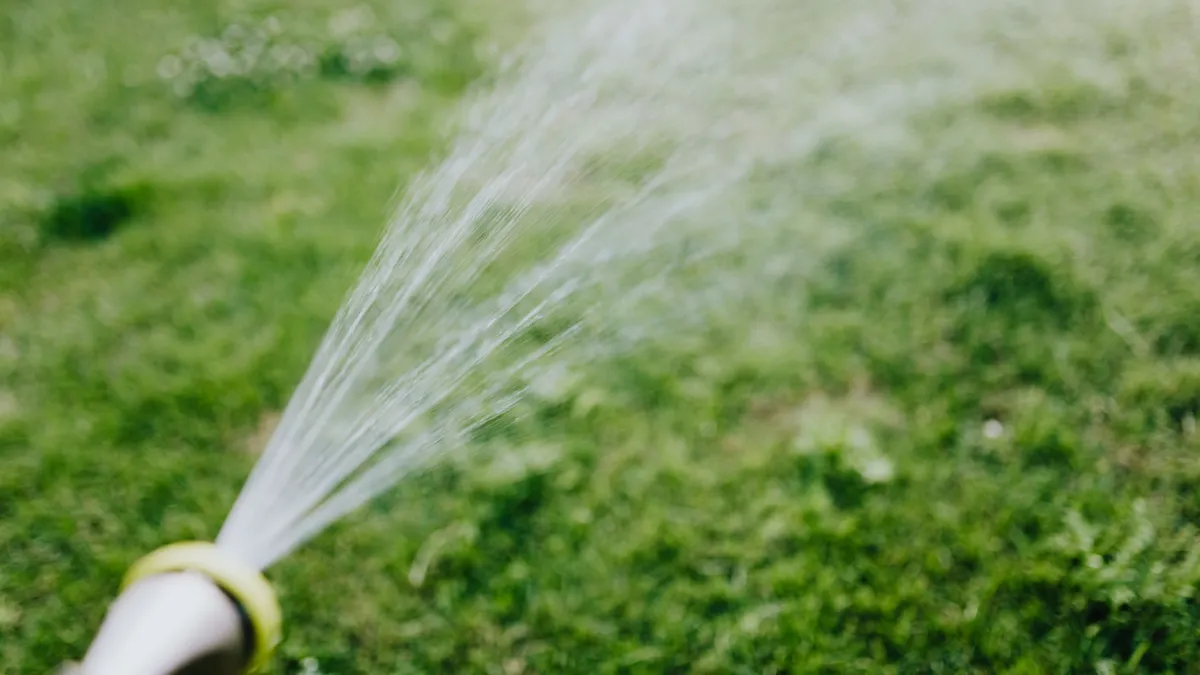
Specifically, clay favors low-intensity delivery over fast spray. A rotary sprinkler usually gives a gentler application than a hard fan of water. An oscillating sprinkler can still work on clay, but it often needs cycle and soak to keep the surface from flooding. The USDA Natural Resources Conservation Service explains soil intake and infiltration behavior in its water and soils guidance, and extension irrigation guides make the same point for scheduling.
If the soil stays glossy, soft, or muddy after a short run, the sprinkler is putting out water faster than the ground can absorb it. That is the sign to slow the delivery, not to water longer.
Which type of sprinkler is safer for clay?
A rotary sprinkler is usually the safer choice for clay soil because it applies water more slowly and more evenly than an oscillating sprinkler. That does not make rotary the only answer, but it does make it the default pick when puddling is the problem.
Here is the practical comparison:
| Type | What it does well | What goes wrong on clay | Best use |
|---|---|---|---|
| Oscillating sprinkler | Covers a rectangular area and is easy to aim | Can dump water too fast and cause puddles or runoff | Small, flat lawns only if run in short bursts |
| Rotary sprinkler | Moves water in streams or rotating arcs at a slower rate | Can miss corners if placement is poor | Most clay-soil lawns that puddle easily |
| Fixed spray head | Simple and cheap | Often applies water too quickly for clay | Small beds with very short run times only |
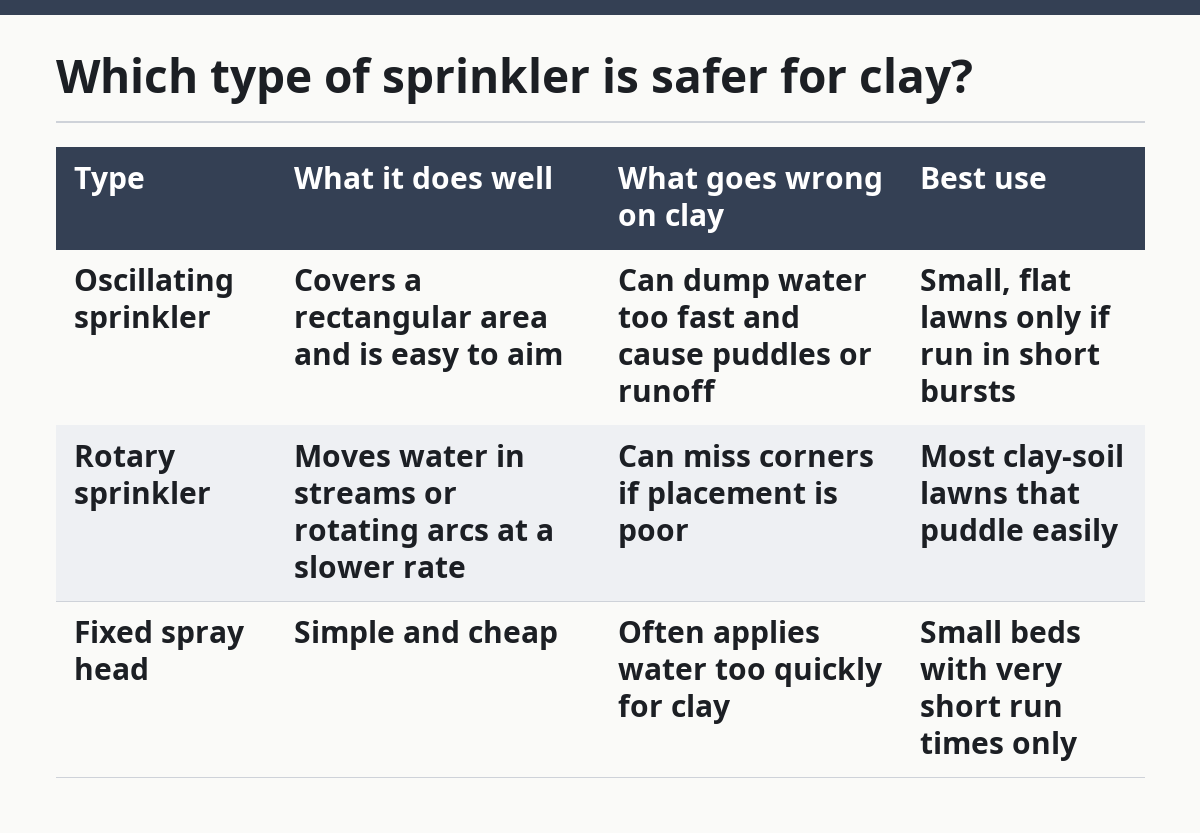
The main reason rotary tends to win is time. Clay soil usually needs a slower application rate, and rotary patterns are better at stretching the watering out. If the yard has narrow strips, an oscillating sprinkler can still make sense, but it should be used in shorter runs and watched closely for pooling.
A fixed spray head is the wrong tool for many clay lawns because it can put out water faster than the soil can absorb it. That means more runoff, less deep watering, and a wetter sidewalk or driveway.
How do I stop puddles on clay soil?
You stop puddles on clay soil by watering in short cycles, watching where the water goes, and cutting the run time before the surface starts shining. The method matters as much as the sprinkler.
Use this sequence:
- Start with a short run, not a full watering session. Run the sprinkler for a brief period, then stop and check the surface. Clay often shows trouble early, so you do not need to wait 30 minutes to see it.
- Look for runoff at edges and low spots. If water starts moving toward a curb, path, or dip, the delivery rate is too high for that area.
- Pause long enough for absorption. Let the top layer drink in the water before starting again. This cycle and soak approach is the right fit for slow-draining ground.
- Repeat only as needed. If the surface is damp but not puddled, keep the next burst short. If standing water appears, shorten the next cycle.
- Adjust the sprinkler placement before you lengthen the run. Moving the sprinkler a little or changing the arc can fix a wet strip without adding more water.
The whole point is to keep the soil from crossing from “moist” into “saturated.” A shallow puddle may look harmless, but it usually means the root zone is getting less oxygen and the water is not moving downward as it should.
As a result, people sometimes make a bad trade: they see a dry patch and assume they need more minutes. On clay, that often creates two problems at once, one wet and one dry. The wet area gets soggy, and the dry area still does not receive water evenly.
What setting should you look for first?
You should look for a sprinkler that can be run in cycle and soak mode or can be manually interrupted in short bursts. That feature matters more than a long list of extras. On clay, the watering pattern matters more than the brand name on the box.
A basic way to think about the choice is this:
- If the yard puddles quickly, choose rotary first.
- If the yard is small and rectangular, an oscillating sprinkler can work, but only with short cycles.
- If the soil is compacted, avoid anything that throws water hard and fast.
A hose-end timer can help because it makes short runs easier to repeat, but the timer is not the main fix. The main fix is still the delivery pattern. If the sprinkler applies water too fast, a timer only helps you stop the damage sooner.
A rotary sprinkler is often the better fit for clay lawns because it stretches the watering across time. An oscillating sprinkler can still be useful for a square patch, but it is more likely to need a short 5-minute run followed by a pause than a single long session. The exact number is less important than the reaction of the soil.
If the lawn is on clay and the water beads up after a few minutes, that is a sign to slow down. If the soil darkens evenly and does not glisten, the setting is closer to right.
What mistakes cause runoff on clay soil?
Runoff on clay soil usually comes from applying water too fast, watering too long, or ignoring compacted ground. Those mistakes cost you water, create muddy patches, and leave roots with less moisture than the surface suggests.
The most common errors are simple:
- Using a high-output pattern because it covers fast. The cost is puddling and waste. Use a slower pattern instead.
- Running one long session. The cost is water that never sinks in. Break the watering into cycles.
- Leaving a sprinkler in one place over a compacted patch. The cost is runoff from one area and dryness in another. Shift the placement or shorten the bursts.
- Ignoring the first signs of sheen or pooling. The cost is standing water before the lawn looks “done.” Stop earlier.
- Choosing coverage over absorption. The cost is a wet surface and a dry root zone. Match the output to the soil first.
Clay soil punishes the wrong kind of confidence. A sprinkler that looks strong is not automatically better. In fact, the strongest-looking spray is often the worst fit for slow-draining ground.
There is one more trap: watering again too soon because the top looks dry. Clay can hide moisture below the surface. If the top inch dries while the lower layer is still wet, adding more water can turn the same area into sludge. That is why short bursts plus a pause work better than back-to-back watering.
For deeper background on soil intake and irrigation behavior, the USDA Natural Resources Conservation Service and university extension guides on infiltration and irrigation scheduling are worth reading, including NC State Extension’s irrigation scheduling resources and the University of California Agriculture and Natural Resources lawn watering guidance.
How do you test if the sprinkler is the right match?
You test the match by watching the soil response during a short run, not by guessing from the sprinkler label. The right sprinkler is the one that leaves the surface damp without creating a slick, shiny layer or water moving downhill.
Use a simple check:
- Start with a short watering burst.
- Watch one clay-heavy spot and one normal spot.
- If the clay spot glistens or pools before the other area is evenly damp, slow the application.
- If the water disappears cleanly and the soil darkens without standing water, the setup is closer to right.
A basic rain gauge or a flat container can help compare how much water lands in one area versus another. The exact amount is less important than the spread. Uneven delivery on clay is a warning sign, because one heavy pass can cause runoff before the rest of the yard catches up.
For example, this is also where an oscillating sprinkler often shows its limits. It can put a lot of water into the same strip if the sweep is too slow or the placement is off. A rotary sprinkler usually spreads the load more gently across the lawn, which is why it often works better for clay.
If the yard is small and the sprinkler must stay put, keep the bursts short and accept that the job may take more than one cycle. That is not a flaw; it is the soil telling the truth about what it can absorb.
What should a clay-soil buyer choose first?
A clay-soil buyer should choose a rotary sprinkler first unless the area is small, flat, and easy to water in short bursts. That is the simplest answer and the one least likely to puddle.
The decision chain is straightforward:
- Clay soil that puddles easily points toward slower application.
- Slower application points toward rotary instead of fast spray.
- If the area is rectangular and small, an oscillating sprinkler can still work with cycle and soak.
- If standing water appears, shorten the run before you change anything else.
This is not the page for slope, hot dry weather, or water pressure. Those change the decision in other ways, and they deserve their own guide. For this page, the key is slow intake and runoff control.
The safest choice is usually the one that gives the soil time to absorb each pass. On clay, that usually means a rotary sprinkler, short watering bursts, and a willingness to stop before puddles start.
FAQ
Why does clay soil puddle when watered?
Clay soil puddles when watered because it takes in water slowly and holds it near the surface. The tiny particles pack tightly, so water moves down more slowly than it does in looser soil. When the sprinkler applies water faster than the ground can absorb it, the extra water collects on top.
What sprinkler works best on clay soil?
A rotary sprinkler usually works best on clay soil because it applies water more slowly and evenly than an oscillating sprinkler. That slower delivery gives the soil time to absorb the water instead of pushing it into puddles or runoff. If the area is small and rectangular, an oscillating sprinkler can still work with short cycles.
How do I stop runoff on clay soil?
You stop runoff on clay soil by watering in short bursts, pausing between cycles, and shortening the run as soon as the surface starts to shine. A cycle and soak approach is the most reliable fix. If water still moves off the lawn, the sprinkler is putting out water too quickly for that spot.
How long should a clay-soil watering burst be?
A short burst is usually best, and this article uses 5 minutes as a practical starting point. That gives you a quick read on whether the soil is absorbing water or starting to puddle.
Should I use an oscillating sprinkler on clay?
Yes, but only if you can keep the runs short and pause between cycles. An oscillating sprinkler can work on a small, flat lawn, but it is less forgiving than a rotary sprinkler on slow-draining soil.
What is the clearest sign that I need to slow down?
The clearest sign is a shiny surface, pooling, or water moving toward a curb or low spot. Those signs mean the application rate is too high for the soil.
Drafted with AI; not yet reviewed by a person.

Leave a Reply