Last updated: November 29, 2026
How to Choose a Sprinkler for Sandy Soil Without Runoff
Quick Answer: For how to choose a sprinkler for sandy soil without runoff, start with a low-application sprinkler and use 2 to 3 short cycle-and-soak passes of 5 to 10 minutes each. Sandy soil takes water in fast, so a nozzle that throws water too quickly can push moisture below the root zone or send it off the surface before it can soak in.
Key takeaways
- Sandy soil needs slower delivery, not just more water.
- A sprinkler nozzle with a low application rate is the first filter to use.
- Cycle and soak matters because one long run often wastes water on fast-draining ground.
- The best setup is often the one that keeps water on the soil long enough to soak in, not the one that looks strongest.
- If the ground seals over or puddles, the application rate is too high for that spot.
What matters most on sandy soil?
Sandy soil needs a sprinkler that delivers water slowly enough for infiltration to keep up. The main number to watch is the application rate, not the spray pattern alone. If water lands faster than the soil can take it in, runoff starts even on ground that looks dry.
A beginner often shops by shape first: rotor, spray, or drip-style. On sandy ground, the better first question is how hard the nozzle throws water. A wide fan can still work if the output is low, while a strong stream can fail even on a small patch.
The job of the sprinkler is simple: wet the root zone without flooding the top layer. Sandy soil drains quickly, but it still has a limit. Once the surface cannot absorb the next pass, the extra water moves away from the target area.
A good match usually favors lower output over high throw. That can mean a spray nozzle set for gentle delivery, a rotor with a slower rate, or a system that lets you split watering into shorter runs. The right choice is the one that gives the soil time to catch up.
For more on the bigger selection process, the hub guide to how to choose a sprinkler can sit above this page. This article stays on sandy soil and runoff control.
How does sandy soil change the choice?
Sandy soil changes the choice because it absorbs water quickly at first, then loses it quickly if you pour too much at once. That means a low application rate is usually the better fit for the area, not the one with the largest spray or the strongest throw.
A generic lawn guide often talks about coverage and uniformity. Those matter, but sandy ground puts more pressure on timing. If the nozzle puts down water faster than the soil can take it in, cycle and soak becomes part of the design, not an optional trick.
This is where many setups go wrong. A person sees dry grass, opens the faucet, and assumes a longer run will help. On sandy soil, a long continuous run can push water past the roots before the top layer has a chance to drink.
The practical rule is plain: match the nozzle to the soil’s intake speed, then use shorter watering cycles. A soil that drains fast does not need a brute-force spray. It needs measured delivery, often in 2 or 3 passes, with a pause between them.
That is also why a “more powerful” head is not always the better choice. More pressure can make the pattern look stronger, but strength is not the same as fit. For sandy soil, the fit comes from slower delivery and better timing.
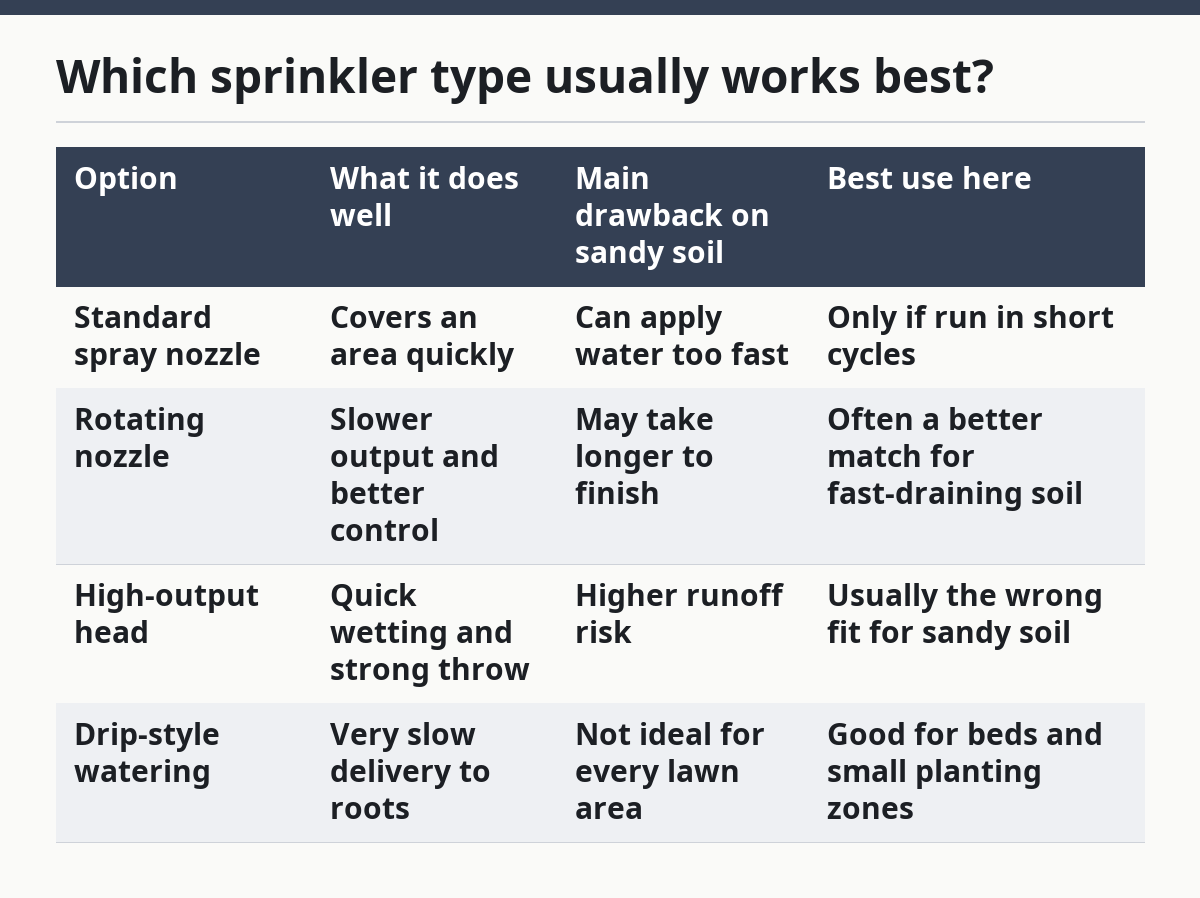
Which sprinkler type usually works best?
A sprinkler with a low application rate usually works best for sandy soil, especially one that can be run in short cycles. Spray nozzles, rotating nozzles, and other low-output heads can all fit the job if the output stays gentle enough for the soil.
Here is the useful comparison:
| Option | What it does well | Main drawback on sandy soil | Best use here |
|---|---|---|---|
| Standard spray nozzle | Covers an area quickly | Can apply water too fast | Only if run in short cycles |
| Rotating nozzle | Slower output and better control | May take longer to finish | Often a better match for fast-draining soil |
| High-output head | Quick wetting and strong throw | Higher runoff risk | Usually the wrong fit for sandy soil |
| Drip-style watering | Very slow delivery to roots | Not ideal for every lawn area | Good for beds and small planting zones |
A rotating nozzle is often the safer starting point for sandy soil because it tends to spread water more slowly than a fast spray. That slower pace gives the soil time to absorb each pass. It also fits the cycle-and-soak method better than a head that dumps water quickly.
A standard spray nozzle can still work if the area is small and the watering runs are split up. The problem is not the label on the package. The problem is the output rate. A spray that is too aggressive can still run off even when the area is level.
High-output heads are the least friendly choice for sandy ground. They are built for speed, and speed is exactly what causes trouble here. If the lawn slope is even slight, the wasted water shows up fast.
Drip-style watering is worth mentioning because it solves the same intake problem in another way. It is slow by design. It is not the answer for every lawn zone, but for planting beds near sandy soil, it can be a clean fit.
What setting should the nozzle have?
The nozzle should be set for the lowest application rate that still wets the target area evenly. That usually means choosing a gentler nozzle design, then adjusting the pattern so water lands where roots can use it instead of on paths, driveways, or bare edges.
The setting matters because runoff often starts at the edge, not the center. A head aimed too wide sends water onto hard ground first, and that water leaves the zone before sandy soil can catch up. A tighter, better-aimed pattern often wastes less than a bigger one.
Think in terms of delivery, not drama. A hard-looking spray can still leave dry strips and wet gullies. A calmer pattern can cover the same area in a way the soil can actually hold.
If the nozzle offers multiple choices, start with the one that lowers output rather than the one that increases distance. Then watch the surface during the first run. If water beads or starts moving sideways in under a few minutes, the setting is still too aggressive for that patch.
The useful test is simple: the ground should look evenly damp, not shiny or striped with moving water. On sandy soil, a modest setting is often the one that disappears into the soil at the pace the soil can accept.
How do cycle and soak stop runoff?
Cycle and soak stops runoff by breaking one long watering period into shorter rounds, usually 2 or 3, with pauses in between. The pause gives sandy soil time to pull water down before the next round starts.
This method matters because even fast-draining soil has a surface limit. If the sprinkler keeps going without a break, the top layer can get saturated for a moment and then shed the rest. A short pause clears that bottleneck.
A simple way to use it:
- Run the sprinkler for a short first cycle, such as 5 to 10 minutes, and stop before the surface starts to move water downhill.
- Wait long enough for the shine on the soil to fade, often 10 to 20 minutes, so the top layer can accept more.
- Run a second short cycle of the same length, then inspect the zone again.
- Add a third cycle only if the soil still absorbs cleanly and the target area is not already dark and even.
- Keep the pattern the same each time so the water lands in the same places and the soil can take it in evenly.
The exact minutes can change with the nozzle, slope, and wind, so the visible cue matters more than the clock. The goal is not to soak everything at once. The goal is to give the soil repeated small chances to absorb.
This method is one of the few tools that helps even when the lawn size stays the same. The soil, not the square footage, decides whether a single long run will work. For context, the U.S. EPA WaterSense program also recommends watering in shorter cycles on some landscapes when runoff starts before the soil can absorb water.
What mistakes cause runoff?
The most common mistake is choosing a sprinkler for coverage instead of intake speed. That usually leads to a nozzle that applies water too quickly, which costs water and leaves the roots with less moisture than expected.
Another mistake is running one long cycle because the surface still looks dry halfway through. Sandy soil can fool the eye. The top may stay pale while deeper layers are already getting enough water, so more time does not always mean better watering.
A third mistake is aiming for distance over control. A strong spray that reaches farther can also put water on pavement, mulch, or bare edges. That water does not help the lawn, and it often becomes runoff within minutes.
A fourth mistake is skipping the pause between cycles. Without the break, the second pass lands on a surface that has not had time to absorb the first one. The result is the same as using a faster nozzle, just in two steps.
The fix is boring but effective: slow the application rate, shorten the run, and give the soil time to catch up. Sandy ground usually rewards restraint more than force. The USDA NRCS notes that sandy soils have large particles and large pore spaces, which is why they drain quickly and need careful timing.
How do I pick one in the store?
Pick one by reading for application rate first, then checking whether it can be used in short watering cycles. If the package or product sheet describes a gentle output, rotating action, or low-flow delivery, that is usually a better sign than a bigger spray radius.
Look for a nozzle that seems built for control, not speed. If the choice is between a fast-filling head and a slower one, the slower option is usually the safer pick for sandy soil. That is true even when both can cover the same lawn.
A useful store rule is to ask one question: can this head water without forcing runoff in 1 continuous pass? If the honest answer looks doubtful, it is probably not the right fit for fast-draining ground. The better choice is the one that pairs with cycle and soak from the start.
Do not buy based only on lawn size or the promise of “more coverage.” Those matter on other pages of the sprinkler decision, but this page is about soil intake speed. Sandy soil makes output rate the first filter.
If a label or spec sheet mentions low application or slower delivery, that is the feature to favor. If it mentions aggressive output, that is a warning sign. The safest choice is often the one that looks modest on paper but matches the soil. For product-level guidance, check manufacturer specs and local extension advice before buying.
Why does this matter more than pressure alone?
Pressure matters, but on sandy soil the delivery rate matters more. A nozzle can have plenty of force and still be a poor fit if it applies water faster than the ground can absorb it.
That is why a pressure-only decision often misses the real problem. The same lawn size can behave differently depending on soil intake. Sandy soil needs a slower, gentler approach even when the water supply feels strong enough.
The practical result is simple: choose the head that lets you water in short rounds without flooding the surface. That is the choice that helps the roots and avoids waste. For irrigation basics, the Irrigation Association and local extension offices both emphasize matching application to the landscape, not just the pressure at the tap.
Why does water run through sandy soil?
Water runs through sandy soil because the particles are large and leave wide gaps between them. Those gaps let water move down quickly, so the surface can accept water fast at first but also lose it fast if the output is too high.
What sprinkler is best for fast-draining soil?
A low-application nozzle is usually best for fast-draining soil. A rotating nozzle or another slow-delivery head often fits better than a standard fast spray because it gives the ground time to absorb each pass.
How do I water sandy soil evenly?
Water sandy soil evenly by using short cycle-and-soak runs and aiming for a low, steady application rate. The first pass wets the surface, the pause lets it sink in, and the next pass finishes the job without pushing water away from the roots.
Drafted with AI; not yet reviewed by a person.

Leave a Reply