Last updated: November 29, 2026
Quick answer: aim for head-to-head coverage, where each sprinkler head reaches the next head’s position, so the spray patterns meet and leave no dry strip between them. In practice, sprinkler coverage overlap means the edges of the spray patterns meet around the next head rather than stopping short in the middle of the run. Too little overlap leaves dry strips, and too much overlap can make borders wetter and waste more water.
Key takeaways
- The safest target is usually head-to-head coverage, where one head reaches the next head’s position.
- Dry bands between heads usually mean the spacing is too wide or the spray pattern does not match the layout.
- Edge coverage needs special attention because borders dry out first.
- A simple walk-through can show weak overlap faster than any guess from the package.
- The right answer is not “as much as possible.” It is “enough to close the gaps without soaking the same strip over and over.”
How much overlap is enough?
Therefore, enough overlap is when the spray from one head reaches the next head’s base and the next head reaches back, creating a continuous wet pattern across the coverage area. In practical terms, that means the watering pattern should touch from head to head instead of stopping short in the middle of the open space.
This is the core idea behind sprinkler coverage overlap. A single spray pattern can look fine on paper and still miss the middle of the lawn once wind, pressure swings, and nozzle shape get involved. The goal is not just to wet a circle or fan shape; the goal is to avoid dry gaps across the whole run.
A good mental test is simple: if one head can water the spot where the next head sits, and the next head can do the same in return, the spacing is in the right range for uniform watering. If the sprays stop several feet short, the center strip between heads is at risk of drying out.
Because of that, this rule matters more than chasing a perfect number. Different sprinkler heads, spray patterns, and coverage areas behave differently. A 90-degree corner head, a 180-degree edge head, and a 360-degree center head do not all cover the same way, so the overlap has to match the pattern, not just the shape of the yard.
According to EPA WaterSense and the Irrigation Association, even distribution and matched output matter more than simple throw distance; that is the logic behind head-to-head spacing. The exact setup still depends on the sprinkler head and spray pattern, which is why the package alone is never enough.
What is head-to-head coverage?
Head-to-head coverage means each sprinkler head throws water far enough to reach the next head’s location. It is the basic spacing standard that helps keep the whole coverage area wet at a similar rate.
So, think of it as a chain rather than separate circles. Each head covers its own zone and also overlaps the edge of the next one by enough that the middle does not fall into a dry band. That overlap is what makes the lawn look evenly watered instead of striped.
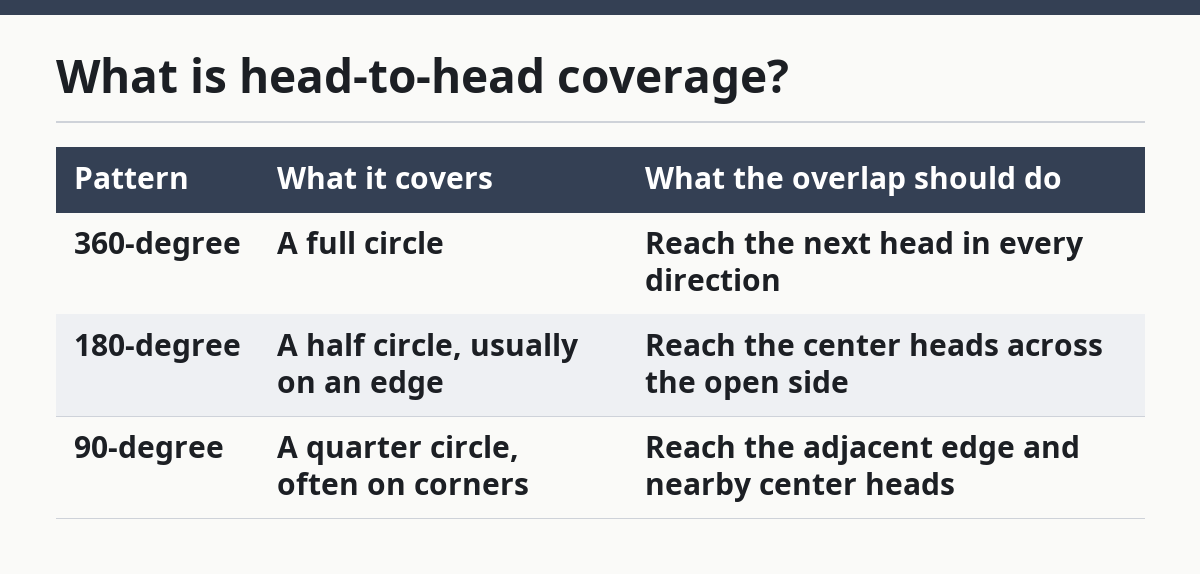
Here is the difference between the main patterns, but for layout decisions it is smart to confirm the spacing with a pro or with the manufacturer’s design guide:
| Pattern | What it covers | What the overlap should do |
|---|---|---|
| 360-degree | A full circle | Reach the next head in every direction |
| 180-degree | A half circle, usually on an edge | Reach the center heads across the open side |
| 90-degree | A quarter circle, often on corners | Reach the adjacent edge and nearby center heads |
For example, this is where many generic guides go wrong: they treat every head as if it should cover the same distance in the same way. A corner head does not need the same full-circle behavior as a center head, but it still needs enough throw to meet the next spray pattern.
Head-to-head spacing also helps with small changes in pressure. If the system runs a little weak, the overlap gives the lawn a buffer. If the system runs a little strong, the extra water does not create a dead zone in the middle. That is the point of the standard.
How do I set spacing?
Next, set spacing by placing each head so its spray reaches the next head’s position, then check the overlap across the entire run before you lock in the layout. The cleanest way is to work from the spray pattern first and the spacing second, not the other way around.
Use this simple procedure:
- Mark the coverage area and note where the edges and corners sit. A straight run, a corner, and a border usually need different head types.
- Choose the spray pattern that matches that spot, such as 90 degrees, 180 degrees, or 360 degrees. That keeps the water aimed where it belongs instead of throwing it into a fence or path.
- Place the next head far enough away that the spray from the first head reaches it. If the streams stop short by a visible gap, the spacing is too wide.
- Check the run from both sides. The overlap should meet in the middle of the gap, not just barely touch at one edge.
- Walk the line again after the system runs. If one strip looks pale or dry, the spacing or spray pattern needs to change before the area goes live.
Because of that, a tape measure can help with layout, but the real test is whether the spray patterns meet in the same place all along the run.
One useful rule is to keep the spacing consistent within the same pattern type. Mixing a tight 90-degree corner with a wide 360-degree center head can create a wet patch next to a dry strip if the overlap does not match. Uniform spacing makes uniform watering much more likely.
This is also the right place to mention the hub topic: if the spacing question is part of a larger decision about how to choose a sprinkler, the overlap rule is one part of that choice, not the whole thing. The model has to match the area, then the spacing has to match the model.
What does edge coverage need?
However, edge coverage needs more care than center coverage because borders dry faster and get less help from nearby heads. A head at the edge usually has to throw water across an open side, so the overlap has to come from the adjacent heads, not from the outside of the lawn.
That means edge heads should not be placed as if they were center heads. A 180-degree head on a border needs enough reach to meet the nearest center head. A 90-degree head in a corner needs enough reach to meet the two adjacent heads without spraying half the water onto pavement or a fence.
This is where waste shows up fast. If the edge head is set too hard or too wide, overspray lands outside the coverage area. If it is set too weak, the border turns dry first. The overlap has to be balanced so the edge gets enough water without pushing the spray past the lawn.
A simple sign of weak edge coverage is a pale strip near a sidewalk, curb, bed edge, or fence line while the middle still looks fine. That pattern usually points to poor overlap, not just a thirsty patch. If the edges are wet but the center is dry, the heads are either too far apart or pointed the wrong way.
Accordingly, edge coverage is also where a reader sees the trade-off most clearly: more overlap can fix a dry edge, but it can also create a wetter border. The right move is to close the gap with the correct head type and placement, not to flood the line.
What are the signs of poor overlap?
Therefore, poor overlap shows up as dry strips, patchy color, and corners that look different from the rest of the lawn. The lawn may also show wet arcs near the heads and a dry band in the middle, which is the classic sign that the spray patterns do not meet.
The most common signs are easy to spot:
- A strip of grass between two heads dries out first.
- One side of a run stays green while the opposite side fades.
- Corners look thinner than the middle of the same zone.
- Water lands on hardscape instead of filling the coverage area.
- Two heads in a row seem to wet the same spot while the next strip stays dry.
These signs tell a different story than “the lawn needs more water.” A dry band between heads usually means distribution is uneven, not that the zone needs a longer run time. If the overlap is wrong, adding more minutes can make the wet spot wetter and the dry spot only slightly less dry.
A better fix is to inspect the pattern, not just the timer. Check whether the head-to-head spacing matches the spray pattern, whether the nozzle is aimed correctly, and whether a corner or edge head should be a different type. Small layout errors can create big visual differences across a short span.
Common mistakes that waste water
Meanwhile, the biggest mistake is chasing coverage by adding more runtime instead of fixing the overlap. That wastes water because the wet areas get wetter while the dry gaps still stay dry. It also hides the real problem until the lawn gets worse.
Another common mistake is using the same spacing rule for every head. A 360-degree center head, a 180-degree edge head, and a 90-degree corner head do not behave the same way, so a one-size layout can leave gaps or overspray. The cost is either dry strips or water thrown outside the coverage area.
A third mistake is trusting the circle on the box more than the actual spray on the ground. Package numbers are not the same as real-world coverage after pressure changes and placement quirks. If the spray does not reach the next head, the area is not evenly watered, no matter what the label suggests.
A fourth mistake is ignoring the outside edge of the zone. Borders dry out first, so weak edge coverage often looks like a lawn problem when it is really a spacing problem. Fixing the edge can make the whole zone look better without changing the rest of the layout.
When this is done well, the result is not flashy. It is simply even watering with fewer dry spots and less runoff. That is the standard worth aiming for.
How do I judge overlap before I buy?
Before you buy, judge overlap by matching the spray pattern to the coverage area and checking whether the heads can reach each other’s positions, not by guessing from a catalog photo. If the head type, pattern, and spacing work together, the lawn is far more likely to water evenly.
A good comparison helps here:
| What to compare | Better choice | Why it helps |
|---|---|---|
| Spray pattern | One that matches the spot: 90, 180, or 360 degrees | Reduces stray water and improves overlap |
| Spacing | Head-to-head | Closes dry gaps between sprinklers |
| Edge layout | Dedicated edge or corner heads | Improves border coverage |
| Fix method | Change spacing or head type | Better than adding time to the timer |
So, a sprinkler with a longer reach is not automatically the better choice if the layout still does not support even watering. Overlap is a layout question first and a hardware question second.
One reliable outside reference point is the EPA WaterSense program, which stresses efficient outdoor watering, and the Irrigation Association, which focuses on matched precipitation and uniform distribution in irrigation practice. Those ideas point to the same thing: a system should water the whole area evenly, not just spray farther.
FAQ
What is head-to-head coverage in irrigation?
Head-to-head coverage means each sprinkler head throws water all the way to the next head. It is the spacing rule that helps prevent dry strips between spray patterns. In practice, the spray from one head should reach the next head’s position, and the next head should do the same back.
How much overlap do sprinklers need?
Sprinklers need enough overlap to close the gap between heads without leaving a dry band in the middle. The usual target is head-to-head coverage, where the spray patterns meet. If the patterns only touch at the edge or stop short of the next head, the spacing is too wide for even watering.
Why are there dry spots between sprinklers?
Dry spots between sprinklers usually mean the overlap is too weak, the heads are spaced too far apart, or the spray pattern does not fit the layout. A dry strip is often a distribution problem, not just a watering-time problem. More minutes may wet the good parts, but it rarely fixes the gap by itself.
Is more overlap always better?
Not always; more overlap can create wetter borders and more water waste if the heads are already close enough. The goal is enough overlap to make the coverage area even, not so much that the same strip gets soaked again and again. A balanced layout beats a crowded one.
What should I check first if the lawn waters unevenly?
Overall, check the spray pattern, the spacing, and the edge coverage first. Those three things explain most dry-strip problems. If the heads do not reach each other or the corners are under-covered, the timer is usually not the real issue.
Drafted with AI; not yet reviewed by a person.
Leave a Reply