
Last updated: November 28, 2026
Quick Answer: choose 1 sprinkler that makes a fine, even spray at low pressure and keep the first watering light enough to dampen the seedbed without making it shine with runoff. For new grass seed, that usually means an oscillating sprinkler set low, a mist nozzle used carefully, or a sprinkler head that can throw a soft pattern instead of hard streams. This article explains how to choose a sprinkler for new seed without washing it away.
What sprinkler is safest for new seed?
For new seed, the safest choice is usually the one that wets the soil gently and evenly, not the one that throws water the farthest. A sprinkler for new seed should keep the top layer of soil moist while the seed is germinating, because bare seed has no roots to hold it in place.
A sprinkler head with a fine spray pattern is usually easier to control than a hard jet. An oscillating sprinkler can work well on small, flat areas because it lays down water in a broad, soft sheet. A mist nozzle can be useful for tiny patches, but it can also drift in wind and evaporate fast, so it is better for short, careful runs than for large lawns. The EPA WaterSense program also advises using efficient watering habits, and local extension offices can help if you need site-specific guidance.
The wrong choice is usually anything that sends out heavy drops or strong streams. Those patterns can move seed, carve little channels in the soil, or puddle in low spots. If the soil surface starts to crust, the seed may stay too dry underneath even while the top looks wet.
For a reader comparing options, the simplest test is this: if the spray looks like rain, it is closer to what new seed wants. If it hits the ground like pebbles, it is too harsh.
What spray pattern should you look for?
A fine, even spray is the right pattern because it slows the water down before it hits the seedbed. In practice, that means a pattern that spreads water across the area without making visible streams or strong arcs.
Look for a sprinkler head or nozzle that can be aimed low and adjusted to soften the spray. A wide, fan-like pattern is easier to manage than a narrow blast, especially when the seed is still sitting on the surface. On small jobs, a mist nozzle can seem gentle, but it can also be too light if the wind picks up or if the area dries fast.
Here is the trade-off in plain language: finer spray is safer for seed movement, but too much mist can fail to soak the top layer far enough down. That means the surface looks wet, then dries out before the seed has a chance to stay moist through the day. A soft spray that reaches the soil is better than a cloud of droplets that vanishes.
A useful rule is to choose the gentlest pattern that still wets the seedbed evenly. If one side of the patch dries much faster than the other, the spray is probably uneven or the head is aimed too high.
| Option | Best use | Main advantage | Main drawback |
|---|---|---|---|
| Oscillating sprinkler | Small to medium flat areas | Soft, broad coverage | Can miss edges if the area is oddly shaped |
| Mist nozzle | Tiny patches or touch-up spots | Very gentle at short range | Wind drift and fast evaporation |
| Adjustable sprinkler head | Fixed beds or precise zones | Spray can be tuned to the space | Too much pressure can still wash seed |
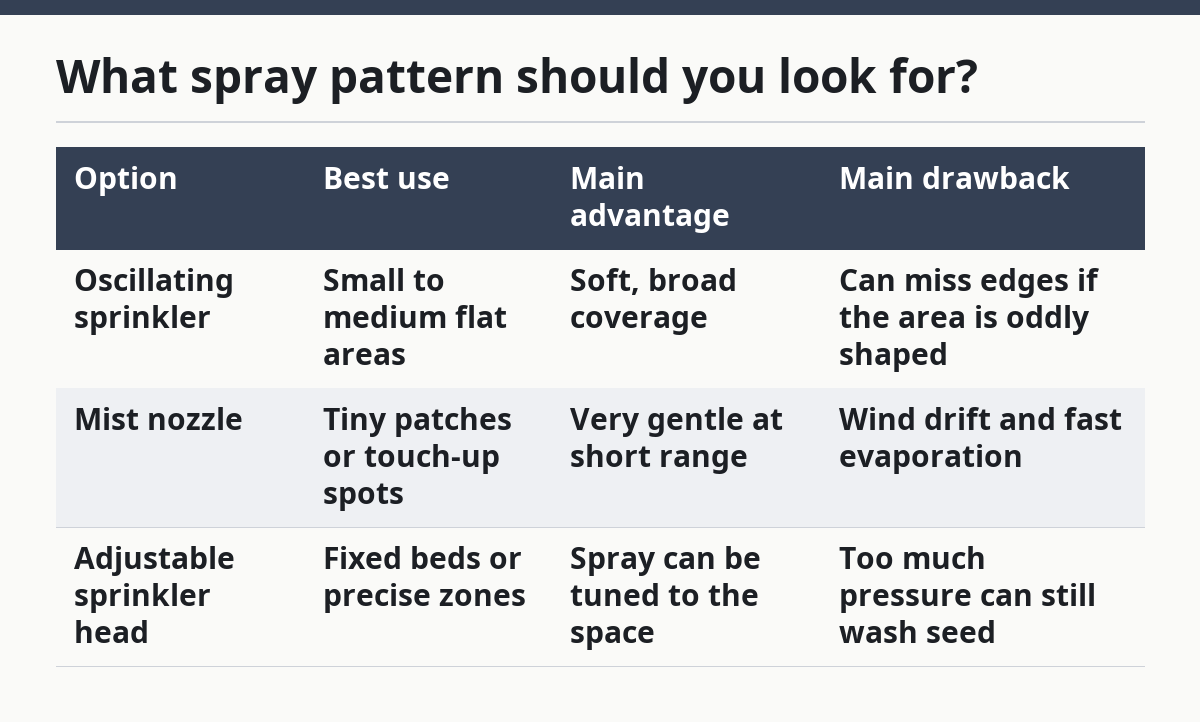
For a quick starting point, think “soft rain,” not “pressure washer.” University extension guides on lawn establishment generally say the same thing: keep the top layer moist and avoid runoff.
How do you set run time without washing seed away?
Set run time in short bursts so the soil gets damp before water starts pooling or running downhill. The goal is not a deep soak on day one; the goal is to keep the seedbed evenly moist at the surface.
Start with a brief cycle, then stop and look at the ground. If water is sitting in shiny patches, the run time is already too long. If the top layer dries to dust within a short time, the cycle may be too short or too far apart. A few short rounds are better than one long blast because they give the soil time to absorb water between runs.
The exact run time depends on soil, slope, and the sprinkler pattern, so there is no honest one-size answer. Clay soil holds water longer and can seal over faster. Sandy soil drains quickly, so it may need lighter but more frequent watering. Sloped ground is the hardest case because water moves downhill before it sinks in.
A practical way to think about it is this: the first run should wet the surface, not flood it. If the seed floats, gathers in lines, or leaves muddy streaks, the water is too heavy. If the surface never darkens at all, the watering is too light to help germination.
How often should you water new seed?
New seed should be watered often enough to keep the top layer from drying out between waterings. That usually means checking the seedbed more than relying on a fixed calendar, because weather, soil, and sun change the drying speed.
The seedbed should stay evenly moist, not soggy. If the top dries out completely even once during germination, some seed can stall or fail. If the soil stays muddy all day, the watering is too frequent or too heavy.
A simple schedule is to water in short sessions and recheck the surface later the same day. On hot or windy days, the soil can dry faster than expected. On cloudy or cool days, it stays damp longer, so a full repeat may not be needed. The point is to watch the soil, not the clock alone.
This is where a fine spray helps most. It lets the soil take on moisture in small steps, which is safer than trying to force the whole area wet at once. A mist nozzle can fit this job on a tiny patch, but it can also encourage too-frequent touching up because it seems gentle while delivering little water. The better habit is to look at the seedbed and confirm that moisture has reached the surface evenly.
For new grass seed, the correct answer is not “once a day” or “every hour.” The correct answer is “as often as the surface starts to lose moisture.”
Which mistakes wash seed away?
The biggest mistakes are too much pressure, too much water at once, and uneven coverage. Each one costs you seed in a different way, but the fix is usually the same: soften the spray, shorten the run, and watch the soil instead of guessing.
Strong streams move seed into piles or bare strips. Heavy runoff carries seed to the low end of the bed, where it clumps and germinates unevenly. Puddling can also compact the surface, which makes it harder for tender shoots to push through. On the other side, a spray that is too fine can disappear before it reaches the soil, which leaves the seed dry even though the air around it feels moist.
Wind is another common problem. A mist nozzle can be gentle on paper and still fail outdoors because the spray drifts away from the bed. That is why a sprinkler head with an adjustable pattern is often a safer choice than an ultra-fine spray on an open, breezy space.
The fix is not to crank the water harder. It is to reduce the blast, break the watering into shorter cycles, and check where the water actually lands. If the soil stays in place and darkens evenly, the setup is close. If seed lines appear or little gullies form, the spray is still too rough.
How do I choose between an oscillating sprinkler, mist nozzle, and sprinkler head?
Choose an oscillating sprinkler for a small, flat lawn area, a mist nozzle for tiny touch-up spots, and an adjustable sprinkler head when you need the spray shaped to one zone. The right tool depends more on the surface shape and wind than on the seed itself.
An oscillating sprinkler is a strong general choice because it spreads water over a broad rectangle with a soft motion. It is easy to set down and leave on a low setting, which makes it useful for new grass seed in a simple layout. The downside is that it can waste water outside the bed if the space is irregular.
An oscillating sprinkler also fits the shape of many seedbeds better than a fixed stream. For a rectangle, the sweep is easy to place and easy to repeat.
A mist nozzle works best when the area is small and sheltered. It gives a very gentle pattern, but that gentleness can become a drawback if the wind moves the spray or if the soil dries too fast. It is not the best choice for a whole lawn.
An adjustable sprinkler head gives more control over direction and spread. That control helps when you want to keep water off sidewalks, driveways, or bare edges. The trade-off is that it is easier to set too aggressively, so the spray must stay soft.
If the site has a simple shape and the weather is calm, an oscillating sprinkler is often the easiest answer. If the patch is tiny, a mist nozzle can be enough. If the bed needs precise aim, a sprinkler head with a gentle setting is the better fit.
What should you check before you turn it on?
Check the soil surface, the slope, and the spray shape before you start watering. A quick look saves seed, because a poor setup can wash the bed in the first few minutes.
Before you turn on the water, make sure the seed is settled into the top layer and not sitting in loose piles. If the surface is very dry and dusty, a hard first watering can move the seed before it has a chance to settle. Second, look for low spots where water may gather. Those spots may need shorter runs than the rest of the area. Third, watch the spray path. If the water reaches the sidewalk more than the seedbed, the angle is wrong.
This is also the time to think about the soil type. Clay holds water longer and can turn slick faster, so it needs a gentler touch. Sandy soil drains faster, so short watering cycles may need to happen more often. That is why the same sprinkler can work well in one yard and poorly in another.
If the goal is new seed, the best setup is the one that gives the bed a quiet, even drink. The sprinkler that works best is the one that does that with the least disturbance.
For a broader guide to the rest of the decision, the main article on how to choose a sprinkler covers the larger comparison and helps place this seed-specific choice in context. If you are also planning the yard layout, see how to water new grass seed and sprinkler types.
Key takeaways
- New seed needs a soft, even spray, not a hard stream.
- An oscillating sprinkler is a strong default for flat, simple areas.
- A mist nozzle is gentle but can drift or dry out too fast.
- Short watering cycles are safer than one long soak.
- If soil moves, puddles, or crusts, the spray is too aggressive.
- Watch the seedbed, because soil moisture matters more than the clock.
What sprinkler is safest for new grass seed?
For new grass seed, the safest choice is the one that makes a fine, even spray with low force. An oscillating sprinkler or an adjustable sprinkler head set to a soft pattern is usually safer than a hard stream because it is less likely to move the seed.
How gentle should watering be for seed?
Water should be gentle enough that the soil surface darkens without shifting, puddling, or forming channels. If the spray looks like heavy rain or creates shiny runoff, it is too strong for new seed.
How often should I water new seed?
Water often enough to keep the top layer from drying out, then stop before the soil turns muddy. The right timing depends on soil, slope, sun, and wind, so the seedbed should be checked directly instead of following only a fixed schedule.
Drafted with AI; not yet reviewed by a person.



Leave a Reply