
Last updated: November 27, 2026
Quick Answer: for most lawns, the right sprinkler choice starts with the yard’s footprint, then the spray pattern. For most lawns, that means a rotary sprinkler for larger open areas, an oscillating sprinkler for rectangles, an impact sprinkler for broad coverage, or a stationary sprinkler for small, simple patches. If the yard has more than one zone, treat each zone as a separate decision, and consult a professional if the zones are complex or the irrigation setup is not straightforward.
Key takeaways
- Start with size, shape, and zone layout before looking at features.
- Rectangles usually point to oscillating coverage.
- Bigger open areas usually point to rotary or impact coverage.
- A simple square is easier to serve than a yard with corners, curves, or multiple zones.
- If the front yard and back yard act differently, choose for each one on its own.
How to choose a sprinkler by lawn size, shape, and layout
The right choice comes from matching the spray pattern to the lawn’s shape and the number of zones, not from picking the most expensive model. A square front yard, a wide back yard, and a long side yard each need different coverage behavior, even if they sit on the same property. For a homeowner comparing options, the practical question is how to choose a sprinkler by lawn size, shape, and layout, not which model looks strongest.
- Measure the lawn with a tape measure to get the rough length and width of each zone, then note whether the space is a square, rectangle, or mixed shape. This tells you which spray pattern fits without obvious waste.
- Sketch the layout on paper and mark fences, patios, trees, and walkways, then divide the yard into front yard and back yard zones if they behave differently. A simple sketch can make the best type easier to see, but it may take longer than 10 minutes if the yard is irregular.
- Match the shape to the spray pattern by comparing the lawn to the coverage style of each sprinkler type. Oscillating works best for rectangles, rotary handles broader open areas, impact suits larger and less fussy zones, and stationary fits small, fixed spots.
- Check how many zones need watering and decide whether one type can cover each zone without repeated repositioning. A yard with two or three separate zones usually needs one choice for each, not one tool forced to do everything.
- Choose the simplest option that covers the full area without spraying hardscape, fences, or neighboring beds. A cleaner fit usually matters more than extra settings.
The main trade-off is that a more flexible spray pattern can cover more shapes, but it is not always the easiest answer for a plain yard. A stationary sprinkler is simple, but it is a poor fit for a broad lawn. A rotary model covers more area, but it can be overkill for a small front patch.
For a broader overview of the decision tree, the hub guide to how to choose a sprinkler can sit beside this page as the next step, but this article stays focused on size, shape, and layout.
What does lawn size change?
Lawn size changes the sprinkler choice because larger areas need a pattern that reaches farther without constant moving. A small patch may be handled by a stationary sprinkler, while a wide open lawn is usually better served by rotary or impact coverage.
A compact lawn with one simple zone is the easiest case. A stationary sprinkler can make sense when the area is small and fixed, because there is no need to cover long reaches or odd corners. That choice is not for bigger lawns, since the spray area is too limited to stay practical.
A medium lawn often points to oscillating coverage if the shape is rectangular. The back-and-forth spray fits that footprint well and is easy to understand at a glance. If the lawn is broader or more open, rotary coverage is usually the better fit because it is designed for larger reaches.
Large lawns usually push the decision toward rotary or impact styles. Rotary coverage is a good match when the area is broad and fairly even. Impact sprinklers can also suit larger open spaces, especially when the layout is simple and the user wants a pattern that can throw water in a more defined arc.
The wrong size match costs time. A sprinkler that is too small means repeated moves and dry patches. One that is too large for a tight zone can send water where it is not needed, which makes the layout harder to manage.
Which shape points to which type?
The shape points to the type because spray patterns are built for different outlines. A rectangle usually favors oscillating coverage, a square can work with oscillating or rotary coverage, and a broad open shape often fits rotary or impact coverage better than a fixed spray.
A square lawn is usually straightforward. If the sides are even and there are not many obstacles, oscillating and rotary are the first two patterns to compare. Oscillating makes sense when the square is more like a neat block with clear edges. Rotary makes sense when the area is larger and needs more reach.
A long rectangle is a classic oscillating case. The back-and-forth motion matches the geometry, so the pattern can cover the width without leaving the ends ignored. A stationary sprinkler is usually too limited for this shape unless the zone is very small.
A broad, open shape gives more room for rotary or impact coverage. These styles are better when the lawn has fewer hard turns and the main job is reaching across a wide span. If the shape is open but not neat, the choice often comes down to which pattern can cover the center without overshooting the edges.
Here is the quick comparison.
| Lawn size or shape | Best first match | Why it fits | Main drawback |
|---|---|---|---|
| Small, fixed patch | Stationary sprinkler | Simple and direct for limited areas | Poor fit for larger zones |
| Rectangle | Oscillating sprinkler | Matches straight edges well | Less suited to wide open layouts |
| Broad open area | Rotary sprinkler | Reaches farther across larger space | Can be more than a small yard needs |
| Large simple area | Impact sprinkler | Handles bigger zones with defined coverage | Not the simplest choice for tight spaces |
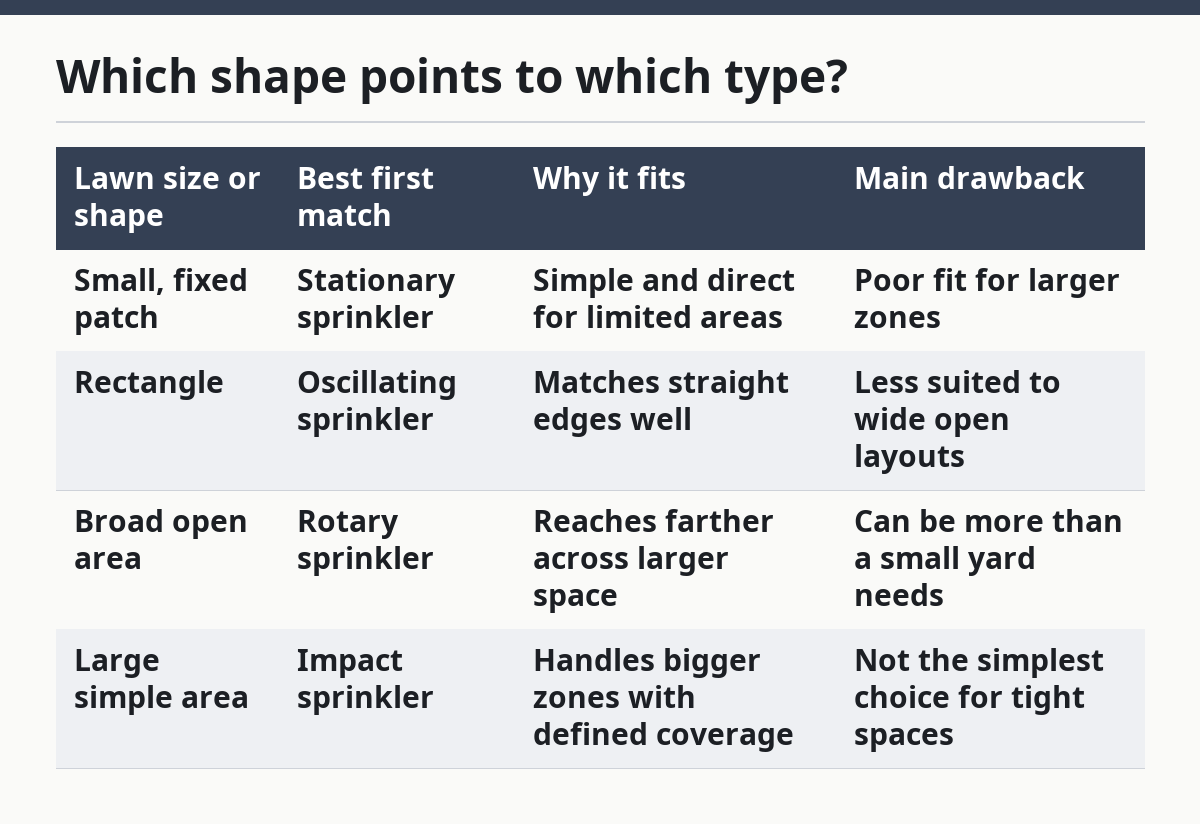
The shape is the part a generic article often skips, but it is the part that saves the most frustration. A yard can be “medium” by size and still behave like a long rectangle, which changes the best match completely.
How do front yard and back yard layouts change the choice?
Front yard and back yard layouts change the choice because each zone may need a different pattern, reach, or placement strategy. A neat front yard with one rectangle may point to oscillating coverage, while a wider back yard can point to rotary or impact coverage.
Many homes have one front zone that is small and one back zone that is larger. In that case, a single sprinkler type is often the wrong answer. A stationary sprinkler may suit the front yard if the space is compact, but the back yard may need something with more reach. A rotary model can solve the back yard while still being too much for the front.
A front yard also tends to have more visual edges to respect, such as sidewalks, driveways, and entry paths. That makes shape a bigger factor than raw size. A back yard may be more open, which can make rotary or impact coverage easier to live with.
This is where layout matters as much as size. A yard with one open zone is simple. A yard with a front zone, a back zone, and a separate side area is a three-part decision, not one. If each area gets the same type by default, at least one of them usually ends up awkward.
The honest limitation is that no single type solves every zone well. The right answer for the front yard can be the wrong answer for the back yard. That is not a failure of the product; it is a sign that the layout needs separate choices, and complex layouts may be worth discussing with an irrigation professional.
What does coverage pattern tell you?
Coverage pattern tells you how the sprinkler will behave on the ground, and that is what makes the decision practical. Oscillating gives a sweeping motion for rectangles, rotary gives a turning pattern for broader areas, impact gives a harder, more defined throw, and stationary gives a fixed spray for small zones.
Oscillating is the simplest match for straight edges. It is easy to visualize because the water moves back and forth across a set area. That makes it useful when the yard has a predictable outline and fewer interruptions.
Rotary is the stronger match when the lawn is larger or more open. Its turning action helps cover broader space without forcing the user to keep moving the unit. It is often the first type to consider once the lawn stops looking like a neat rectangle.
Impact is a good middle ground for larger or more open zones, especially when a firmer spray style makes sense. It is not the easiest option for small spaces, but it earns its place when the area needs coverage that is more substantial than a fixed spray.
Stationary is the simplest pattern and the most limited. It is useful when the zone is small and the layout is easy. It is not the right answer when the yard stretches farther than a fixed pattern can comfortably handle. The EPA WaterSense guidance on watering lawns and landscapes is a useful reference here: https://www.epa.gov/watersense/watering-lawns-and-landscapes.
How I chose these criteria
The criteria here come from the lawn’s shape, size, and zone layout, not from brand claims. I used the kinds of choices a homeowner actually faces: a square front lawn, a rectangular back yard, a broad open patch, or more than one zone on the same property.
This page is built around common sprinkler types and common watering guidance, including the EPA WaterSense page on watering lawns and landscapes: https://www.epa.gov/watersense/watering-lawns-and-landscapes. That source is useful because it keeps the focus on practical water use rather than on brand language.
The selection logic also follows a simple rule used by irrigation guides from extension services and professional irrigation groups: match the application pattern to the area first, then compare features. That matters because a sprinkler that looks powerful on paper can still be the wrong tool for a small or oddly shaped zone. For broader irrigation planning, the EPA WaterSense page and local extension guidance are useful starting points.
The limitation is worth stating plainly. This guide is not about build quality, nozzle types, exact spacing, or brand comparisons. Those are separate decisions. This page is only about choosing the type that fits the lawn’s footprint.
What mistakes should you avoid?
The biggest mistake is choosing by lawn size alone and ignoring shape. A yard can be medium in square footage and still behave like a long rectangle, which changes the best match completely. That is how people end up with a pattern that looks fine on the box but misses the edges in real use.
The second mistake is using one sprinkler type for the entire property when the front and back yards are not alike. A front yard that is small and tidy may need a different answer from a broader back yard. Forcing one type across both zones usually creates the wrong compromise in at least one place.
The third mistake is picking a stationary model for a space that clearly needs wider coverage. Stationary coverage is simple, but simplicity does not help if the spray cannot reach the full area. That mistake usually leads to moving the unit again and again.
The fourth mistake is treating the layout as an afterthought. Fences, patios, trees, and walkways change how the water pattern lands. If those features are ignored, the “right” sprinkler becomes the wrong one as soon as it is set down. In that situation, it is worth checking the layout with an irrigation professional before buying.
A cleaner method is to read the yard in this order: size, shape, then zones. That order keeps the choice grounded in the actual footprint instead of in a guess.
What should you choose first?
Choose the sprinkler type that fits the shape you water most often, then adjust for the other zone. If the lawn is mostly rectangular, start with oscillating. If it is broader and more open, start with rotary or impact. If it is small and fixed, start with stationary.
That rule works because it keeps the decision tied to the layout the yard actually presents. A square or rectangle is easy to misread when the eye jumps straight to size. The better habit is to ask, “What shape does this zone behave like?” and let that answer guide the type.
If the yard has two clearly different zones, choose the best type for each one rather than forcing a single answer, and consult an irrigation professional if you are unsure how the zones interact. That is the most practical way to choose by size, shape, and layout without overcomplicating the process.
What sprinkler works best for a square lawn?
A square lawn usually fits oscillating or rotary coverage best. Oscillating is a strong choice when the square is neat and not too large, while rotary makes more sense when the space is broader or the reach needs to be longer. Stationary is usually too limited unless the square is very small.
What sprinkler works best for a long narrow lawn?
A long narrow lawn usually fits oscillating coverage best. The back-and-forth pattern matches the length of the space better than a fixed spray does. Rotary can work in some open narrow zones, but stationary usually leaves too much of the strip uncovered.
How do I match a sprinkler to lawn shape?
Match the spray pattern to the outline before you think about anything else. Rectangles usually point to oscillating, broader open areas usually point to rotary or impact, and small fixed spots usually point to stationary. If the front yard and back yard are different, choose for each zone on its own.
Drafted with AI; not yet reviewed by a person.




Leave a Reply