Last updated: November 20, 2026
Quick answer: Choose an adjustable hose-end sprinkler with a spray distance under 30 feet and a pattern that matches the space. For how to choose a sprinkler for a small yard, side yard, or narrow strip, the right choice is usually not the biggest sprinkler but the one that can throw water in a tighter arc, turn down the reach, and avoid spraying the driveway, fence, or sidewalk.
Key takeaways
- A small yard needs control more than reach.
- Narrow strips do better with fixed corner coverage or a pattern that can be narrowed, not a broad circle.
- Side yards often need a sprinkler that can aim one side harder than the other.
- Short spray distance matters because overspray wastes water and leaves wet pavement.
- An adjustable hose-end sprinkler is often a practical starting point for a small yard, especially when the space is tight.
What makes a small-yard sprinkler different?
Because the goal is to cover a tight shape without soaking everything around it, a small-yard sprinkler is different from one used on a larger lawn. A broad spray that works on a front lawn can be a bad fit for a 10-foot-wide side yard or a long strip of grass beside a house.
The main things to look for are adjustable spray pattern, short throw, and the ability to aim corners. A sprinkler with a 180-degree setting can make sense against a fence line or wall, while a 360-degree pattern is often too wide for a narrow strip. If the nozzle cannot be turned down enough, the water will hit hardscape instead of grass.
This is why a generic “best sprinkler” article misses the point. The small-yard problem is shape, not just size. A 30-foot reach is no help if your lawn is only 8 feet wide.
What sprinkler fits a small yard?
Therefore, a sprinkler fits a small yard when it can water the grass you have without spraying much beyond it. That usually points to an adjustable hose-end sprinkler with a short spray distance and a pattern you can narrow.
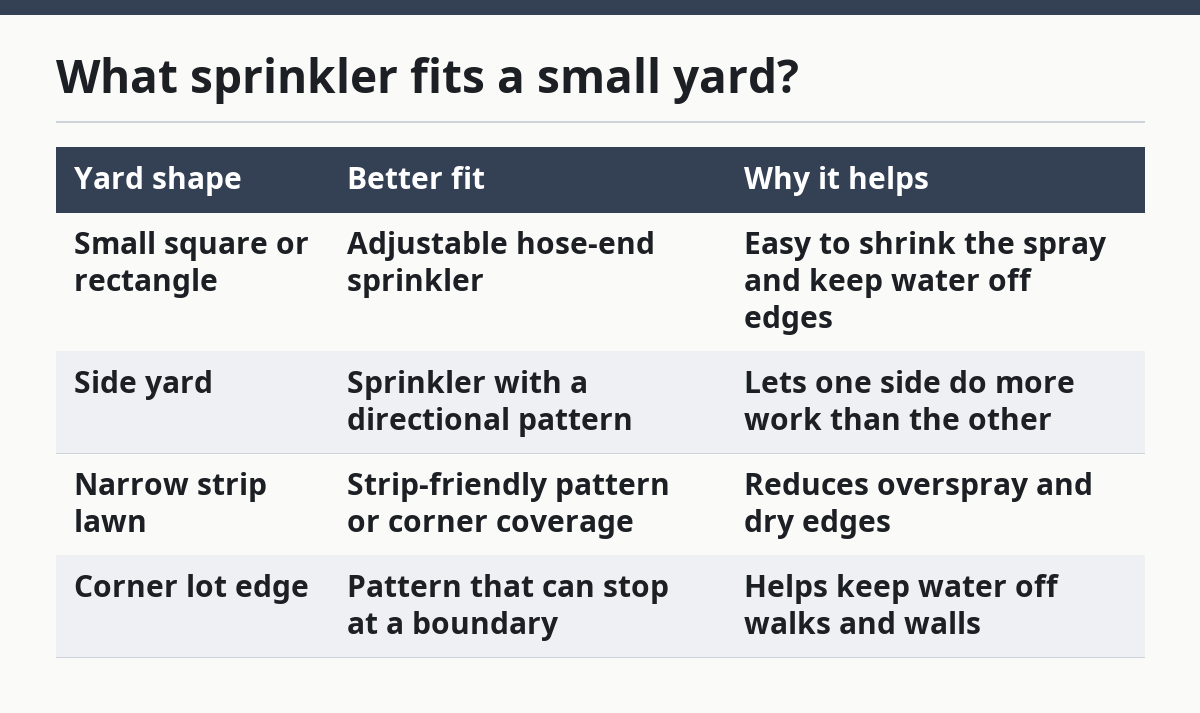
The easiest way to think about it is by shape:
| Yard shape | Better fit | Why it helps |
|---|---|---|
| Small square or rectangle | Adjustable hose-end sprinkler | Easy to shrink the spray and keep water off edges |
| Side yard | Sprinkler with a directional pattern | Lets one side do more work than the other |
| Narrow strip lawn | Strip-friendly pattern or corner coverage | Reduces overspray and dry edges |
| Corner lot edge | Pattern that can stop at a boundary | Helps keep water off walks and walls |
For example, a fixed pattern can work if the space is simple, but an adjustable sprinkler gives more room to fine-tune. That matters when the lawn is narrow on one end and wider at the other, or when a corner has a fence post, trash bins, or a patio taking up space.
In contrast, a large rotating sprinkler is usually the wrong choice here. It may cover too much ground, overshoot the lawn, or force you to place it awkwardly just to make the spray land in the right place. If you are comparing setup styles, our sprinkler setup tips can help.
How do you water a narrow lawn evenly?
Since a narrow lawn gets watered evenly when the spray pattern matches the strip, the distance stays short, and the sprinkler is placed so the water lands on grass, not pavement, the goal is even coverage across a tight lane, not a wide wash.
Use this simple setup process:
- Measure the strip with a tape measure. A side yard that is only a few feet wide needs a much tighter pattern than a broad lawn.
- Pick a pattern that matches the shape. A 180-degree setting works along one edge; a 90-degree setting can help at a corner.
- Set the spray distance low first. Start with the shortest reach the sprinkler allows, then open it only as much as needed.
- Place the sprinkler near the center line of the strip. This usually reduces dry edges and keeps overspray down.
- Run it for a short test cycle. Watch where the water lands for 5 to 10 minutes, then adjust the pattern or distance.
- Move it if one end stays dry. Narrow strips often need one repositioning, especially near corners or bends.
A strip that is too long for one placement may need two positions instead of one. That is not a failure of the sprinkler. It is a sign that the shape is doing the work, and the sprinkler needs a smaller job.
If the water keeps drifting onto concrete, the spray is too wide or the pressure is too high for the yard. A tighter setting usually fixes more than adding run time.
Should you choose adjustable spray pattern or fixed pattern?
Overall, an adjustable spray pattern is often the better choice for a small yard, while a fixed pattern makes sense only when the space is simple and the edges are easy to predict. Adjustment gives control over corners, fences, and odd angles.
The trade-off is plain. Adjustable models can take a few minutes longer to set up, and some people never dial them in correctly. Fixed models are simpler, but they leave less room for a side yard that narrows halfway down or a strip that bends around a gate.
A 180-degree spray is useful when the sprinkler sits along a wall or fence. A 90-degree spray helps in a corner where only one quarter of the yard needs water. A 360-degree spray is usually too broad for a narrow strip unless the sprinkler is placed far from all edges, which small yards rarely allow.
If the yard has two or three awkward shapes, adjustable beats fixed. If the space is a clean rectangle with little obstruction, a fixed pattern can be fine and less fussy.
What common mistakes waste water in small spaces?
However, the most common mistake is choosing too much reach. A sprinkler that throws water beyond the lawn wastes water on pavement, siding, or a fence, and that runoff does nothing for the roots.
Another mistake is using the same setup for a side yard and a front lawn. A narrow strip needs a different spray arc than a broad bed of grass. If the sprinkler keeps soaking the same edge, the other edge will stay dry, and the middle may still get more water than it needs.
A third mistake is ignoring corners. Corners are where a small yard often loses the most coverage because the spray pattern does not match the shape. A 90-degree or 180-degree setting can fix that, but only if it is chosen on purpose.
The last mistake is assuming one placement will solve every strip. In a yard with a bend, gate, or alcove, two short placements often work better than one long one. That is especially true when the lawn is narrow enough that a single central placement leaves one end short.
A quick check before you settle on a sprinkler: if the lawn shape needs precision more than distance, do not buy for max reach. Buy for control.
How we chose the features to look for
This guide is built around the questions a person asks when a standard sprinkler feels too big for the space. It focuses on the features that matter most in a small yard: adjustable spray pattern, short spray distance, and corner coverage.
Specifically, the selection criteria focus on hose-end sprinklers with adjustable arcs such as 90 degrees, 180 degrees, and 360 degrees. Public guidance from the EPA WaterSense outdoor water use page is useful here because it stresses practical water-saving habits, and the University of California Agriculture and Natural Resources irrigation guidance is a strong reference point for matching watering to plant and yard needs. The point is not to pick a brand here; it is to match the sprinkler to the shape.
The wrong answer for this page is a broad comparison of every sprinkler type. That belongs on a different page. This page is for the person with a small yard, side yard, or narrow strip who needs a clear match, not a catalog.
How do I decide before I buy?
Meanwhile, the simplest decision comes from the shape of the lawn and the amount of control you need. If the space is tight, adjustable usually wins. If the yard has a long narrow run, corner coverage matters more than wide throw.
Use this final check:
- If the lawn is under simple shape pressure, choose adjustable.
- If the edges are close to pavement or a wall, choose short spray distance.
- If the yard is a strip, choose a pattern that can narrow to one side.
- If the corners are the problem, choose a sprinkler that can do 90-degree or 180-degree coverage.
- If you want the least setup time and the yard is simple, a fixed pattern may be enough.
The main downside of a more adjustable model is that it asks for more setup time. The upside is that it is far less likely to waste water in a yard that gives you very little room to waste any.
For a small yard, the right sprinkler is the one that fits the shape first and the lawn size second.
What sprinkler is best for a small yard?
Therefore, an adjustable hose-end sprinkler is often a good starting point for a small yard. It gives you room to shorten the spray, narrow the pattern, and keep water on the grass instead of the edge. A fixed-pattern sprinkler can work too, but only when the yard shape is simple and the boundaries are easy to predict.
How do I water a narrow lawn evenly?
Because a narrow lawn gets watered evenly when the spray pattern matches the strip and the sprinkler sits close to the center line of the grass, a 90-degree or 180-degree setting often works better than a full круг, and short test runs help expose dry spots before you commit to a long cycle.
Can one sprinkler cover a side yard?
Ultimately, one sprinkler can cover a side yard if the yard is short, straight, and not much wider than the sprinkler’s controlled spray. A longer or bent side yard may need two placements or a different pattern. If water keeps landing on concrete or a fence, the setup is too broad for one spot.
Drafted with AI; not yet reviewed by a person.





Leave a Reply