Last updated: November 20, 2026
Water pressure changes how far a sprinkler throws, how evenly it covers, and whether the spray turns into a fine mist or a weak drip. If the pressure is too low, a sprinkler head may not pop up or spin well; if it is too high, the spray can break apart, waste water, and miss the target area.
Key takeaways
- Pressure is measured in psi, and sprinkler heads are built to work within a pressure range, not at any random setting.
- Flow rate matters as much as psi. A hose can show decent pressure and still starve a sprinkler if it cannot move enough water.
- Long hoses, small-diameter hoses, and extra fittings all add pressure loss.
- Too much pressure often looks like misting, bouncing spray, and dry patches; too little often looks like short throw and weak motion.
- A pressure regulator can help, but it cannot create more flow than the hose or water source can supply.
What does water pressure do to a sprinkler?
Water pressure controls how hard water enters the sprinkler head, and that changes the shape and reach of the spray. A spray head, rotor, or oscillating sprinkler all depend on enough pressure to lift water through the nozzle and spread it across the lawn.
In simple terms, pressure is the push and flow rate is the amount. A hose may have enough psi to move water, but if the hose is narrow or very long, the sprinkler still may not perform well. That is why one backyard sprinkler can throw a clean arc while another only dribbles, even on the same faucet.
The practical effect shows up fast. At lower psi, sprinkler heads may not pop up fully, the pattern may stop short, and the water can fall in a heavy strip near the head. At higher psi, the stream can break into fine droplets that drift in the wind and evaporate before they reach the ground.
This matters for any hose-based setup, from a simple garden hose to a portable sprinkler head on a pressure regulator. It is the hidden constraint that decides whether the sprinkler works as expected or just looks busy.
How do psi and flow rate work together?
Psi and flow rate work together because pressure alone does not tell the whole story. Psi tells you how hard the water is pushing, while flow rate tells you how much water is available to keep the sprinkler pattern steady.
A common mistake is to focus only on pressure. A hose bib may feel strong, but a sprinkler needs enough water volume to maintain its designed spray pattern. If the flow rate drops, the head can pulse, stall, or leave gaps.
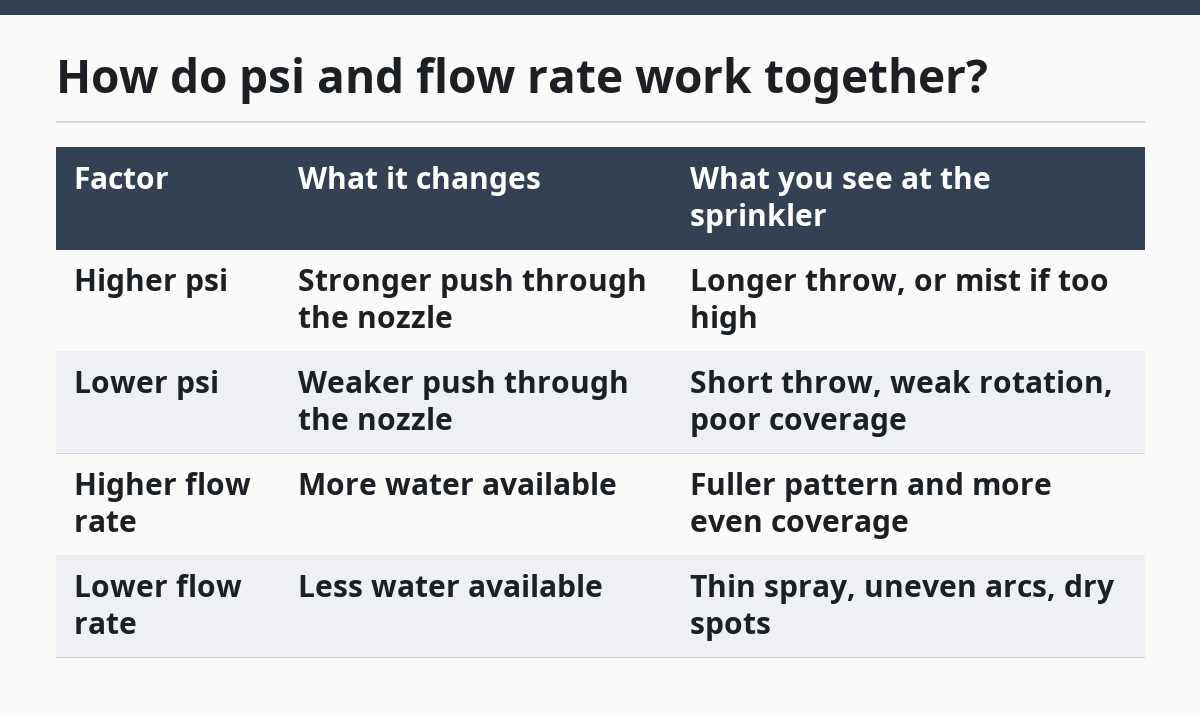
Here is the basic relationship in plain terms:
| Factor | What it changes | What you see at the sprinkler |
|---|---|---|
| Higher psi | Stronger push through the nozzle | Longer throw, or mist if too high |
| Lower psi | Weaker push through the nozzle | Short throw, weak rotation, poor coverage |
| Higher flow rate | More water available | Fuller pattern and more even coverage |
| Lower flow rate | Less water available | Thin spray, uneven arcs, dry spots |
A pressure regulator can help keep psi in the range the sprinkler head expects, but it does not solve a flow shortage. If the supply line or hose cannot deliver enough water, the sprinkler still underperforms.
What happens when pressure is too low or too high?
Too low pressure usually gives short spray distance, weak rotation, and dry patches, while too high pressure usually gives misting, splashback, and uneven coverage. Both problems reduce sprinkler performance, but they do it in different ways.
Low pressure is the easier one to spot. The sprinkler head may not fully rise, a rotor may crawl instead of turning smoothly, and water may land in a tight ring around the sprinkler. That can leave part of the lawn dry even after a long run time.
High pressure often looks better at first because the spray seems forceful, but that can be a trap. When pressure is too high, water breaks into tiny droplets that drift in wind and lose range. The pattern may also bounce off leaves or pavement instead of settling into the soil.
The trade-off is simple: more pressure is not always better. A pressure regulator can help keep a sprinkler head from being overfed, but if the sprinkler is already starved by the hose, the regulator cannot fix that.
How does hose length change sprinkler performance?
Hose length changes sprinkler performance because every extra foot of hose adds pressure loss. A short hose near the faucet usually sends more usable water to the sprinkler head than a much longer hose with the same diameter and fittings.
That loss is easy to miss. The faucet may feel strong at the start, then the sprinkler at the far end behaves as if the pressure is lower than expected. The longer the hose, the more friction the water meets inside the line, and the more pressure drops before it reaches the nozzle.
The size of the hose matters too. A narrow hose usually loses more pressure over distance than a wider one. Extra connectors, quick couplers, and sharp bends can add resistance as well.
This is why one setup with a 25-foot hose can work well while a longer run on the same water source does not. If a sprinkler head performs badly only when it is placed far from the faucet, hose length is a likely cause before the sprinkler itself is blamed.
How can you tell if the hose is the problem?
The hose is the problem when the sprinkler works well near the faucet but gets weak, erratic, or misty farther away. That pattern points to pressure loss along the line rather than a bad sprinkler head.
A simple way to sort it out is to check the setup in a few steps:
- Attach the sprinkler close to the faucet first. If the spray pattern looks even near the source, the head itself is probably capable of working well.
- Add hose length in one step at a time. Move from a short hose to a longer one and watch the change in throw and pattern. If the spray degrades with each added section, pressure loss is building.
- Check for kinks and sharp bends. Straightening the hose often restores flow more than people expect, because a kink can narrow the path inside the hose.
- Look at the spray shape. A clean arc suggests the head is getting enough pressure and flow; misting, splatter, or weak rotation suggests the supply is being choked.
- Compare the same sprinkler on a different hose. If one hose works and another does not, the problem is more likely the hose than the head.
This is a practical test for a hose and sprinkler setup, not a full irrigation design check. It helps separate pressure loss from a sprinkler head that is simply the wrong type for the job.
What fixes pressure problems without guessing?
The best fix is to match the sprinkler head, hose, and pressure regulator to each other instead of pushing one part to compensate for another. That usually means reducing pressure loss, not just turning the water on harder.
A pressure regulator is useful when the supply pressure is too high for the sprinkler head. It protects the spray pattern from breaking apart and helps the head work in the range it was built for. A regulator is not a cure for a weak hose run, though, because it cannot add flow rate.
There are three common fixes that help without guesswork:
- Shorten the hose run. Less hose usually means less pressure loss.
- Use a wider hose when possible. A hose with more internal room can deliver water more easily over distance.
- Remove avoidable restrictions. Kinks, tight coils, and extra fittings can all cut performance.
The wrong fix is to keep adding pressure and hope the sprinkler recovers. That can make misting worse and still leave the lawn unevenly watered. This is also the point where sprinkler selection matters, which is why this guide sits under the broader sprinkler selection fundamentals page.
How was this guide put together?
This guide was built from sprinkler physics, hose behavior, and common pressure terms like psi, flow rate, pressure loss, and pressure regulator use. It focuses on how those parts affect performance on a hose-based setup, not on sprinkler placement, timer setup, or irrigation system design.
The sections were chosen to answer the questions a reader usually has after seeing weak spray, dry patches, or misting. The goal was to cover the cause, the signs, the hose effect, and the basic fixes in one place. No product claims, test claims, or purchase claims are needed to explain that relationship.
That approach matches the most useful reading for this topic: what pressure does, what flow changes, and what a hose can ruin before the sprinkler even starts.
What water pressure do sprinklers need?
Sprinklers need the pressure that their head and nozzle were built for, not a random number that feels strong at the faucet. If pressure is too low, the spray stays short and weak; if it is too high, the spray can break into mist and waste water.
The right range depends on the sprinkler head type, the hose setup, and the pressure regulator if one is installed. A quick clue is the spray pattern: clean and even usually means the pressure is close, while misting or a weak arc usually means it is off.
Can low pressure affect sprinkler spray distance?
Yes, low pressure can reduce spray distance and leave dry spots. The water does not leave the nozzle with enough force to carry the full pattern, so the throw gets shorter and the head may not rotate or pop up properly.
The loss can be easy to mistake for a bad sprinkler head. If the same sprinkler throws farther on a shorter hose, the pressure loss is probably in the line rather than the nozzle.
How do I check my hose water pressure?
The simplest check is to compare how the sprinkler behaves at different points in the hose run. Start near the faucet, then move the sprinkler farther away and watch the spray distance, rotation, and pattern shape.
If the sprinkler weakens as the hose gets longer, the hose is likely causing pressure loss. Kinks, tight bends, and extra fittings can make that change more obvious, even on a short 25-foot hose.
Drafted with AI; not yet reviewed by a person.





Leave a Reply