
Last updated: November 19, 2026
Key Takeaways
- Gather tools first so lawn mower oil change work stays quick and clean.
- Run the engine 2 to 3 minutes, then shut it off and pull the spark plug wire.
- Use the oil grade on the label or in the manual; many small engines use SAE 30 or 10W-30.
- Tip a mower only if the manual allows it and only in the correct direction.
Your lawn mower oil needs changing if the engine starts hard, runs hot, or the oil looks dark and gritty. How to change lawn mower oil starts with draining the old oil, refilling with the oil type your mower calls for, and checking the level before you start the engine again. The steps below show a clean way to do it without guessing, spilling, or overfilling.
What you need before you start
How to change lawn mower oil is easier when you gather the tools first. Picture this: you’re in the garage with a warm mower, a drain pan on the floor, and no second trip to the store.
You need engine oil, an oil pan, a funnel, and, on some mowers, an oil filter. A rag, a wrench, and the mower’s manual help too. If the manual is missing, look for the oil fill cap and drain plug before you touch anything.
- New engine oil
- Oil pan or drain tray
- Funnel
- Rags or paper towels
- Wrench, if your mower uses a drain plug
- Oil filter, only if your engine has one
The key detail: the correct oil type is in the manual or on the engine label. Don’t guess from the color of the old oil. A wrong oil grade can make starting harder and can thin out too much in heat.
Most walk-behind mowers use a small splash-lubed engine, so how to change lawn mower oil is simpler than changing oil on a car. No jack stands. No lift. Just a level surface and patience.
How do I change lawn mower oil?
How to change lawn mower oil means warming the engine briefly, draining the old oil into a pan, replacing the filter if the engine has one, and refilling with the correct amount of fresh oil.
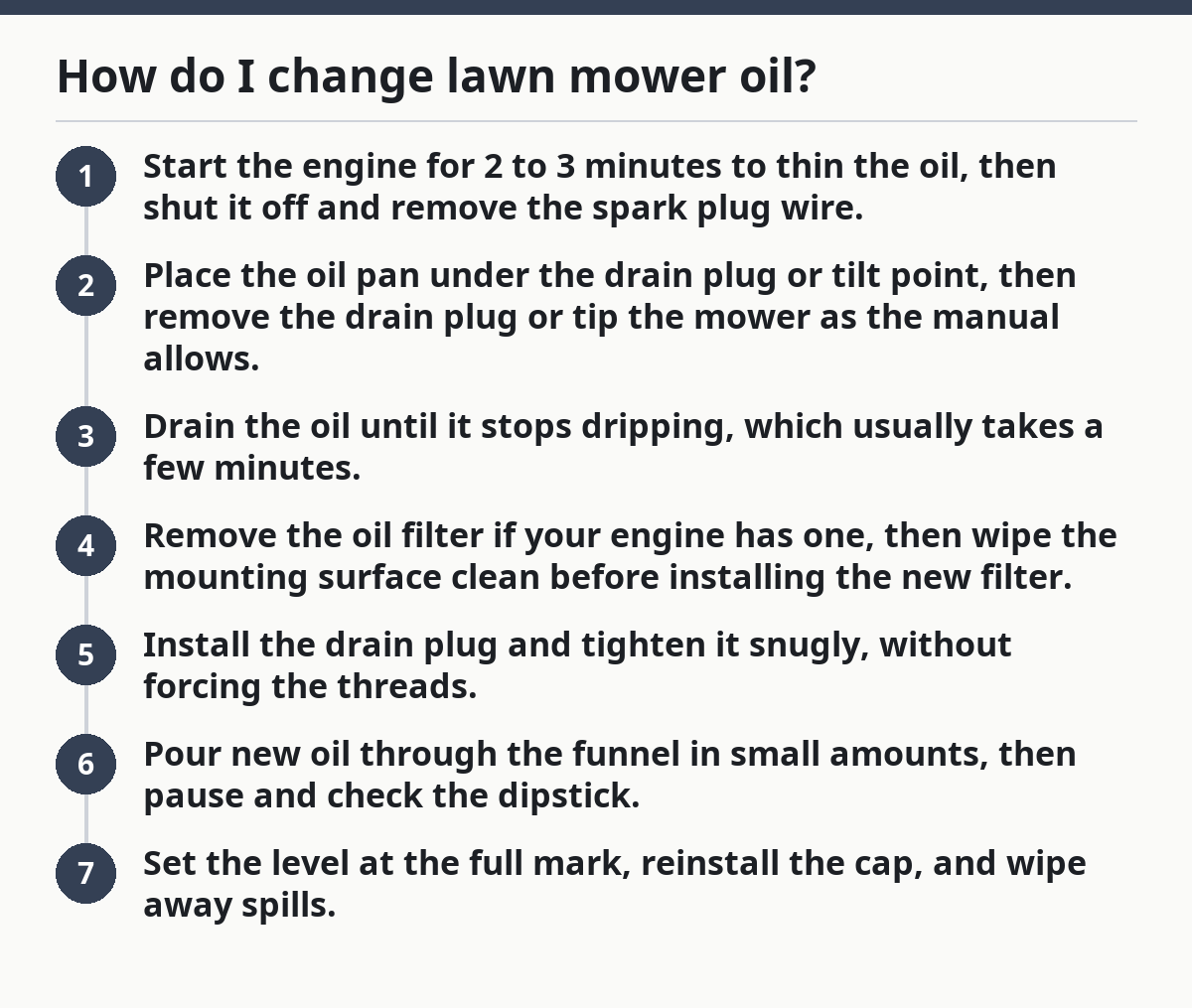
- Start the engine for 2 to 3 minutes to thin the oil, then shut it off and remove the spark plug wire.
- Place the oil pan under the drain plug or tilt point, then remove the drain plug or tip the mower as the manual allows.
- Drain the oil until it stops dripping, which usually takes a few minutes.
- Remove the oil filter if your engine has one, then wipe the mounting surface clean before installing the new filter.
- Install the drain plug and tighten it snugly, without forcing the threads.
- Pour new oil through the funnel in small amounts, then pause and check the dipstick.
- Set the level at the full mark, reinstall the cap, and wipe away spills.
On some mowers, tipping the engine the wrong way can send oil into the air filter or carburetor. If your manual says to tilt, tilt only in the approved direction. That matters more than speed.
A clean drain is the goal, not an empty engine bay.
Which oil should a lawn mower use?
How to change lawn mower oil depends on the grade listed on the engine label or in the manual, and most small engines use SAE 30 or a multigrade oil such as 10W-30. That choice depends on temperature range and engine design.
Picture this: you’re standing in the oil aisle with two bottles that both say “small engine.” One may work fine in warm weather, and the other may be better for cooler starts. The label on the mower decides, not the bottle design.
Use the manual’s recommendation first. If the manual allows more than one grade, pick the one meant for your outdoor temperature. In many walk-behind mowers, the oil fill is small, so even a slight overfill can matter.
- SAE 30 is common in warmer weather and many older push mowers.
- 10W-30 is often used for wider temperature swings.
- Synthetic small-engine oil may be allowed if the manual lists it.
What not to do: don’t use automotive oil just because it’s nearby unless the label and manual allow it. Some car oils have additives that may not suit every small air-cooled engine.
If you service several mowers, keep the manual with the oil can. It saves a mistake later.
Can you tip a mower to change oil?
Yes, you can tip a mower to change oil if the manual allows it and you tip it in the correct direction. On many walk-behind mowers, tipping the wrong side can flood the air filter or carburetor with oil.
Picture this: you’re ready to drain the engine, but the mower has no easy drain plug. Tipping looks simple, and it is simple if you respect the engine layout. If you don’t, the cleanup can take longer than the oil change.
The safe method is to check the manual before you move the mower. If it says to tip, remove the spark plug wire first, keep the fuel tank low, and place the mower on a stable surface. Use a drain pan wide enough to catch splash oil.
A few practical rules help:
- Tip only in the direction the manual approves.
- Keep the air filter side up, if that is what the manual directs.
- Never tip a hot mower onto grass or a soft slope.
- Let the oil finish dripping before you set the mower upright.
Many people ruin a simple oil change by rushing the tilt. If the manual does not make tipping clear, use the drain plug method instead. That takes longer, but it keeps oil out of the intake.
What if my mower has an oil filter?
If your mower has an oil filter, replace it during the oil change or inspect it if the engine calls for that interval. Small engines with filters usually make the job a little messier, but the process is still straightforward.
Picture this: you’ve drained the oil and are staring at a small filter tucked against the engine block. That extra part changes the order a bit, but not the whole job. The filter traps debris the oil carries, so leaving a clogged one in place can shorten the life of the fresh oil.
Remove the old filter by hand or with a filter wrench if it’s tight. Wipe the mounting surface clean, then coat the gasket on the new filter with a thin film of fresh oil before installing it. Tighten it as directed on the filter, usually hand-tight plus a small turn.
Two common mistakes cost people time:
- Dry gasket installation can make the next removal ugly.
- Cross-threading can damage the mount and cause leaks.
Who Should Skip This: someone with a mower that has no filter should follow the drain-and-refill steps instead. A filter change is only for engines built with one.
Buy this if: you own a mower with a serviceable spin-on oil filter and want the full oil service done in one pass. Skip this if: your mower uses a filterless small engine and you’re only trying to refill after a drain.
How much oil goes back in, and how do I avoid overfilling?
The correct amount is the amount the manual lists, and the dipstick is the final judge if your engine uses one. Overfilling can make a mower smoke, leak, or run badly.
Picture this: you’ve poured in fresh oil and the dipstick still isn’t reading right, so you add a little more. That is where people get into trouble. A small engine usually needs less oil than your eye expects.
Add oil in small pours, then wait a few seconds before checking the dipstick. Keep the mower level while you check. If the manual gives a capacity in ounces or quarts, use it as a guide, but check the dipstick and consult a professional if the level still seems unclear. The final level matters more than the bottle count.
- Fill slowly through a funnel.
- Stop before the full mark.
- Wipe the dipstick clean before each read.
- Check again after the first short run.
If the engine was overfilled, drain a little into the oil pan and recheck. If the level is low, add oil in small amounts. A half ounce can make the difference on some mowers.
When should you change mower oil, and what do you do with the old oil?
Change mower oil at the service interval in the manual, and dispose of used oil at a collection point that accepts motor oil. If the oil looks black, smells burnt, or the engine has been run through a long season, service time is probably close even if you haven’t hit the exact interval yet.
Picture this: the mowing season is over, the oil is dirty, and you’re holding a pan of used fluid. The job is not done until that oil leaves your garage the right way. Old engine oil belongs in a sealed container, not down a drain or onto the ground.
Your manual may list service by hours, seasons, or both. If you keep a small notebook or a note in your phone, write down the date of each change and the oil type you used. That saves arguments with yourself six months later.
For disposal:
- Pour used oil into a sealable container.
- Keep it separate from gasoline and coolant.
- Take it to an auto parts store, recycling center, or local hazardous-waste site that accepts oil.
Fresh oil reduces wear inside the motor, where problems start long before you can see them.
For a broader service schedule, the lawn equipment maintenance guide on this site covers the rest of the upkeep chain without mixing it up with blade work or deck cleaning.
How often should you change mower oil?
Change mower oil at the interval listed in the manual, and shorten that interval if the mower works hard, runs in dust, or sees long mowing sessions. If the manual gives a seasonal schedule, treat that as the baseline and confirm it with the owner’s manual or a small-engine service professional.
A mower that sits all winter with old oil in it is not getting a free pass. Oil breaks down over time, not just over use. If you only remember one thing, remember to check the manual before the first mow and again before storage.
What kind of oil does a lawn mower use?
A lawn mower uses the oil grade listed by the engine maker, often SAE 30 or 10W-30 for many small engines. Some models allow synthetic small-engine oil, but the manual decides that, not the bottle.
Use the grade that matches your temperature range and engine design. If you live where mornings are cool and afternoons get hot, the multigrade option may fit better if the manual allows it.
Can you tip a mower to change oil?
You can tip a mower to change oil only if the manual allows tipping and only in the approved direction. The wrong tilt can flood the air filter or carburetor with oil.
If there is no clear tipping direction, use the drain plug or service port instead. That takes a little longer, but it avoids a messy intake system.
Do all mowers have an oil filter?
No, not all mowers have an oil filter. Many walk-behind mowers use simpler small engines with no replaceable filter at all.
If your mower has no filter, don’t hunt for one. Follow the drain and refill steps, then check the dipstick and run the engine briefly before a second level check.
Drafted with AI; not yet reviewed by a person.





Leave a Reply