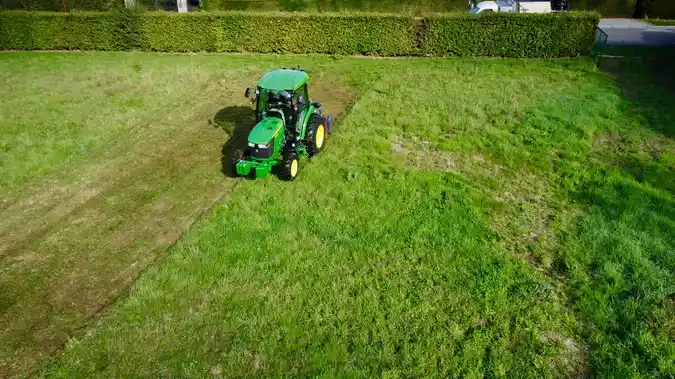
Last updated: November 19, 2026
Key Takeaways
- Mowing handles the main lawn, edging sharpens borders, and trimming cleans tight spots and obstacles.
- Cutting too much at once can stress turf and leave a pale, ragged look.
- A crisp edge gives a yard a finished frame, even if the grass itself is plain.
- A trimmer clears areas a mower cannot reach with fast-spinning line, not a blade.
Your lawn looks messy because the cut is uneven, the edges are shaggy, and the hard-to-reach spots are still standing. Mowing handles the open grass, edging sharpens the border, and trimming cleans the places the mower can’t reach. This guide on mowing, edging, and trimming — The Complete Guide settles which tool does what, when to use each one, and how to get a finish that looks deliberate instead of rushed. Quick answer: mow first, trim second, and edge last for the cleanest result. That sequence usually saves one extra cleanup pass.
The fast answer: which job does each tool do?
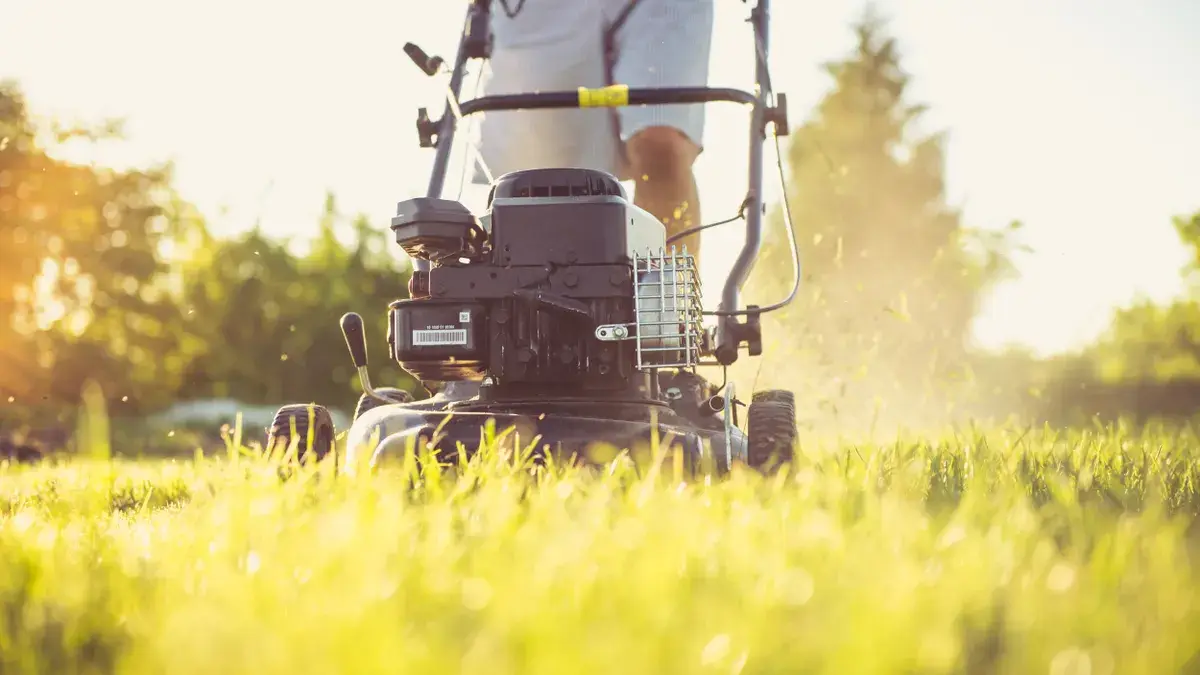
Mowing cuts the main lawn surface, edging defines the line along sidewalks and driveways, and trimming clears grass around fences, trees, and other obstacles. A mower is for broad areas, an edger is for a crisp edge, and a trimmer is for detail work.
A beginner usually gets into trouble by asking one tool to do all three jobs. That’s why the lawn looks uneven at the corners and soft at the curb.
For example, if you finish mowing and the yard still looks untidy because the grass is hanging over the walk, the fence line is fuzzy, and the beds have stray blades poking out, the fix is not “mow more.” It’s the right order and the right tool for each edge.
Here’s the simplest way to think about it:
- Mower: cuts the field
- Edger: cuts the border
- Trimmer: finishes the details
The order matters too:
- Mow first.
- Trim second.
- Edge last.
That sequence keeps clippings from ruining a clean edge and helps you see where the line should be. A lot of beginners edge first, then mow over the line and blur it again. That wastes time and weakens the finish.
What mowing actually does well
Mowing handles the whole lawn surface, and it works best when the grass is kept at one height instead of being hacked down all at once. Cutting too much in a single pass stresses the lawn and leaves a pale, ragged look.
Because of that, the mower should set the main height, not rescue a yard that has been ignored for too long.
For example, if you’re pushing a mower across a yard that has thin spots, thick spots, and a patch near the curb that always grows faster, the mower gives you the main shape, but it won’t solve the uneven borders or the tufts around fixed objects.
A better mowing habit is plain and unglamorous:
- Set the deck to a sensible height for the grass type and season.
- Cut regularly instead of waiting until the lawn gets tall.
- Keep blades sharp enough that the grass is sliced, not torn.
- Change your pattern so the grass doesn’t lean one way every time.
The cleanest cut comes from even coverage, not brute force. If the mower leaves stripes that look ragged at the tips, the blade is probably dull or the grass is too tall for one pass. In that case, use a second pass at a higher setting instead of forcing the deck lower.
Mowing also has limits. It does not clean the narrow strip between pavement and mulch, and it won’t give a crisp visual line along concrete. That’s not a failure. It’s just the wrong tool for those jobs.
Why edging changes the whole look
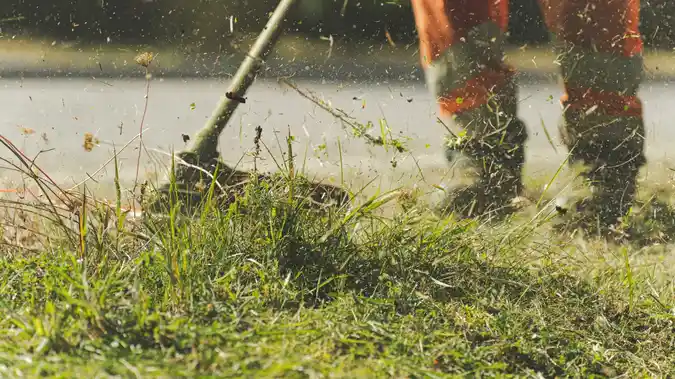
Edging gives the yard a finished boundary, and that sharp line is what makes a home look cared for even when the grass itself is ordinary. The edge is the visual frame. Without it, the lawn can look freshly cut and still look sloppy.
For instance, the driveway may be neat, but the grass can still spill over the concrete in a soft, green lip. A mower can’t cut that cleanly because the wheel path never lets the blade bite the edge squarely.
An edger is built for that exact line. It slices a trench or a clean vertical border along:
- sidewalks
- driveways
- curbs
- patios
- landscape borders
The best edging is straight and consistent, not deep. A shallow, clean line is enough to separate lawn from pavement. If you cut too deep, the edge collapses faster and looks gouged.
This is where beginners overdo it. They try to make every edge look like a hotel walkway. That’s not necessary for a normal yard, and it can leave a harsh ditch that collects debris and dries out. The goal is definition, not a moat.
If the lawn edge already has a neat line, a light pass is enough. If the edge has disappeared, you may need a slower first pass and then a cleanup pass a few days later. Edging is a finishing move, not a demolition job.
Where a trimmer fits — and why it’s not a mini mower
A trimmer cleans the places a mower can’t reach, and it does that by cutting with a fast-spinning line rather than a blade. It’s the tool for the ugly little places: around posts, under low shrubs, beside fences, and against the base of a mailbox.
Since the mower has already cut the open lawn, the grass around the air-conditioning unit, the tree trunk, and the fence corner is still standing. That’s trimmer territory, not mower territory.
A trimmer is useful for:
- fence lines
- tree rings
- around steps
- along walls
- tight spots near hardscape
- under benches or railings
The biggest mistake is using the trimmer like a mower and carving down whole stretches of lawn. That chews up the line, throws debris, and leaves a jagged finish. A trimmer should skim, not bulldoze.
There’s also a difference between trimming and edging, even though the same tool can sometimes do both. Trimming usually means cutting horizontally or at a slight angle around obstacles. Edging with a trimmer means turning the head so the line runs vertically along a hard edge. That trick works, but it’s less stable than a real edger and takes a steadier hand.
If the yard has many obstacles and little open lawn, the trimmer becomes more important. If the property is mostly straight pavement and wide lawn, edging matters more.
The right order: mow, trim, then edge
The right order is mow first, trim second, and edge last because each step cleans up the mess left by the step before it. If you reverse that order, you lose time and blur the finish.
For example, if you edge a driveway beautifully, then mow across the lawn and scatter clippings over the line you just made, you have to blow or sweep again, and the crisp border is gone.
Here’s the practical sequence:
-
Mow the full lawn.
Get the main height down first. -
Trim around obstacles.
Clean the spots the mower missed. -
Edge the hard borders.
Finish the visual line after the grass height is settled. -
Blow or rake clippings.
Clear the pavement and the bed edges.
That order saves work because the mower throws the most debris, the trimmer throws the next most, and edging leaves the final line you want to keep visible.
A lot of people edge first because it feels precise. However, it only stays precise if you don’t disturb it afterward. That’s why it belongs at the end.
Mowing, edging, and trimming: the honest side-by-side
Mowing wins on coverage, edging wins on definition, and trimming wins on access. None of them replaces the others, and pretending otherwise is how lawns start looking half-finished.
For example, if you’re standing at the curb deciding which tool to grab first, the answer depends on what the yard needs most—bulk cut, clean border, or tight-space cleanup.
| Criteria | Mowing | Edging | Trimming | Winner for condition |
|---|---|---|---|---|
| Main job | Cuts the lawn surface | Cuts a hard border | Cleans around obstacles | Depends on the task |
| Best surface | Open grass | Concrete, curb, bed line | Tight spaces and corners | Depends on the task |
| Finish quality | Even height | Crisp visual line | Removes stray growth | Depends on the task |
| Speed over large areas | Fast | Slow | Moderate | Mowing |
| Detail control | Low to moderate | High along edges | High in tight spots | Edging and trimming |
| Risk of a bad cut | Scalping if deck is too low | Gouging if too deep | Nicking bark or paint | Mowing and edging |
| Best tool for beginners | Easiest to learn | Needs steadier hand | Easy in small doses | Mowing |
| Best for curb appeal | Good foundation | Biggest visual payoff | Strong cleanup value | Edging |
| Can replace the others? | No | No | No | None |
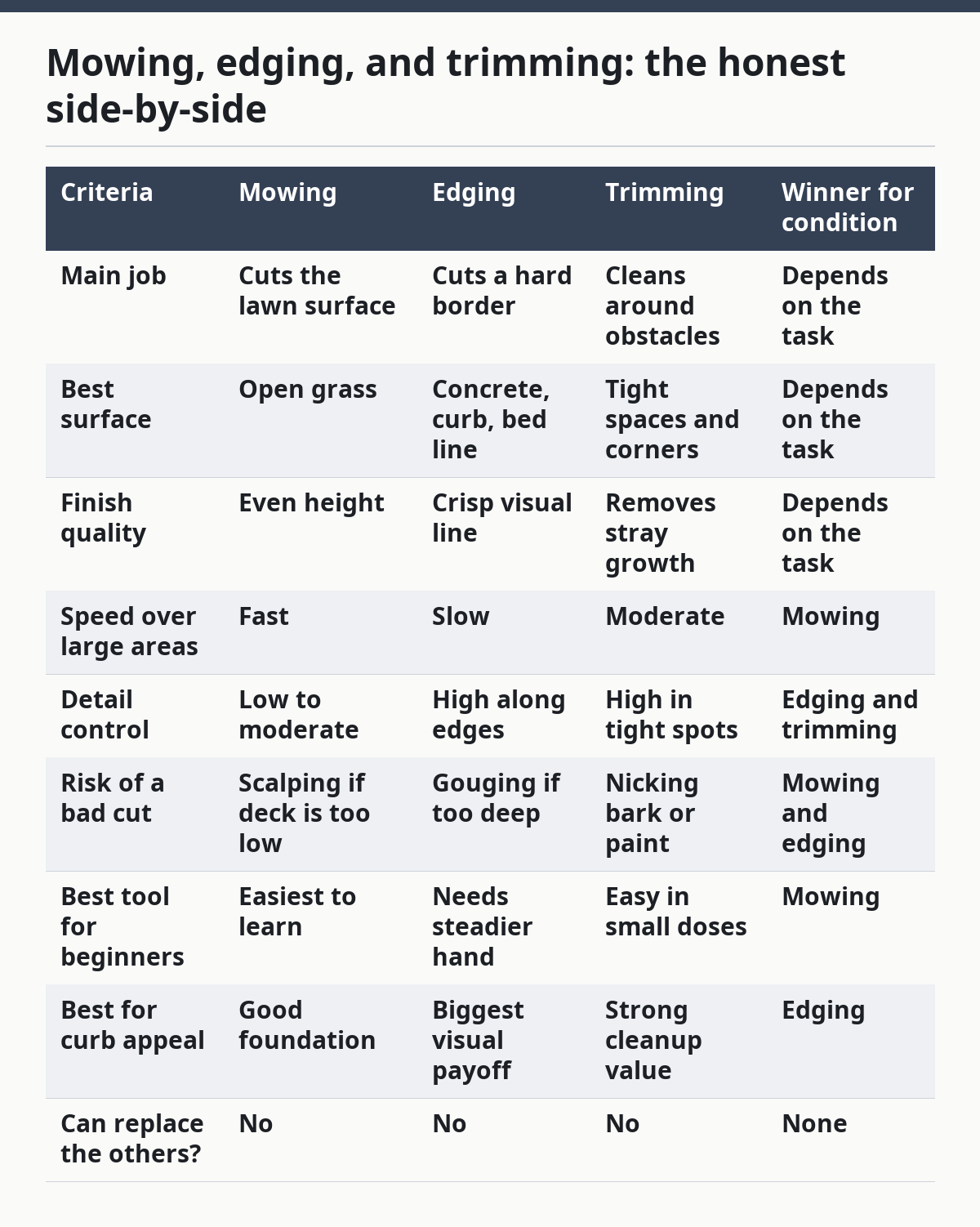
The table makes one thing obvious: mowing is the base layer, but edging changes the look fastest. Trimming matters most when the yard has a lot of fixed objects and awkward corners.
The useful part is simple. You do not need fancy equipment to understand the roles. You need a clear job list. That alone prevents most wasted effort, though a local landscape pro can help if your yard has roots, steep grades, or damaged borders.
What a good finish looks like, and what it does not
A good finish looks even, clean, and intentional, and it still looks that way after the clippings are gone. The lawn should read as one surface, the edge should read as a line, and the corners should not look hacked.
For example, if the grass is the same height across the open area, the sidewalk edge is sharp, and the fence line is free of wisps, that’s the finish people notice even if they can’t say why it looks better.
A bad finish usually shows one of four signs:
- the mower left strips because the deck was set too low for the first pass
- the edge is too deep and crumbling
- the trimmer shaved the ground in patches
- clippings are left in the border and make the yard look messy again
There’s a simple rule here: the lawn should look like it was cut by design, not by rescue effort. If one tool is doing all the damage cleanup for another tool, the order or the settings are wrong.
The cleanest yards often look simple because the work is quiet. No gouges. No jagged shoulders around the beds. No grass hanging over the concrete.
Common mistakes that waste time and make the yard look worse
The biggest mistakes are cutting too low, edging too deep, and trimming too aggressively around every obstacle. Each one creates more cleanup and a rougher finish.
For example, if you want a sharp yard in under an hour, drop the mower deck, race the edger along the driveway, and whip the trimmer around the tree roots, the result is usually brown tips, a chipped edge, and torn bark.
Avoid these habits:
- Mowing too short: scalps the lawn and exposes soil.
- Edging too deep: makes a trench that breaks down fast.
- Trimming too close: damages trunks, posts, and mulch beds.
- Skipping cleanup: leaves the yard looking unfinished.
- Using one tool for everything: creates extra passes and ugly lines.
The fix is boring, but it works. Slow down at the borders. Keep the mower on a steady path. Let the trimmer handle only what the mower missed. Save the real edge work for the end.
If you want the yard to look better fast, don’t try to make every line dramatic. Make every line consistent.
How to decide what your yard needs most
The right priority is the one that solves the ugliest part of the yard first. If the grass is too tall, mow first. If the surface is already short but the borders are fuzzy, edge first after mowing. If the corners look messy because of trees, fences, or steps, trim carefully after the main cut.
For example, if you look at the yard from the street and one problem jumps out more than the others, that’s the job that deserves the first pass.
Use this quick check:
- Tall open grass: mow first.
- Neat lawn, fuzzy curb: edge first after mowing.
- Mess around obstacles: trim after mowing.
- All three problems at once: mow, trim, edge.
The truth is, many yards need all three jobs, but not always with the same intensity. A small city lot with lots of concrete may need edging almost every time. A larger backyard may need mowing most often and edging less often. A yard with many trees and beds may demand trimming more than either of the others.
That’s why the best routine is a sequence, not a single trick.
How often should you do each one?
Mowing usually happens the most often, edging less often, and trimming as needed around growth and obstacles. The exact rhythm depends on season, rain, and how fast the grass grows, so there is no single schedule that fits every yard.
For example, after a week of warm rain, the lawn is growing fast and the border is starting to blur. In a drier week, the mower may be the only tool that really needs to come out.
A practical way to think about frequency is this:
- Mowing: whenever the grass reaches a height that starts to look uneven or close to too tall for one cut
- Edging: when the border loses its line and begins to spill over pavement
- Trimming: when the mower can’t physically reach a spot or the growth around obstacles stands out
A lot of people over-edge because they like the sharp look. That’s fine, but edging too often can make the border look worn. It’s a finish step, not daily maintenance. Trimming can also be overdone around trees and posts, where repeated line damage can stress the area and leave bare rings.
If you keep one rule in mind, make it this: the lawn should tell you what needs attention, not the calendar alone. For a specific schedule, a local lawn-care professional can adjust the timing to your grass type and climate.
FAQ
Do I need all three tools?
Yes, if you want a finished lawn with open grass, sharp borders, and clean obstacle work. A mower handles the main area, an edger sharpens the border, and a trimmer reaches the places the mower misses.
Can I use a trimmer instead of an edger?
Yes, but only as a substitute, not the best option. A trimmer can stand up the line along pavement, but it is harder to control and usually leaves a less consistent edge than a dedicated edger.
Should I edge before or after mowing?
Edge after mowing. Mowing first sets the final grass height, and edging last keeps the border clean instead of burying it under clippings or knocking it out of shape.
What if my yard is small?
A small yard still benefits from all three jobs, but trimming and edging may matter more than speed. In a tight space, one careful pass around the borders can change the look more than rushing through the middle.
Why does my lawn still look messy after I mow?
Because mowing only solves the main surface. If the edges are soft and the grass around fences, trees, and walkways is still standing, the yard will still read as unfinished even when the center is cut well.
Drafted with AI; not yet reviewed by a person.





Leave a Reply