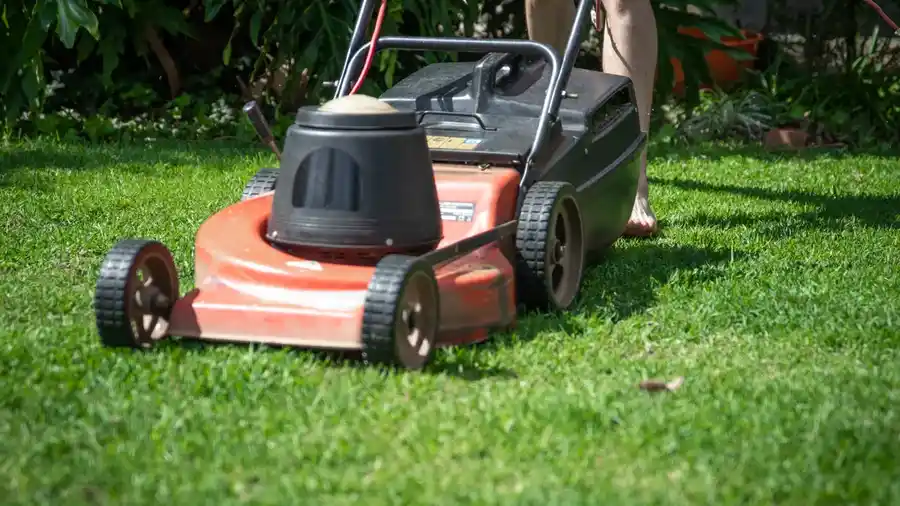
Last updated: November 19, 2026
Quick Answer: For most homeowners, 3 core tools cover the basics: a mower, a string trimmer, and a rake or blower. In this guide to Lawn equipment and tools — The Complete Guide, the right setup depends on yard size, grass type, slope, storage space, and how much noise and maintenance you can tolerate. For a small, flat yard, a corded or battery mower plus a string trimmer is enough. For larger or rougher properties, a self-propelled mower, edger, leaf blower, and a rake or dethatcher start to matter fast.
Key Takeaways
- Start with tools that cut, trim, and clean; add more only when the yard shows a real need.
- The mower should usually be the first buy, but the exact order depends on yard size and layout.
- A common mistake is buying a premium trimmer while the mower stays old and dull.
- A riding mower makes sense when the lawn is large enough that walking it is the main burden.
I write on outdoor power equipment and yard-care buying guides, so I know which features change the job and which are just marketing gloss. Lawn equipment and tools are easiest to choose when you match them to the yard, not the ad copy.
What lawn equipment actually matters for your yard?
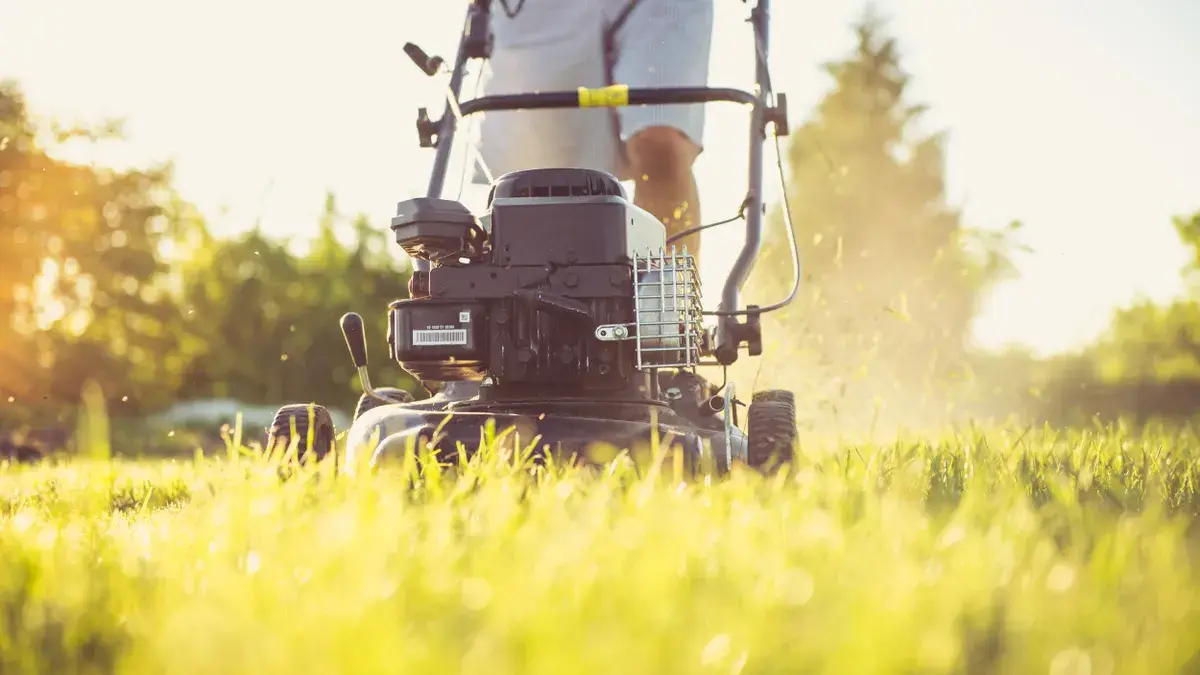
The shortest useful answer is this: start with the tools that cut, trim, and clean, then add only what your yard proves it needs. A lot of generic guides list every tool ever made, from aerators to tow-behind sweepers, but most homeowners need four basics first: a mower, a string trimmer, an edging tool, and a hand rake or leaf rake. That core set handles the work most lawns demand in a typical 1/8- to 1/2-acre setting.
The real decision is not “Which brand is best?” It is “What task is the bottleneck?” If the grass gets long fast, cutting power matters more than fancy storage. If the lawn borders beds, fences, or a deck, trimming accuracy matters more than top mowing speed. If the yard has a clean curb or sidewalk line, an edger changes the look of the property more than a second mower upgrade.
The terrain matters too. A flat, fenced suburban lot and a hillside, tree-filled yard are different equipment problems. A push mower can be fine for a small, level lawn, especially when the grass stays manageable. The same tool can feel punishing on a slope or when the grass is thick after rain. Self-propelled drive, larger rear wheels, and variable speed are not luxury features in that situation; they are workload reducers.
Storage and charging matter as well. Battery equipment works best when the battery system fits your whole yard routine. A single 40V or 56V platform from one maker can simplify charging, but only if the line has the attachments and run time you need. If you only need one tool and will use it occasionally, buying into a battery ecosystem can be overkill.
The cleanest way to shop is to sort tools by job, then by power source, then by size. That keeps you from paying for features you will never use.
Which lawn tools should come first?
The first purchase should usually be a mower, because it sets the schedule for everything else. After that, a string trimmer comes next for edges, posts, fence lines, and places the deck cannot reach. A third buy is usually an edger if your sidewalks and driveway make a visible border. If the property drops leaves, cut grass clippings, or twigs after storms, add a rake and a blower only if cleanup is starting to consume your weekends.
Here is the practical order most homeowners should follow:
- Mower — the core tool.
- String trimmer — the cleanup tool.
- Edger — the finish tool.
- Leaf rake or leaf blower — the seasonal cleanup tool.
- Hand tools like pruning shears, a hoe, a spade, and a cultivator — for beds and spot work.
- Higher-specialty gear like dethatchers, aerators, and spreaders — only when the lawn needs a specific treatment and a professional may be worth consulting for the timing and method.
A lot of buyers want to jump straight to battery systems or riding equipment. That is a mistake if the yard is small. A riding mower, for example, only pays off when the time saved justifies the storage space, maintenance, and turning radius. For many suburban lawns, a self-propelled walk-behind mower is the smarter ceiling.
The first question to ask is: how many square feet do I need to maintain, and how often? A smaller lawn can be handled with 20V to 40V battery gear or a corded mower if outlets are convenient. A larger lawn usually benefits from more battery capacity, a gas engine, or a wider deck. Turf density matters too. Thick St. Augustine, Zoysia, or overgrown cool-season grass asks more of the machine than a thin, dry patch of fescue.
One more overlooked point: the attachment ecosystem can save money only if the attachments are actually useful. A powerhead with multiple attachments sounds efficient, but if you only ever use the trimmer head and the edger, the package may not beat buying dedicated tools. If you are unsure about specialty tools, a local extension office or lawn-care professional can help you decide what actually belongs on the property.
Gas, battery, or corded: what should I buy?
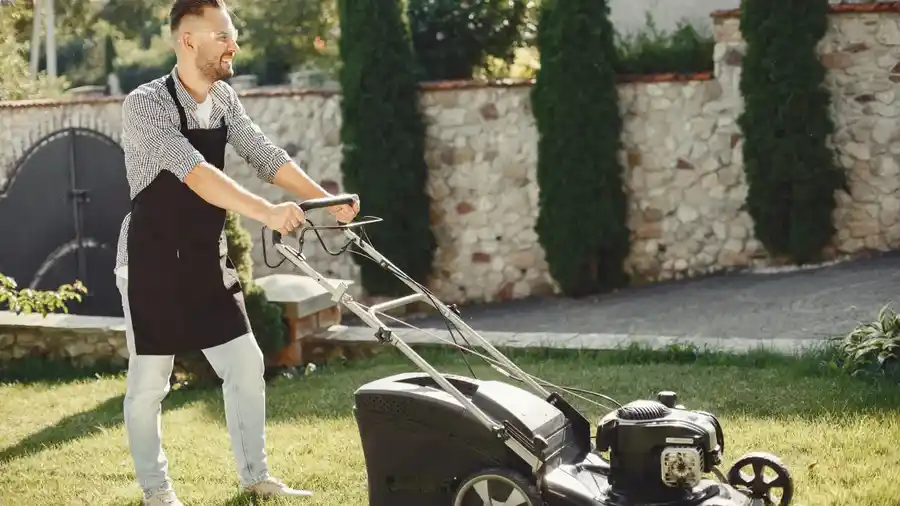
Battery equipment is often the best fit for many homeowners now, gas still wins for long runtimes and heavy work, and corded tools make sense for tiny lawns where extension-cord range is not a problem. That is the decision in plain language.
Battery tools are easiest to live with. They start with a button, run quieter than gas, and avoid fuel mixing and carburetor storage problems. That matters if the yard gets maintained in short bursts instead of one long weekend block. Battery systems also keep improving, with many makers offering 40V, 56V, 60V, or similar platforms and multiple tools that share the same pack. The trade-off is runtime. Once the battery is empty, the work stops unless there is a spare pack on the charger.
Gas still has a place. It is the simplest choice for large lots, long mowing sessions, heavy spring growth, and properties where charging access is limited. It also tends to recover faster under load when the grass gets dense. The downside is obvious: noise, maintenance, fuel storage, winterization, and emissions. For a reader who wants low upkeep, gas is the wrong choice unless the yard is large enough to make that penalty worth paying.
Corded tools are narrow but useful. A corded string trimmer or small mower can be a smart buy for a compact city yard with outlets nearby. The obvious limitation is the cord itself. It can snag, limit reach, and make the job feel more annoying than it should. For many people, that inconvenience outweighs the lower purchase price.
This is also where safety and standards matter. Battery packs and chargers should come from recognized manufacturers and be used with the correct equipment listed by the maker. For electrical outdoor gear, the Consumer Product Safety Commission is a useful reference point for product safety alerts and recalls: https://www.cpsc.gov/ and the Occupational Safety and Health Administration has practical guidance on outdoor power equipment hazards: https://www.osha.gov/.
The right call depends on the lot and the user. If you want the simplest ownership experience, battery is often the best default. If you maintain a large property, gas remains practical. If the yard is tiny and the storage closet is close to the outlet, corded gear can still make sense. For more context on maintenance and storage, see our battery tools guide and gas lawn mowers guide.
The honest side-by-side: mower, trimmer, and edger
| Criteria | Mower | String trimmer | Winner for this condition |
|---|---|---|---|
| Main job | Cuts the main lawn surface | Cleans borders, fences, posts, and tight spots | Mower for the core cut |
| Best yard size | Any lawn, but especially the open middle | Small to medium yards with lots of edges | Mower for broad coverage |
| Learning curve | Moderate, especially with self-propelled controls | Low once the head angle feels natural | Trimmer for first-time users |
| Fatigue factor | Higher on slopes or heavy turf; lower with self-propelled drive | Lower for short sessions, higher if used as a substitute for edging | Trimmer for quick touch-ups |
| Finish quality | Defines mowing height and striping | Removes grass the deck misses | Tie, depending on task |
| Noise and fumes | Highest with gas units | Lower with battery models | Trimmer for quieter use |
| Maintenance | Blade sharpening, fuel or battery care, deck cleaning | Line replacement and head cleaning | Trimmer for simpler upkeep |
| Storage needs | Larger footprint, especially riding units | Compact wall or shelf storage | Trimmer for tight storage |
| Cost impact | Biggest purchase in the basic set | Usually lower than a mower | Trimmer for budget entry |
| Best use case | Regular weekly mowing | Edges, beds, and hard-to-reach spots | Mower if the lawn itself is the problem |
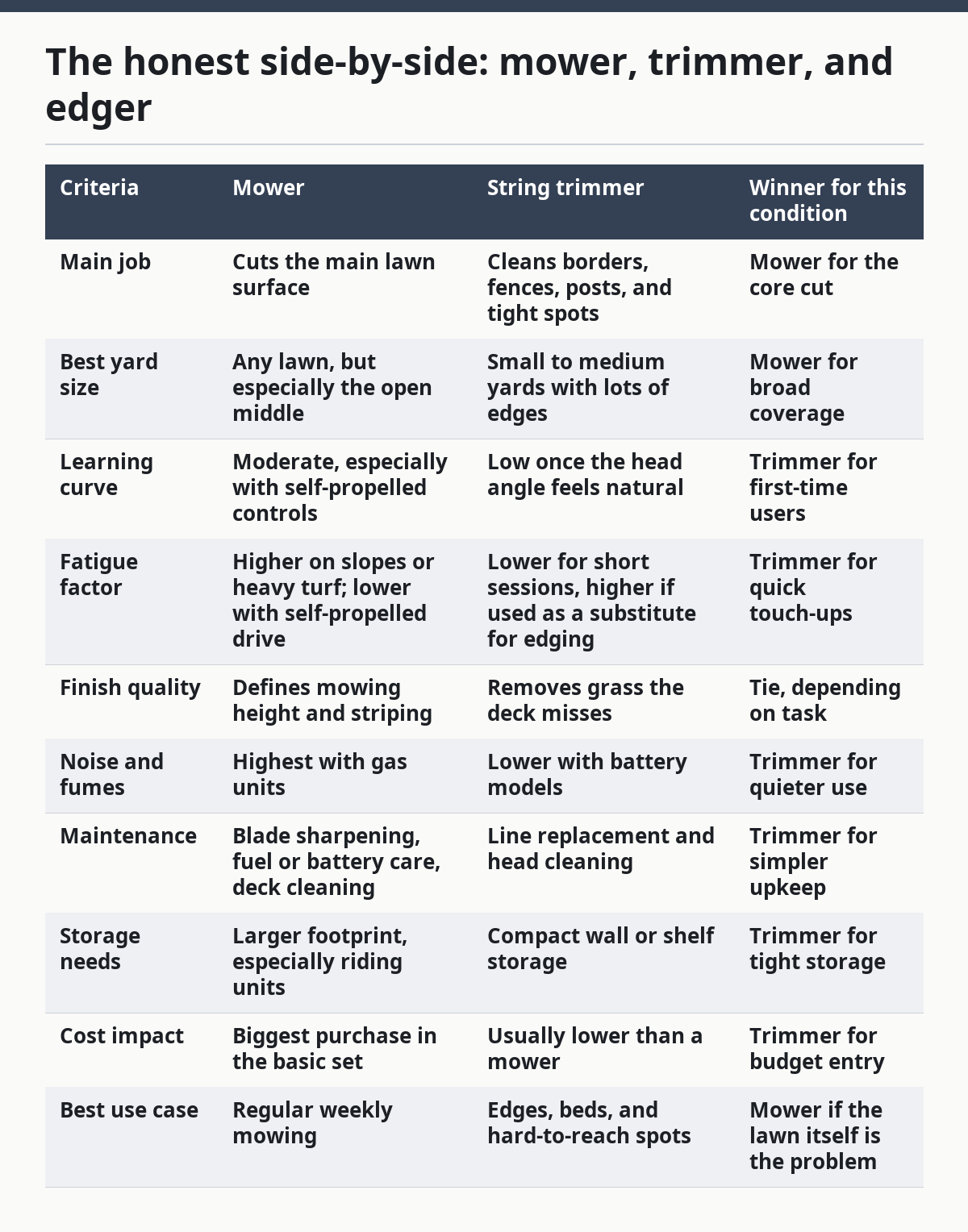
The table makes one thing clear: the mower is the anchor, and the trimmer is the support tool. A lot of shoppers reverse that and buy a top-tier trimmer while keeping an old, dull mower. That is backwards. A poor mower leaves the lawn ragged everywhere; a poor trimmer only makes the edges look unfinished.
The mower wins when the grass height, blade width, and deck quality determine how long the whole job takes. A 21-inch walk-behind deck is common in the residential category because it balances coverage and maneuverability. Larger decks cut faster but turn less easily in tight spaces. Self-propelled drive is worth serious attention if the yard is sloped or if the soil gets soft after rain.
The trimmer wins where the mower cannot physically go. It is the tool for mailbox posts, fence lines, landscaping rocks, and the narrow strip beside a house. The downside is that it is easy to abuse the trimmer as a substitute for a poorly chosen mower. That leads to uneven cutting, more fatigue, and a lawn that never looks truly finished.
The direct recommendation: if the budget only allows one quality tool now, buy the best mower you can justify and pair it later with a trimmer that matches the battery platform or fuel system. For homeowners comparing models, our walk-behind mower guide and edgers guide can help narrow the field.
When does a riding mower make sense?
A riding mower makes sense when the lawn is large enough that walking the whole thing is the main problem, not the cutting itself. That usually means acreage or a very wide suburban property with few obstacles, but the exact threshold depends on terrain, gates, storage, and turning space. A riding unit can save time, yet it also demands more maintenance, more garage room, and more money to own.
This is where generic buying guides often mislead people. They imply that a riding mower is the obvious upgrade once a push model feels annoying. That is not true. For a lawn full of trees, landscape beds, and narrow passages, a rider can be slower than a walk-behind because every turn, reverse, and trim pass becomes awkward. A zero-turn mower is faster on open ground, but it is a poor choice if the yard is chopped into tight sections or if the buyer is new to that steering style.
The obvious strength of riding equipment is reduced physical effort. The less obvious strength is consistency on larger properties. A riding mower is more likely to keep weekly maintenance on schedule because the job feels manageable. The weak point is cost discipline. Buyers often underestimate blades, belts, battery systems on electric riders, service intervals, and storage. The machine may cut the lawn well, but the total ownership burden is larger than that of a walk-behind setup.
This choice is wrong for a small or awkward yard. It is also wrong for a user who dislikes upkeep. A riding mower solves time and fatigue, not maintenance. If the yard can be finished with a 21-inch or 30-inch walk-behind in a tolerable amount of time, that smaller tool usually remains the better buy.
What hand tools still belong in a serious lawn setup?
Hand tools still matter because not every yard task deserves a powered machine. A pruning shear, a flat spade, a garden hoe, a hand cultivator, a leaf rake, and a digging trowel solve a surprising amount of day-to-day work. These tools are cheap to store, simple to clean, and useful when the job is too small for a power tool.
A lot of people skip hand tools and then waste time firing up a blower or trimmer for a 2-minute task. That is backward. A rake clears a small patch of clippings faster than setting up a larger machine. A spade resets a bed edge or plants a shrub better than improvising with a mower. Pruning shears clean up low growth around the lawn border before it becomes a weed problem.
The honest limit is that hand tools do not scale. If the property has heavy leaf drop, a half-acre of turf, or a serious thatch layer, hand work becomes slow and tiring. A manual rake can still be useful for final cleanup, but it should not be your only plan if the yard consistently produces more debris than one person can manage in a reasonable session.
For most homeowners, the smart hand-tool kit is small and specific. Buy the items that solve recurring problems. Skip the specialty tools until the yard proves it needs them. A 6-inch or 8-inch hand trowel is useful in beds; a long-handled rake is useful for leaves; bypass pruners are useful for light stem work. Everything else is optional until the landscape says otherwise. Related basics are covered in our garden hand tools guide and yard cleanup guide.
Which add-on tools are worth buying later?
The add-on tools that earn their keep are dethatchers, aerators, spreaders, and blowers, but only if the lawn actually needs those jobs. A dethatcher is valuable when thatch becomes thick enough to block water and air from reaching the soil. An aerator matters when compacted soil prevents roots from breathing and absorbing moisture. A spreader pays off if you fertilize or seed across a broader area, and a professional can help you decide whether a product and timing are right for the lawn. A blower helps when the yard produces enough debris that raking becomes a chore.
The key mistake is buying these tools in advance. A dethatcher or aerator used once and stored for years is a poor investment for a small, low-maintenance yard. In many cases, renting makes more sense than buying. That is especially true for heavier seasonal tools that live in the garage most of the year.
This category also has a quality trap: many low-end tools do the job badly enough to create frustration. A weak spreader can throw material unevenly. A bargain dethatcher can miss swaths or dig too aggressively. In lawn care, uneven application matters because grass responds unevenly. That can leave stripes, weak growth, or burned patches. The USDA and university extension programs are good references when you want timing and soil advice before buying specialized equipment.
A practical rule works better than enthusiasm: buy add-ons only after the lawn has shown a recurring need for at least one full season. That keeps the tool chest aligned with reality instead of aspiration.
The verdict: which lawn equipment setup should you choose?
Choose a battery mower plus string trimmer if your yard is small to medium, you want lower noise, and you value easy storage over unlimited runtime. Choose gas equipment if the lawn is large, thick, sloped, or too spread out for charging breaks. Neither if you are tempted to buy a riding mower for a yard that still fits comfortably under a 21-inch walk-behind or if you hate routine maintenance enough that you will stop using the equipment.
That call covers most homeowners. The best default setup for a lot of people is a self-propelled battery mower, a matching trimmer, a simple edging tool, and a rake. It keeps the system manageable, quiet, and easy to store. Gas only becomes the better answer when the property and workload are large enough to justify the upkeep. Riding equipment only enters the picture when walking the yard is the true burden, not just the fact that mowing is annoying.
The cleanest mistake to avoid is overbuying on the first pass. A lawn care system should grow with the property. Start with the core cut, then add only the tools that remove a real pain point. If the lawn does not demand an aerator, do not buy one. If the edges look fine without a dedicated edger, keep the simpler setup. The best lawn equipment is the set that gets used all season, not the one that looks impressive in the garage.
What if the usual answer is wrong for your yard?
The usual answer flips in a few cases, and those cases matter.
First, choose gas over battery if you maintain a large lot and hate waiting for charge cycles. A wide property with long mowing sessions can drain even good battery systems faster than a homeowner wants to manage. If there is no convenient charging workflow, gas remains the more practical tool.
Second, choose corded tools if the yard is tiny and the outlet situation is easy. A compact lawn with a short run to the house can make a corded trimmer or mower perfectly sensible. The cord is annoying, but the lower cost and simple storage can outweigh that annoyance in a small space.
Third, choose a rider only when walking the yard is the main problem. If the property has many trees, gates, beds, or tight corners, a riding mower can slow the whole process down. A walk-behind may still be the smarter fit even if the lawn is large enough to tempt a rider.
Fourth, skip buying specialty tools if you only need them once in a while. A dethatcher or aerator can sit unused for years. Rental or seasonal service is often the better call when the need is occasional and the storage space is limited.
These exceptions matter because lawn equipment is not about owning the most tools. It is about matching the tool to the real work outside the door.
Drafted with AI; not yet reviewed by a person.





Leave a Reply