Last updated: November 19, 2026
Quick answer: For when to plant grass seed in your region, most cool-season lawns do best in late summer to early fall, and most warm-season lawns do best in late spring to early summer.
The exact window changes by region.
Use the guide below to match seeding with temperature, frost risk, and grass type—otherwise you can burn seed for nothing.
Key takeaways
- Cool-season grasses usually seed best when nights cool off and the soil stays warm enough for fast sprouting.
- Warm-season grasses need real heat; a chilly seedbed slows germination and leaves bare soil open to weeds.
- Frost dates matter because a young seedling can get damaged fast if a cold snap hits too soon.
- A soil thermometer tells you more than the calendar does.
- If your region has a short growing season, your planting window can be only a few weeks wide.
When to plant grass seed in your region
Plant grass seed when the soil matches the grass type, not just the month on the calendar. In much of the Midwest and Northeast, that usually means late summer to early fall for cool-season grasses; in the South, warm-season grasses usually go in after the soil has warmed in spring.
Picture a yard, a rake, and a weather app glowing on a phone. That’s the real scene. The answer is blunt: seed when your region gives the grass enough time to root before stress shows up. Generic advice misses that part all the time.
The details shift from one property to the next. One yard sits in open wind; the next stays shaded, damp, or colder at night. Frost dates, elevation, and exposure all move the target.
- Cool-season lawns: best in late summer through early fall in colder regions.
- Warm-season lawns: best in late spring through early summer in hot regions.
- Short-season areas: seed as soon as soil conditions are right, because the window can close fast.
For a broader look at lawn establishment, the lawn establishment guide is the right place to start after this page.
Cool-season grass: when to seed
Cool-season grass seed is usually planted in late summer to early fall, when daytime heat eases but the soil is still warm enough to help germination. That timing fits grasses like Kentucky bluegrass, tall fescue, and perennial ryegrass.
Think of a northern yard in late August. Summer heat is fading, but the ground still has some warmth in it. That mix gives new roots a fighting chance, which is why the fall slot works so well in many colder regions.
The practical rule is to seed after the worst heat has passed and with enough time left before hard frost for seedlings to establish. In many places, that means 6 to 8 weeks before the first expected frost date, though the exact date changes by town and elevation.
- In the Upper Midwest and Great Lakes, late August through mid-September is often a strong window.
- In the Mid-Atlantic and lower Northeast, September into early October can still work well.
- In cooler mountain areas, the window may close earlier because frost can arrive fast.
A soil thermometer helps here. Cool-season seed generally wants soil that is still warm but not hot; if the ground is baking in midsummer, the seedbed dries too fast and germination suffers. That math stops working fast.
Warm-season grass: when to seed
Warm-season grass seed is usually planted in late spring to early summer, after soil temperatures rise and frost risk is mostly gone. That timing suits grasses like bermudagrass, zoysiagrass, centipedegrass, and some types of bahiagrass.
Your nights should be mild by then. The soil should feel warmer too. Once that happens, warm-season seeding weather has arrived, because these grasses want heat to germinate and grow fast.
The difference is straightforward: warm-season grass seed needs a longer stretch of warmth than cool-season seed. Plant too early, and the seed may sit there and rot, sprout slowly, or get beat by a late cold snap.
- In the Southeast, late April through June is often the main window.
- In transition-zone areas, late spring is safer than early spring because one cold spell can set seedlings back.
- In coastal or frost-free areas, the season can start earlier, but wet soil and low night temperatures still matter.
Wait too long, and that brings its own problems. Seed warm-season grass deep into summer, and young plants face higher heat, stronger weed pressure, and more watering demand.
Can you plant grass seed after the last frost?
Yes, you can plant grass seed after the last frost, and in many regions that is exactly when warm-season grasses should go in. For cool-season grasses, though, planting right after the last frost is often not the best timing because spring heat can arrive before seedlings build roots.
The last frost date may be gone, and the forecast may look mild for a week. Still, that does not make every lawn ready. The better test is whether the next 8 to 10 weeks give the grass the right temperature and moisture to establish.
What matters most is the grass type:
- Cool-season seed: better in fall than in spring in most northern and transition areas.
- Warm-season seed: often planted after the last frost because it needs a warm seedbed.
- Mixed or uncertain lawn: match the dominant grass type, not the free seed bag at the store.
If you’re unsure about your local frost dates, check a trusted source such as the National Weather Service or a county extension office. Those local frost charts are more useful than a general national calendar.
How warm should soil be for grass seed?
Soil should be warm enough for germination but not so hot that it dries out fast, and the right range depends on the grass. A soil thermometer is the cleanest way to check, because air temperature can look fine while the top inch of soil is still too cold or too hot.
The forecast may say 72 degrees, yet the lawn can still feel cold at dawn. That mismatch trips up new seed. Soil temperature tells the truth.
A simple field rule works better than guessing by month:
- Cool-season grasses like moderate soil warmth and steady moisture.
- Warm-season grasses need hotter soil before they wake up fast.
- Bare soil with strong sun can swing hot in the afternoon and cool hard at night, so read the soil at the root zone, not just the air.
No thermometer? A local extension office or garden center may be able to point you to the best seeding window for your area based on average soil temperatures and frost timing.
Regional timing by climate
Regional timing changes the seeding window more than most people expect, and that is why one national answer never fits every yard. A lawn in Minnesota, North Carolina, and coastal Texas may all need different grass and a different planting month.
You can compare three websites and get three different months. That conflict is real because climate drives the schedule. Your region decides the right month more than the seed bag does.
Here is the practical breakdown:
- Northern cold climates: cool-season grasses usually do best in late summer to early fall.
- Transition zone: both grass types can work, but timing is tighter and spring heat can arrive early.
- Hot southern climates: warm-season grasses usually get seeded after frost danger passes and soil stays warm.
Local conditions matter too. Sandy soil warms and dries faster than clay, so the planting window can open earlier but close faster. Clay soil holds moisture longer, which can help germination but also stay cold and soggy into spring.
If you’re in a city with windy sites, hilltop lots, or shaded tree cover, expect your window to shift by 1 to 3 weeks compared with the broader region.
What a bad seeding job looks like
A bad seeding job usually shows up as thin patches, uneven color, seed washing into low spots, or seedlings that sprout and then disappear. Often, the calendar was the problem—not the seed.
Picture this: you spread seed at the wrong point in the season, water it like crazy, and still get patchy results. That can happen when the seed went in too early, too late, or before the soil was ready.
The common timing mistakes are easy to spot:
- Seeding cool-season grass in the heat of summer.
- Seeding warm-season grass before frost risk is gone.
- Planting too close to the first hard frost.
- Waiting so long in fall that seedlings cannot root before winter.
A contractor should be able to explain the local window in plain terms and point to frost dates, soil temperature, and grass type. If they only say “spring is fine” or “fall is fine,” that is too vague for a real estimate.
What to ask before you hire someone for seeding
Ask for the planting window, the grass type, and the reason that timing fits your yard. A good contractor should also explain whether your soil, slope, or shade changes the schedule.
You’re not looking for a canned pitch. You want a local answer that fits your yard, not just the county. That is the difference between useful advice and showroom talk.
Ask these questions:
- What grass type are you planning for this yard?
- What soil temperature or frost date are you using as the trigger?
- If the first planting window passes, what is the backup plan?
- How long will the seedbed need to stay moist after planting?
- What would make you delay the job?
In many areas, the cost of seeding work depends on lawn size, seed type, site prep, and whether grading or topsoil is needed. The labor can be a small job or a full prep project, so timing and surface conditions affect the price as much as the seed itself.
Which timing is wrong for your yard?
Late timing is wrong if frost will hit before roots form, and early timing is wrong if the soil is too cold or the heat is already too strong. That is why the best answer is regional, not national.
Picture a cold-region homeowner seeding in mid-summer just because the schedule is open. Now picture a southern yard getting seeded in early March because the calendar says “spring.” Both can fail for the same reason—the grass type and local climate were ignored.
This approach is not for anyone trying to use one fixed month for every lawn. It also won’t help if your real problem is a bare spot caused by drainage failure, compacted soil, or shade so dense that grass won’t hold.
If your yard has those issues, timing helps only after the ground conditions are fixed.
Which source should you trust for your area?
Trust the source that gives you local frost dates, local soil conditions, and a grass-type match, not just a generic planting month. County extension offices and regional weather services are usually the most useful starting points.
You want one clear answer before buying seed or booking a crew. Start local, then adjust for sun, soil, and slope. That sequence works better than guessing from a national chart.
Use these checks:
- Compare your expected planting date with the first frost date for your town.
- Use a soil thermometer instead of guessing from air temperature.
- Match the seed to cool-season or warm-season growth habits.
- Leave a few weeks of buffer before stress season starts.
That’s the real answer to when to plant grass seed in your region: seed when your local climate gives the grass enough warmth, enough time, and enough moisture to root before the next stress hits.
What people usually ask next
Is fall better than spring for grass seed?
For many cool-season lawns, yes—fall is better because the soil is warm, the air is cooler, and weeds are less aggressive. For warm-season grasses, spring or early summer is the better fit because the seed needs heat to get going.
Can I plant grass seed after the last frost?
Yes, but only if the grass type and soil conditions fit the season. Warm-season grass often gets planted after the last frost, while cool-season grass usually does better later in the year in cooler regions.
How warm should the soil be?
Warm enough for germination, but the exact target depends on the grass type. A soil thermometer is the best way to check, because air temperature alone can mislead you.
When is it too late to seed a lawn?
It’s too late when there isn’t enough time for the grass to root before frost, heat, or drought stress arrives. In practice, that means the timing window closes earlier in short-season regions and later in milder ones.
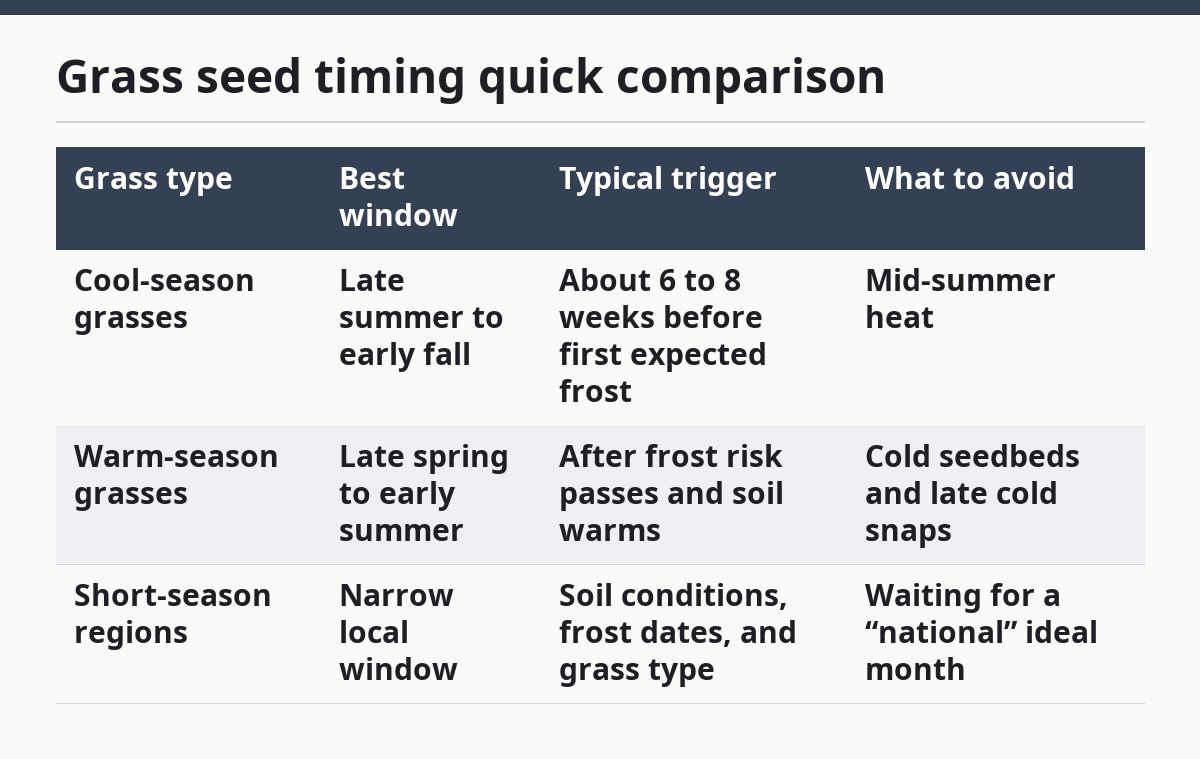
Grass seed timing quick comparison
| Grass type | Best window | Typical trigger | What to avoid |
|---|---|---|---|
| Cool-season grasses | Late summer to early fall | About 6 to 8 weeks before first expected frost | Mid-summer heat |
| Warm-season grasses | Late spring to early summer | After frost risk passes and soil warms | Cold seedbeds and late cold snaps |
| Short-season regions | Narrow local window | Soil conditions, frost dates, and grass type | Waiting for a “national” ideal month |
FAQ
What is the best month to plant grass seed in my region?
There is no single best month for every yard. For many northern lawns, late August through September works well for cool-season grass; for many southern lawns, late spring into early summer fits warm-season grass.
Can I use the same timing for every type of grass seed?
No. Cool-season grass and warm-season grass follow different temperature patterns, so the right seeding window changes with the grass type.
Do frost dates really matter for grass seed?
Yes. Frost dates help you leave enough time for roots to form before cold weather can damage seedlings.
Do I need a soil thermometer?
It helps a lot. Air temperature can be misleading, but soil temperature shows whether the seedbed is ready.
Should I follow my state’s general planting calendar?
Use it as a starting point, then adjust for your town, elevation, slope, shade, and grass type. Local conditions can shift the window by a week or more.
Drafted with AI; not yet reviewed by a person.





Leave a Reply