Last updated: November 29, 2026
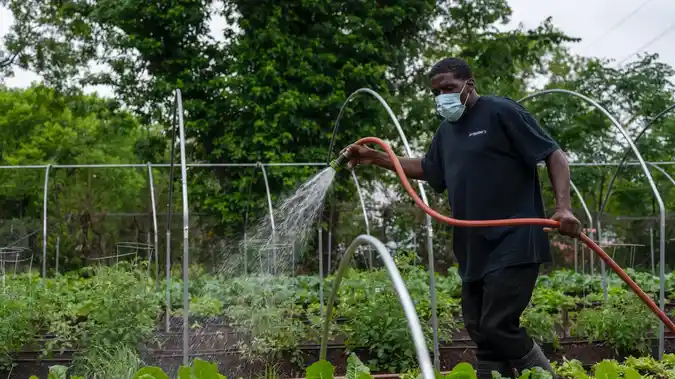
Quick answer: for container plants and raised beds, start with one small zone and test a low-throw option such as micro-spray, a soaker hose, or a bubbler. For container plants and raised beds, the goal in How to choose a sprinkler for container plants and raised beds is not a wide lawn pattern; it is steady coverage with little overspray. In many 2- to 3-foot-wide beds, that means keeping water low and close to the soil.
Key takeaways
- Container plants and raised beds need narrow, low-throw watering, not a broad arc.
- Micro-spray works when plants are grouped tightly and need light coverage across the surface.
- A soaker hose fits long rows and simple bed layouts, especially when the soil line is level.
- A bubbler is useful for filling a single container or a short run of large pots.
- Overspray wastes water, wets paths, and can leave some roots dry if the pattern is too wide.
What kind of sprinkler fits container plants and raised beds?
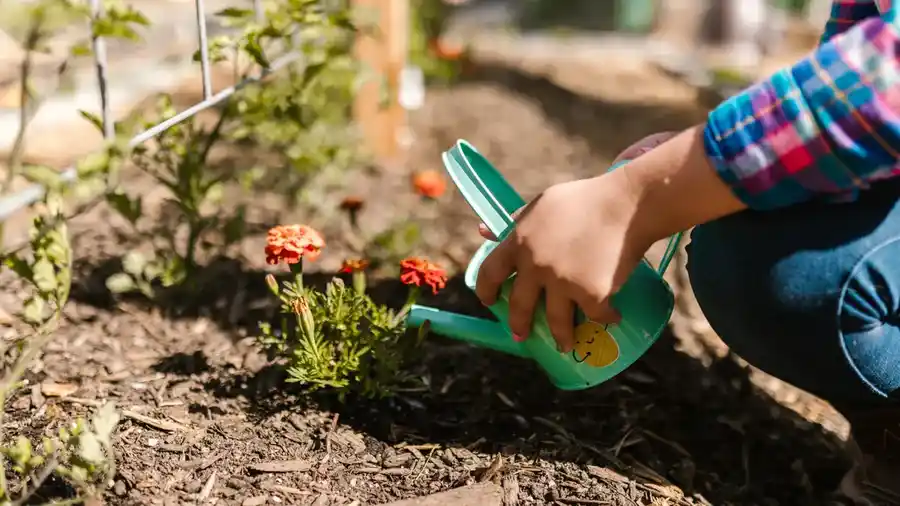
The best fit is often a small-zone sprinkler that matches the shape of the planting area, not a general-purpose lawn head. For container plants, that usually means a bubbler or a very short-throw micro-spray aimed at each pot group. For raised beds, a soaker hose or micro-spray line is often easier to control because it keeps water low and close to the soil.
A generic pop-up head is usually the wrong tool here. It throws water too high, misses the root zone in windy spots, and can soak paths, siding, or the outside of the bed. That is a poor trade in any bed under about 4 feet wide, where the target area is compact and overspray shows up fast.
Think in terms of layout first. A square raised bed with evenly spaced vegetables needs even edge-to-edge coverage. A cluster of 10-inch or 14-inch pots needs more precise aim. A long rectangular bed often works best with a straight line of soaker hose, while an L-shaped bed may need two short zones so the water stays where the plants are.
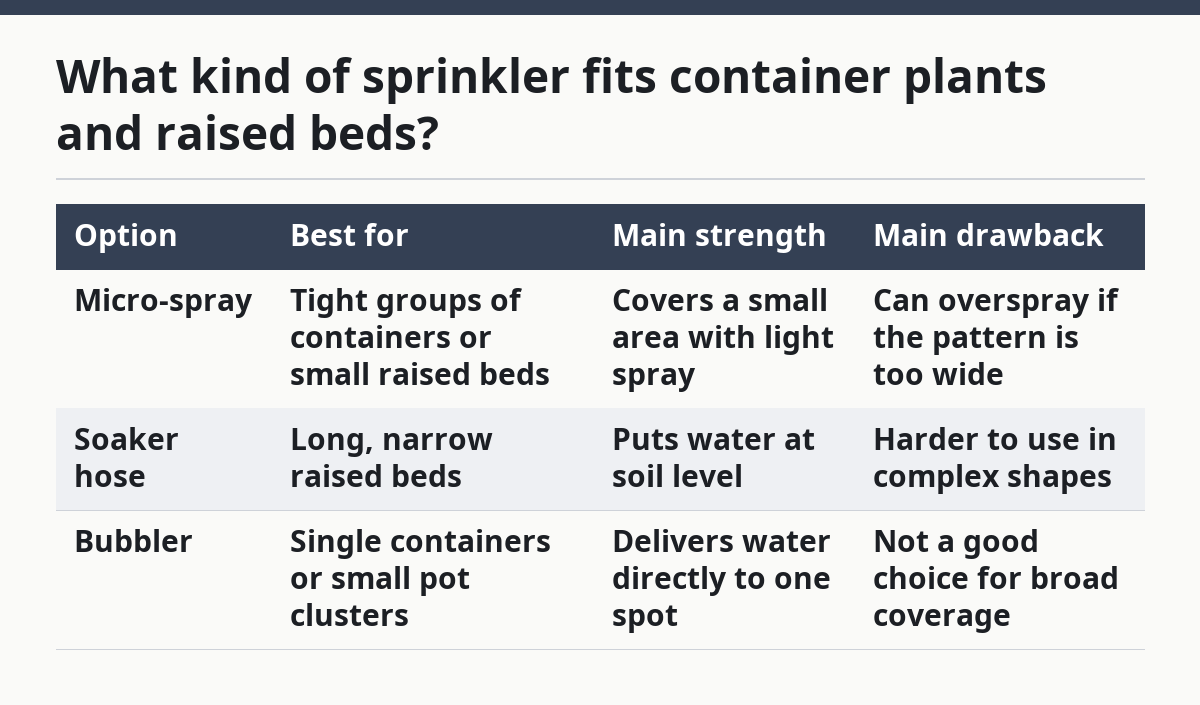
A useful comparison looks like this:
| Option | Best for | Main strength | Main drawback |
|---|---|---|---|
| Micro-spray | Tight groups of containers or small raised beds | Covers a small area with light spray | Can overspray if the pattern is too wide |
| Soaker hose | Long, narrow raised beds | Puts water at soil level | Harder to use in complex shapes |
| Bubbler | Single containers or small pot clusters | Delivers water directly to one spot | Not a good choice for broad coverage |
If the bed has mixed plant sizes, the safer choice is the one that can be split into smaller zones. The how to choose a sprinkler hub covers broader sprinkler selection, but this page stays focused on the tight, raised spaces that need more careful aim. For related setup basics, see how to set up a small-zone irrigation layout and how to avoid overspraying raised beds.
How does bed shape change the choice?
Bed shape decides whether the water pattern should run in a line, a circle, or a series of small spots. A bed that is 2 to 3 feet wide is usually easier to water with a soaker hose or one narrow micro-spray line. A bed with many corners, cutouts, or different plant heights often needs more than one small zone so no corner gets left dry.
A raised bed with straight sides and uniform planting is the easiest case. One hose laid in a loop or a pair of parallel runs can reach most roots without spraying the walkway. A bed with containers set inside it is different; each container may need its own bubbler or a separate micro-spray point because the potting mix dries faster than the surrounding soil.
Height affects the pattern too. A raised bed sits above the surrounding ground, so wind can push spray away more easily. That makes low-throw patterns a better match than high arcs. If the planter is against a wall or fence, a setup that can be directed inward is often the safer choice to reduce staining, runoff, and wasted water.
There is also the question of plant density. Dense plantings benefit from evenly spaced delivery points. Sparse plantings do not need the same coverage and can do poorly if the water lands on empty soil between plants. In that case, a bubbler or a short section of micro-spray may be better than a full-bed spray pattern.
What should the water pattern do?
The water pattern should wet the root zone without soaking the edges, paths, or nearby walls. That means choosing a short throw, light flow, and a pattern that fits the bed width rather than trying to cover everything in one pass. For most container plants, the pattern should land inside the pot or just at the base of the plant. For raised beds, it should spread across the top layer of soil without bouncing off hard surfaces.
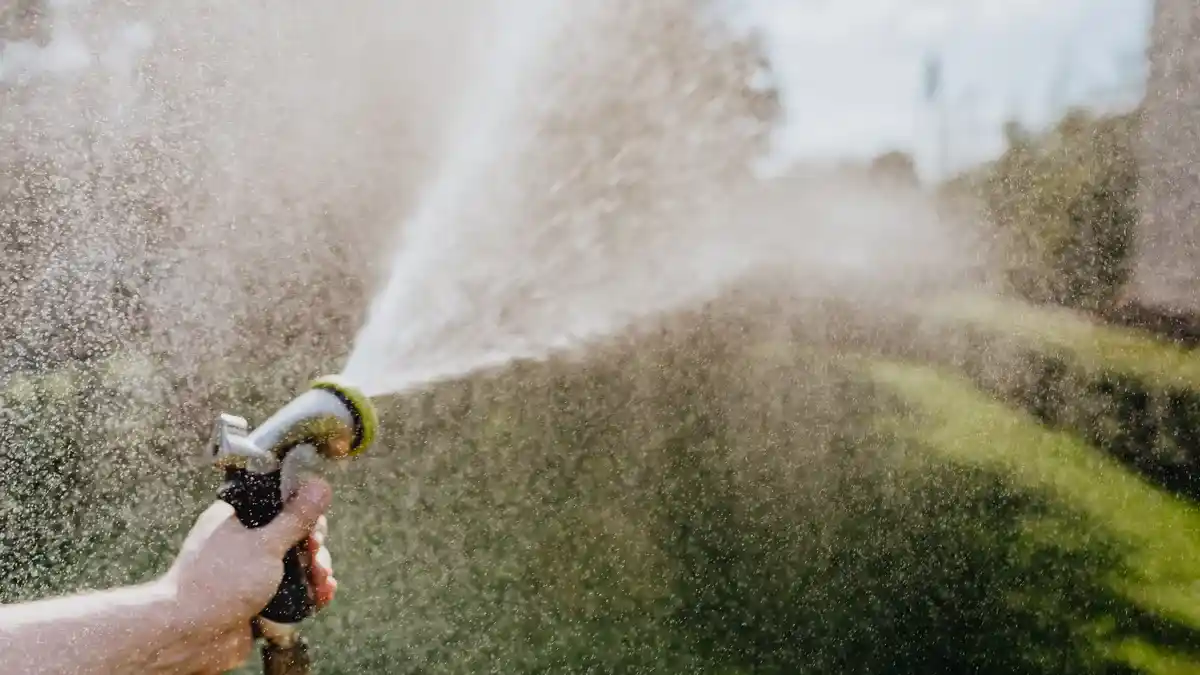
A common mistake is choosing a pattern because it looks complete on paper. A wide spray can look efficient and still miss the root zone in a windy yard or on a hot patio. A lower pattern usually wastes less water and leaves the foliage drier, which is often a better fit for compact plantings.
When comparing patterns, ask three simple questions. Does it stay inside the bed? Does it avoid overspray? Can it be adjusted if the planting changes later? A pattern that is fixed at one size can become a bad fit when a bed shifts from seedlings to larger plants or when container pots are moved closer together.
The best patterns for this job are usually narrow arcs, short runs, and direct delivery. Anything that throws water high or far is more likely to hit the wrong surface. For this topic, the best pattern is the one that disappears into the planting layout, not the one that looks impressive from across the yard.
How do I set up a small-zone irrigation layout?
A small-zone layout should divide the planting area into short, controlled runs instead of one broad spray. Start by measuring the bed or container group, then match the delivery method to the shape. A 6-foot raised bed is a very different job from six mixed-size pots on a patio.
Use this process:
- Measure the planting area. Note the bed length, width, and where the pots or plants sit. A simple sketch on paper is enough.
- Pick the lowest-throw option that fits the shape. Use a soaker hose for a long rectangle, micro-spray for a tight cluster, or a bubbler for a single container.
- Place the line at soil level. Keep the hose or emitter close to the root zone so water does not drift away.
- Check the edges. Stand back and look for wet walkways, siding, or dry corners. Adjust until the water stays inside the target area.
- Split the area if needed. If one pattern cannot cover the whole bed without overspray, divide it into two smaller runs rather than forcing one large spray to do too much.
The main goal is even coverage with as little waste as possible. A longer bed may need more than one line, while a shallow container grouping may need only one or two emitters. That is normal.
Small-zone irrigation works because it respects the shape of the planting area instead of trying to treat it like lawn. EPA WaterSense and university extension irrigation guides both emphasize efficient outdoor watering and careful placement. See the EPA WaterSense outdoor watering guidance and a university extension irrigation guide such as UC ANR irrigation resources. For this topic, the number that matters is not gallons per minute alone; it is whether the water lands in the root zone.
What mistakes waste the most water?
The biggest mistake is using a spray pattern that is too wide for the space. That wastes water on paths and fences, and it leaves the root zone unevenly watered. A second mistake is placing the watering point too far from the plant crown, which is common in deep containers and wide raised beds.
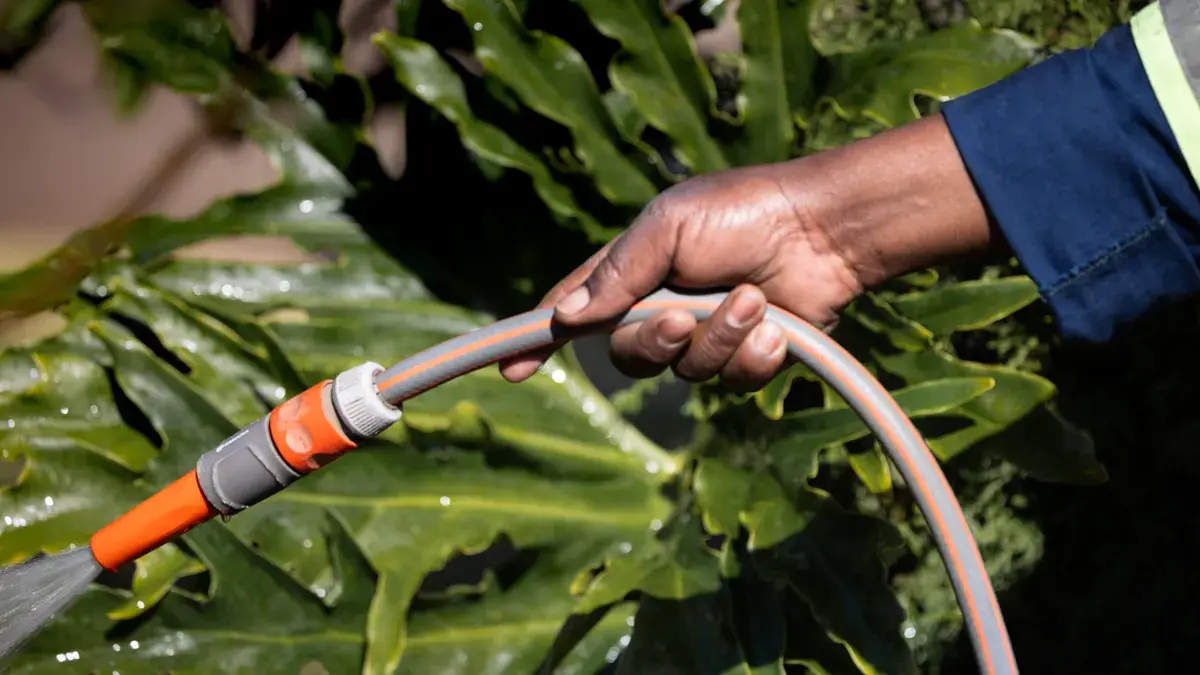
Another common error is treating every bed like it needs the same output. A sunny patio container and a shaded raised bed do not dry at the same pace, so one fixed setup can be too much for one area and too little for another. That is why adjustable micro-spray or split zones are often safer than a single fixed pattern, and why a garden center or irrigation professional may be worth consulting when the layout is mixed or unusual.
Clogging is another issue. Small openings can clog faster than wider ones, especially where water carries grit. A blocked emitter may look fine from a distance but leave one pot dry for days. The fix is simple: check the flow at the start of the season and again after any change in water pressure or layout.
There is also the temptation to aim for the foliage instead of the soil. For container plants and raised beds, that usually costs water and can create damp surfaces that dry slowly. Aim low and direct the flow to the root area. For a bed with mulch, keep the pattern close enough that water gets through the top layer instead of landing beside it.
Which option is wrong for this job?
A full-size lawn sprinkler is wrong for this job, and so is any head that throws water high and wide. Container plants and raised beds need precision, not distance. A broad pattern may look efficient in a yard, but it usually misses the real target in compact planting areas.
This is not the place for a one-size-fits-all setup. If the planting area includes many different pot sizes, uneven bed edges, or a narrow walkway beside it, the safer choice is a smaller pattern that can be aimed or split. That may mean more setup at the start, but it usually saves water and reduces cleanup later.
A tall spray is also a poor match for windy spots. Even a mild breeze can move the water off target when the delivery point is high. Low delivery avoids that problem better than trying to overcome it with more pressure. That is why soaker hose, micro-spray, and bubbler setups come up again and again for this kind of planting.
For gardeners who want broad coverage across a mixed landscape, a different guide is the better fit. This page is for the tight spaces that need careful control, not for large beds, lawn edges, or general yard irrigation.
Where do I check the basics before I buy?
The basics are coverage, control, and fit. Coverage means the water reaches the whole planting area without gaps. Control means the pattern can be kept inside the bed or container group. Fit means the shape and size of the sprinkler match the shape and size of the planting area.
A practical way to judge this is to compare the delivery method against the layout before buying anything. A row of containers favors direct, low delivery. A rectangular raised bed favors a straight line or loop. A mixed bed with corners favors a setup that can be divided into smaller runs.
For general watering guidance, the EPA WaterSense program and university extension irrigation guides are useful references for efficient outdoor watering and water-saving practices. Those sources are helpful because they keep the focus on delivery pattern, placement, and waste, which matters more here than brand names or decorative features.
The final test is simple: if the setup looks bigger than the planting area, it is probably the wrong fit. Small planting spaces need small, controlled watering. That rule does more to guide the choice than any long feature list.
Can sprinklers water raised beds?
Yes, but only if the pattern stays low and fits the bed shape. A soaker hose, micro-spray, or bubbler is usually a better match than a broad lawn head because raised beds are narrow and easy to overspray. The goal is to wet the root zone without throwing water onto paths, siding, or the outside of the frame.

What is the best way to water container plants?
The best way is direct, low watering that reaches the potting mix without waste. A bubbler or a short micro-spray usually works better than a wide spray because containers dry out quickly and do not need water landing far from the plant. The smaller and more exposed the pot, the more important precise placement becomes. For container plants, the right answer depends on pot size, wind exposure, and how many pots share one zone, so a local irrigation professional can help if the layout is crowded or uneven.
How do I avoid overspraying raised beds?
Avoid overspraying by choosing a short-throw pattern, placing it at soil level, and splitting the bed into smaller zones if one pattern is too wide. Raised beds often sit higher than the ground, so wind can push water off target. If water hits the walkway or the frame, the pattern is too large for the bed.
Drafted with AI; not yet reviewed by a person.
Leave a Reply