
Last updated: November 29, 2026
Quick answer: in a windy yard, start with a rotary head or low-trajectory spray head, and aim for a lower, tighter pattern rather than a tall, airy one. For how to choose a sprinkler for windy yards and spray drift, the simplest setup is usually the one that keeps water close to the ground and off hard surfaces.
Key takeaways
- Wind pushes fine droplets away fast, so a safer pick is usually the one that makes larger drops and keeps the spray low.
- Rotary heads are often better than fixed spray heads in open, exposed yards because they move water in a tighter pattern.
- Low-trajectory spray matters as much as nozzle type; a flatter arc gives wind less chance to catch the stream.
- Placement still matters. A good head in a bad spot can drift as much as a poor head in the right spot.
- This is about putting water on target, not about fixing every irrigation problem at once. Soil, pressure, and spacing still matter too.
What makes a windy yard hard to water?
A windy yard is hard to water because wind breaks a spray pattern apart before the water reaches the soil. The same head that works in calm weather can send droplets off course once gusts start pushing them sideways.
The biggest problem is spray drift. Fine droplets hang in the air longer, so they move farther before they land. That is why a soft mist often looks efficient at the nozzle and wasteful on the lawn. A heavier stream or larger droplet has more mass, falls faster, and resists wind better.
This is where the choice between a rotary head and a fixed spray head starts to matter. A fixed spray head sends water through a set arc such as 90 degrees, 180 degrees, or 360 degrees. In a windy yard, that lighter spray can drift more. A rotary head moves the water in a rotating stream, which usually creates a more controlled pattern for exposed spaces.
The short version is simple: the more open the yard, the less you want a fine, high spray. If the yard sits between fences, buildings, or hedges, the wind problem is smaller. If the lawn is open on two or more sides, the wind problem becomes part of the sprinkler choice.
Which type works best in wind?
A rotary head is often the better choice for windy yards because it tends to send out a heavier stream with less spray drift. A fixed spray head can still work, but it is easier for the wind to scatter.
Here is the useful comparison.
| Option | What it does well | Wind drawback | Best use |
|---|---|---|---|
| Rotary head | Controlled rotating stream; better on larger or open areas | Slower coverage and more moving parts | Windy, open, or irregular lawns |
| Fixed spray head | Simple coverage for small zones | Fine droplets drift more in wind | Small, sheltered beds or tight lawn strips |
| Low-trajectory nozzle | Flatter spray path keeps water lower | Can still drift if pressure is too high | Exposed areas where drift is a problem |
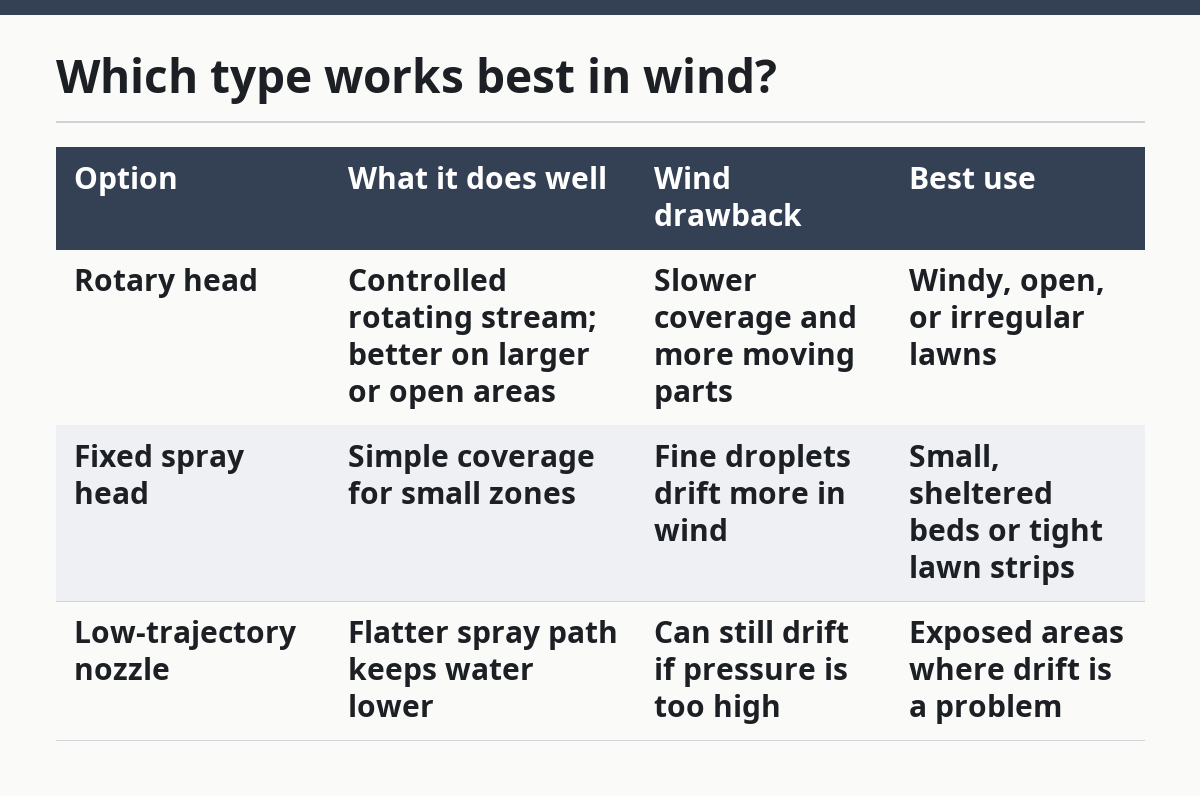
A rotary head is not magic. It trades speed for control, and it can be the wrong choice for a tiny strip where a fixed spray head would cover the space more cleanly. It is also not the answer if pressure is poor or the heads are aimed too high.
A fixed spray head can still make sense in a sheltered yard, especially for narrow planting beds or short throws. In a windy yard, though, it is often the first thing I would question. If the spray looks like a light cloud, the wind has too much to grab.
How should you set the spray pattern?
A low-and-tight spray pattern is usually better for wind than a tall, airy one. A low-trajectory spray keeps the water closer to the ground, which gives the wind less time and space to push it off course.
The practical choice comes down to three things: arc, droplet size, and position. A smaller arc such as 90 degrees or 180 degrees puts water only where it is needed. Larger arcs such as 360 degrees are useful for round or open areas, but they can waste water fast if the head is aimed poorly. Droplet size matters too. Bigger droplets usually drift less than fine droplets.
Use this core procedure when picking a sprinkler for a windy yard:
- Look at the exposed part of the yard first, not the whole property. Mark the beds, narrow strips, and open lawn sections that face the wind, because those spots need the most control.
- Choose a rotary head for larger open areas, or a fixed spray head only for small sheltered zones. This narrows the spray pattern before you start adjusting anything else.
- Pick the lowest spray path available for that head or nozzle style. A flatter arc keeps the water lower, which helps reduce drift in steady wind.
- Match the arc to the space, such as 90 degrees for corners or 180 degrees for edges. That keeps water on the target instead of throwing it across a walkway or driveway.
- Place heads so the spray overlaps where needed, not far beyond the planting area. Clean overlap matters more than a long throw in a windy yard.
- Watch the pattern on a windy day and look for the first sign of misting or sideways pull. If the spray breaks apart, move to a heavier stream or lower arc rather than trying to force a high pattern to work.
A common mistake is choosing a head because it looks strong at the nozzle. Strong-looking spray can still drift badly if the droplets are fine and the path is high. Another mistake is using a large 360-degree pattern where a 90-degree or 180-degree pattern would do less damage.
How do you reduce drift without changing the whole system?
You reduce drift by lowering the spray, tightening the pattern, and keeping the water in the right place from the start. In many windy yards, that matters more than swapping the entire system.
A few placement choices make a real difference. Put heads so they do not spray directly into the wind when you can avoid it. Use the yard’s edges, fence lines, and shrubs as natural wind breaks where they already exist. Keep spray off sidewalks, driveways, and hard surfaces, because hard surfaces show drift fast and waste water fast.
Pressure also matters, even when the topic is not pressure itself. Too much pressure can turn a clean stream into a foggy spray. Too little pressure can leave gaps and weak coverage. If the spray looks shredded or hazy, the head may be too high, the stream too fine, or the pressure too aggressive for the nozzle.
The first sentence to remember is this: the best anti-drift move is often not a new gadget, but a lower, heavier pattern. That is why low-trajectory spray is the central idea for windy yards. It is simple, and it often addresses the core problem fastest.
If the yard is very exposed, a rotary head with a lower arc is often the safer bet than a fixed spray head with a tall mist. If the area is tiny and enclosed, a fixed spray head can still be fine. The wrong fit is using a delicate spray in an open, gusty place and expecting it to behave like a calm-day setup.
What mistakes cost the most water?
The most expensive mistakes are using too much arc, too much height, and too fine a spray. Those three choices let wind carry water away before it reaches the soil.
A few errors show up again and again:
- A misty pattern that looks efficient but drifts in the first breeze.
- A 360-degree head in a place that only needs 90 degrees or 180 degrees.
- A head mounted or aimed too high, so the spray spends too long in the air.
- A fixed spray head used in an open yard where a rotary head would hold the pattern better.
Each mistake has a cost. Fine mist raises drift. Oversized arc wastes water outside the target zone. Extra height gives the wind more time to work. The result is patchy turf, wet pavement, and dry spots where roots actually need the water.
The fix is usually boring, which is good. Swap to a lower trajectory, reduce the arc, and choose the head style that keeps the pattern compact. If a setup still drifts after that, the next place to look is the layout, not just the nozzle.
This is also where a lot of generic advice goes wrong. It tells people to “adjust the sprinkler” without saying what that means. In a windy yard, adjustment means changing the kind of spray pattern, not only turning a screw a little bit.
When is a rotary head the wrong choice?
A rotary head is the wrong choice when the area is very small, tightly shaped, or sheltered enough that a fixed spray head gives cleaner coverage. It is also not the right answer if the yard needs very quick coverage in a compact bed.
Rotary heads usually trade speed for control. That trade works well in open, windy yards because the water stays more organized. But in a narrow strip beside a walkway, the rotating stream may be more than you need. A fixed spray head with a 90-degree or 180-degree arc can be simpler there.
It can also be the wrong fit if the yard has many tiny sections with different shapes. In that case, the better answer may be a mixed setup: rotary heads for open lawn, fixed spray heads for tight corners, and a low-trajectory nozzle where drift is the main complaint. That split approach is often better than forcing one style to do every job.
The real test is not brand loyalty. It is whether the spray stays on target in the wind that actually hits the yard. If the pattern breaks apart, switch the style. If the pattern is clean but the coverage is wrong, change the arc.
For a broader decision path on the site, the hub on how to choose a sprinkler is the next step after this page.
What should you ask before you buy?
You should ask how the spray will behave in wind, not just how far it will reach. Distance matters, but a long throw with drift is a poor trade in an exposed yard.
Before choosing, check these points:
- Does the head make a low-trajectory spray?
- Does it create larger droplets or a tight rotating stream?
- Can it be set to 90 degrees, 180 degrees, or 360 degrees where needed?
- Is it meant for a small sheltered zone or an open lawn?
- Will the placement keep the spray off hard surfaces?
If the answer to most of those questions is no, the head is probably a weak fit for a windy yard. That does not make it a bad product; it just makes it the wrong tool for this job.
Two helpful references for irrigation basics are EPA WaterSense and the Irrigation Association. EPA WaterSense explains water-saving irrigation practices, and the Irrigation Association publishes practical guidance on irrigation systems and scheduling. For a windy yard, those sources are useful because they keep the focus on putting water where it belongs rather than on adding more spray.
Why does wind affect sprinklers so much?
Wind affects sprinklers because the water spends time in the air before it lands. The lighter and higher the spray, the easier it is for moving air to push it aside.
A mist breaks up fastest, so it drifts the most. A heavier stream or lower arc spends less time exposed, which is why it usually performs better in open yards with steady wind.
What sprinkler is best for windy conditions?
A rotary head is often the best starting point for windy conditions because it tends to make a tighter, heavier spray pattern. A low-trajectory fixed spray head can also work in smaller or more sheltered spots.
The wrong choice is usually a fine mist in an open yard. That kind of spray looks smooth at the head and messy on the ground.
How do I reduce sprinkler drift?
Reduce drift by lowering the spray path, tightening the arc, and using a head that creates a heavier stream. Placement matters too, because a head pointed into open wind will drift more than one protected by the yard’s layout.
If the spray still looks hazy, the pattern is probably too delicate for the conditions. In that case, a rotary head or low-trajectory nozzle is the better fix.
Drafted with AI; not yet reviewed by a person.



Leave a Reply