Last updated: November 28, 2026
In short: choose the sprinkler whose spray distance and coverage radius match the area you need to wet, with a little overlap at the edges and no throw aimed past sidewalks, fences, or beds. A sprinkler with the wrong spray distance wastes water fast: too short leaves dry patches, too long sprays pavement and windows. The right coverage radius is the one that fits the space without forcing the pattern to do a job it was not built for.
Key takeaways
- Match the sprinkler’s throw distance to the farthest part of the area you want to water, not to the middle.
- Look at coverage radius and coverage diameter together, since one is half of the other.
- Pick the sprinkler head and spray nozzle for the shape of the area, not just for the largest number on the box.
- Use reach adjustment and nozzle choice to trim overspray instead of forcing one head to cover everything.
- A little overlap helps coverage; a big mismatch usually means the wrong head type.
What does sprinkler coverage radius mean?
Sprinkler coverage radius is the distance from the head to the outer edge of the spray pattern. If a head covers a 10-foot radius, the full watered circle is about 20 feet across. That number matters because it tells you whether the sprinkler can reach the edge of the area without overreaching it.
A generic “sprays up to 30 feet” claim is not enough on its own. A rotary sprinkler, an oscillating sprinkler, and a fixed spray nozzle can all advertise distance, but they do not deliver water in the same shape. A rotary sprinkler sends one or more moving streams in a narrower pattern. An oscillating sprinkler lays down a moving fan across a rectangular strip. A spray nozzle usually creates a fixed fan with a shorter throw and tighter control.
The useful question is not “Which one sprays farthest?” It is “Which one matches the space?” A long throw can be a bad fit for a narrow side yard, a small bed, or a strip beside a driveway. In those cases, a shorter-radius head often does the cleaner job because it puts water where it belongs the first time.
For a broader watering guide, this page supports the main “how to choose a sprinkler” hub.
How do I match the spray distance to the area?
Match the spray distance to the farthest edge of the area, then leave the pattern room to finish cleanly. That is the simplest way to avoid dry edges and overspray at the same time.
-
Measure the area with a tape measure and note the longest and widest sides in feet.
A 12-foot by 18-foot strip needs different coverage than a 20-foot square, even if both feel “small.” -
Choose the sprinkler head for the shape first, then for distance.
A spray nozzle suits tight beds and narrow runs; an oscillating sprinkler fits rectangular turf; a rotary sprinkler works better when the spray needs to reach farther. -
Check the throw distance on the product label and compare it to the farthest edge.
If the edge is 15 feet away, a head rated for 15 feet is usually too tight; a little extra reach gives the stream room to land without falling short. -
Look at the coverage radius, not just the max distance language.
Radius tells you the actual reach from the head outward, which is the figure that matters when the unit sits at one edge of the space. -
Confirm the pattern can be adjusted if the area has corners, curves, or a narrow end.
Reach adjustment helps trim spray that would otherwise hit paving, fencing, or planting beds. -
Test the edge mentally before buying by asking what happens at the boundary.
If the spray lands past the boundary line, the head is too aggressive for that spot; if it stops short, the area will need a different model or a different placement.
The mistake many readers make is buying for the biggest listed distance and hoping the rest will sort itself out. That often leads to uneven watering and a pattern that hits only part of the target. A better fit is usually the one that covers the shape with the least strain.
Which sprinkler type fits which distance?
The right type depends on how much distance the head needs to cover and how tidy the pattern must be. A spray nozzle usually gives the shortest, most controlled reach. An oscillating sprinkler covers a strip or rectangle with a fan-like sweep. A rotary sprinkler is the better choice when the area needs a longer throw and a more directed stream.
| Sprinkler type | Best use | Typical pattern shape | Main strength | Main drawback |
|---|---|---|---|---|
| Spray nozzle | Small beds, tight edges, short runs | Fixed fan | Good control and cleaner edges | Shorter reach |
| Oscillating sprinkler | Rectangular lawns or strips | Back-and-forth fan | Covers a wide band | Can overspray corners |
| Rotary sprinkler | Larger areas that need longer throw | Moving streams | Reaches farther with focused delivery | Can be too much for small spaces |
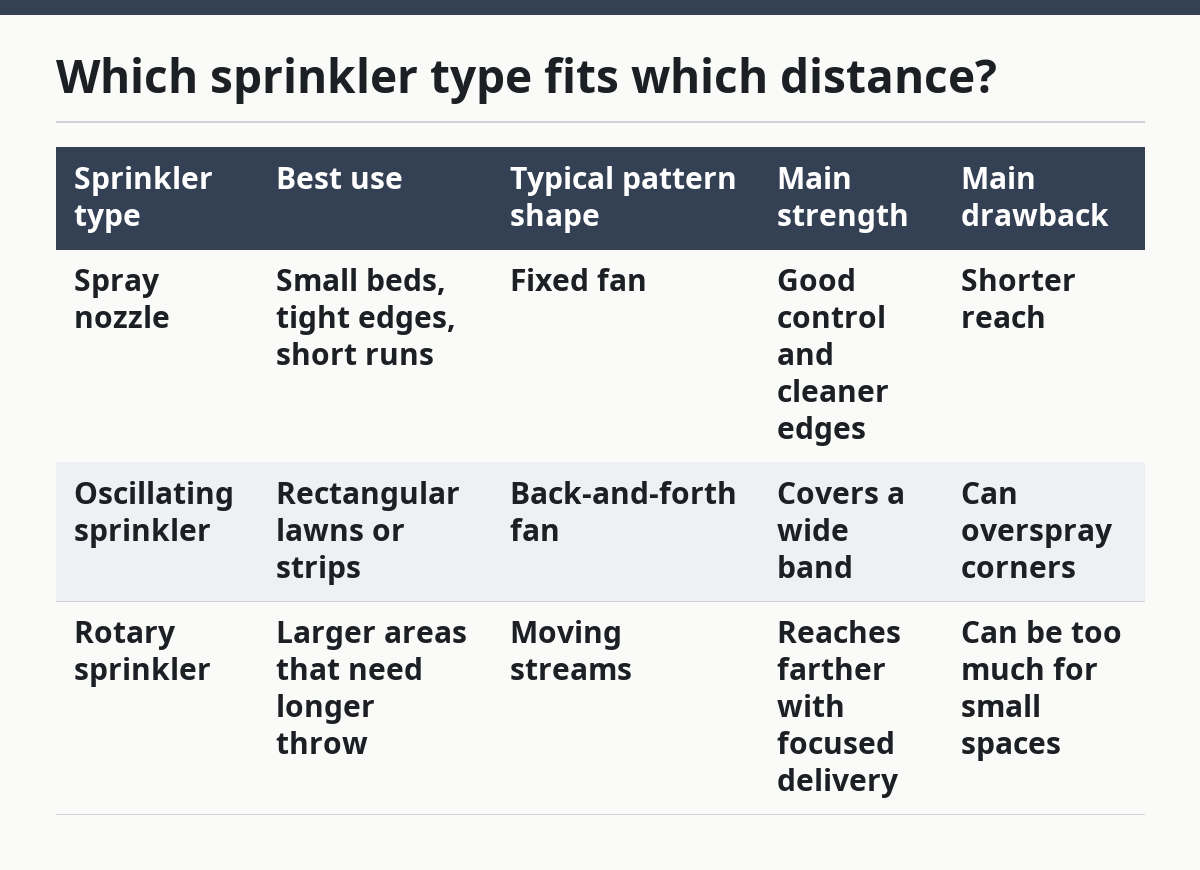
The wrong choice usually shows up at the edges. A spray nozzle can leave a far corner dry if the area is too deep. A rotary sprinkler can spray past the intended zone if the space is small. An oscillating sprinkler can fit a narrow rectangle well, but it is not the best answer for irregular borders with curves and angles.
A 20-foot by 20-foot square and a 10-foot by 30-foot strip can both be “medium,” but they do not want the same head. The square may suit a rotary head with overlap from more than one point. The strip may do better with an oscillating pattern, as long as the spray stays inside the boundaries. The shape decides the fit more than the headline range.
How much overlap should the water pattern have?
The water pattern should overlap enough to avoid dry gaps, but not so much that the same ground gets soaked twice from every direction. Overlap matters because no spray pattern lands in a perfect line, and wind, slope, and placement all change where the water ends up.
A simple way to think about it is this: the edge of one pattern should meet the next pattern without leaving a bare strip between them. That is true for spray nozzles, rotary heads, and oscillating sprinklers alike. If the patterns barely touch, the seam between them often turns into the driest part of the area.
Too much overlap has a cost too. It can create soggy zones, runoff, and waste. It can also hide a bad fit by making the center look wet while the edges still miss coverage. A setup that relies on heavy overlap is usually working around the wrong spray distance.
This is where reach adjustment helps. If the throw is too long, shorten it before trying to fix the shape with more heads. If the throw is too short, move to a head with a larger coverage radius rather than stacking more spray into one spot. The goal is even coverage, not brute force.
The cleanest pattern is often the one that hits the target once and lets the next pattern meet it neatly. That is easier to get when the sprinkler head matches the area size from the start. A 15-foot radius head in a 10-foot zone often creates the very overlap problem the reader is trying to avoid.
What should I check on the box before buying?
Check the spray distance, the coverage radius, the nozzle type, and whether the head allows reach adjustment before buying anything. Those four details tell more truth than a marketing headline that says “large coverage” or “long range.”
Start with the coverage number in feet. Then look at whether that number is a radius, a diameter, or a maximum throw claim. Radius tells the usable reach from the head outward. Diameter tells the full width across the pattern. Mixing those up is one of the fastest ways to buy the wrong head.
Look next at the shape the product is meant to water. A rotary sprinkler is a poor fit for a short, wide strip that needs a flat fan. A spray nozzle is a poor fit for an area that needs distance beyond a small bed. An oscillating sprinkler is best when the area is more rectangular than round.
The last check is adjustability. A head with some reach adjustment is easier to tune around a path, a fence, or a planter edge. That does not make a bad match good, but it does help a close match become useful. If the product gives no room to trim the pattern, the margin for error is smaller.
The better purchase is often the one that fits the shape with less effort, not the one with the biggest claim. A 12-foot pattern that lands inside the target is better than a 25-foot pattern that sprays into the driveway.
What mistakes should I avoid?
The biggest mistake is choosing by maximum distance alone, because the farthest throw is not the same thing as the best fit. A long spray distance can look impressive and still miss the real job. It may wet outside the area, leave inner corners weak, or create a patchy edge that needs extra heads.
Another common mistake is treating a coverage diameter like a radius. If a label says 20 feet across and the reader reads it as 20 feet out from the head, the result is a mismatch that can double the expected reach. That kind of error often leads to overspray, which is easy to notice only after the setup is in place.
A third mistake is buying one sprinkler to cover a shape that actually needs different zones. A narrow strip, a square corner, and a curved edge rarely want the same pattern. One head type can do one job well, but it usually cannot solve every part of a mixed layout. This is why a spray nozzle, rotary sprinkler, and oscillating sprinkler are not interchangeable.
The simple fix is to measure first and buy second. If the area is 14 feet deep, a head built for 8 feet will miss the back edge, while one built for 25 feet may wash the fence line. When the target is clear, the right throw distance becomes easier to spot.
If water lands on pavement, the setting is too long or the pattern is too open. If dry patches show up at the far edge, the reach is too short or the head type is wrong. In both cases, the issue is usually the match, not the water.
For reference, the EPA WaterSense program explains outdoor water use basics, and the Irrigation Association is a useful source for irrigation terms and equipment concepts. Those references help when a product label uses vague language instead of a clear distance figure.
How far should a sprinkler spray?
How far a sprinkler should spray depends on the edge of the area it needs to cover, not on the biggest number the label offers. The right throw distance reaches the far boundary without spraying past it. A short bed usually needs a shorter-radius head, while a larger open area may need a rotary sprinkler with a longer reach.
How do I know how much coverage I need?
The amount of coverage you need is the area size and shape you are trying to wet, measured in feet. A 10-foot by 10-foot square asks for a different pattern than a 10-foot by 25-foot strip. The right answer is the head that fits the shape with the least wasted spray and the least dry edge.
Does spray distance affect water pressure?
Yes, spray distance and water pressure are linked, because a longer throw usually needs more force to keep the pattern consistent. If the pressure is too low for the chosen head, the spray may fall short or look weak. If the pressure is too high for the pattern, overspray and misting can become a problem, so the head must still match the setup.
Drafted with AI; not yet reviewed by a person.
Leave a Reply