Last updated: November 20, 2026
Quick answer: for sprinkler material and build quality, check 4 parts before you buy—body, connector, seal, and moving parts. Sprinkler material and build quality: what matters before you buy matters because those parts decide how long the sprinkler lasts, how well the seals hold, and how often the body cracks, leaks, or jams. A plastic sprinkler can be fine, but only if the body, connector, and seal are made well. A metal sprinkler can feel tougher, yet it still fails fast if the threads or moving parts wear out.
Key takeaways
- The body material matters less than the weak points: connector, seal, threads, and moving parts.
- Plastic is not automatically cheap, and metal is not automatically durable.
- A sprinkler with a solid connector and tight seal is usually a better buy than one with a heavier shell.
- Thin plastic, loose threads, and exposed wear points are the signs that usually shorten service life.
- Check the parts that meet the hose or pipe first, because that is where many leaks start.
How I chose what matters
I focused on the parts that affect lifespan, not spray pattern or coverage. This guide is based on standard product details, common material terms used by manufacturers, and general build-quality checks that matter for sprinkler construction.
I compared the main material choices people see in stores: plastic sprinkler bodies, metal sprinkler bodies, and mixed designs that combine a plastic shell with metal fittings or a metal connector. I also looked at the failure points that show up again and again in product descriptions: seals, threads, joints, pivots, and the connector where water enters the sprinkler. For background on common material and durability language, I also looked at guidance from organizations such as ASTM International and the Irrigation Association, plus EPA WaterSense guidance on water-efficient irrigation products.
What does sprinkler construction actually mean?
Sprinkler construction means how the body, connector, seal, and working parts are put together. That includes the shell material, the thread quality, how the head joins to the hose or pipe, and whether the moving parts sit inside a protected housing.
A sprinkler can look strong on the shelf and still be weak where it counts. A thick outer shell means little if the connector strips after a season or the seal starts to seep. A better build usually has fewer loose seams, cleaner threads, and parts that sit tightly together instead of rattling when you shake the sprinkler.
For a buyer, the useful question is not “plastic or metal?” by itself. The better question is “which parts are stressed, and how well are those parts made?” That is the kind of thinking that fits the larger guide to how to choose a sprinkler, because build quality should support long use, not just one good afternoon of watering.
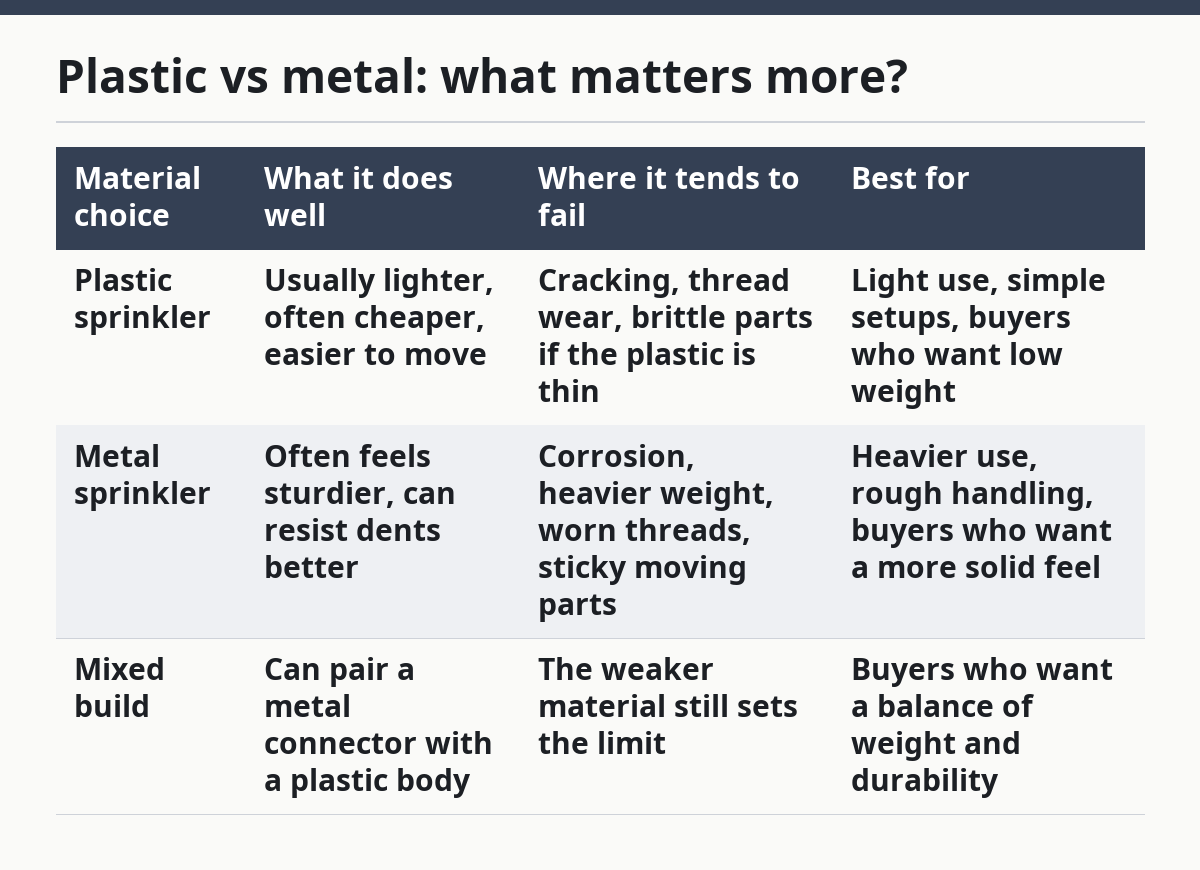
Plastic vs metal: what matters more?
The connector and the wear points matter more than the label on the shell. A plastic sprinkler can outlast a metal one if the plastic is thick, the threads are clean, and the seal sits tightly. A metal sprinkler can still fail early if corrosion or thread wear starts at the connector.
Here is the practical trade-off:
| Material choice | What it does well | Where it tends to fail | Best for |
|---|---|---|---|
| Plastic sprinkler | Usually lighter, often cheaper, easier to move | Cracking, thread wear, brittle parts if the plastic is thin | Light use, simple setups, buyers who want low weight |
| Metal sprinkler | Often feels sturdier, can resist dents better | Corrosion, heavier weight, worn threads, sticky moving parts | Heavier use, rough handling, buyers who want a more solid feel |
| Mixed build | Can pair a metal connector with a plastic body | The weaker material still sets the limit | Buyers who want a balance of weight and durability |
The mistake is buying by feel alone. A heavy sprinkler can seem durable, but weight does not protect a weak seal or a poor connector. A lighter sprinkler can still be a smart buy if the body is thick enough and the stressed parts are reinforced.
A good rule: if the product listing or box says only “metal” or “plastic,” that is not enough detail. Look for the connector material, the seal design, and the places where the head turns or attaches. Those details tell you more than the shell alone. For related buying checks, see the guide to how to choose a sprinkler.
Which parts wear out first?
The connector, seal, threads, and moving joints usually wear out first. Those parts take the load every time water turns on, pressure shifts, or the sprinkler is moved.
The connector is the first place I would check. If it feels loose, rough, or thin, that is a warning sign. A bad connector can cause leaks even when the rest of the sprinkler body looks fine. The seal matters just as much, because a poor seal can let water seep out at the joint and slowly weaken the connection.
Threads are another common weak point. Clean, sharp threads help the sprinkler seat properly. Rough threads, crooked threads, or threads that already look worn can lead to cross-threading and leaks. That is especially true on parts that are connected and removed often.
The moving parts matter on oscillating or rotating models, but even simple static sprinklers have joints and pivots that can loosen. If a part already feels sloppy in the hand, it is unlikely to get better under water pressure. The outer shell can survive a lot; the joint usually gives up first. For threaded connections and hose ends, see the page on garden hose fittings.
How do I judge build quality in the store?
Judge build quality by checking four things in about 60 seconds: the body thickness, the connector, the seal, and the fit of the moving parts. You do not need a tool for this, only a close look and a hand on the product.
- Look at the body thickness. Hold the sprinkler up and check the shell where it curves and where corners meet. Thin, shiny plastic and sharp edges usually mean less material and more risk of cracking.
- Inspect the connector. Check the hose or pipe connection for clean threads and firm material around the opening. A connector that flexes too much or feels soft is more likely to leak or strip.
- Check the seal area. Find the ring, washer, or gasket point where water enters. If the seal looks shallow, uneven, or poorly seated, expect drips later.
- Move the working parts. Turn, tilt, or rotate the parts that are meant to move. They should feel controlled, not loose or gritty.
- Read the material notes. If the package or listing names the body material, the connector material, and the seal type, that is a better sign than vague marketing language.
A stronger build is often obvious once you know where to look. The part that matters is not always the largest part. A sprinkler with a solid shell and a weak connector still has a weak spot, and that weak spot is where the leak starts.
If the product has no material details at all, that is a bad sign. It usually means you are being asked to trust appearance instead of construction. That is not a good basis for a purchase that should last through repeated use over a season.
What build details are worth paying for?
Pay for reinforced connectors, better seals, and thicker body walls before you pay for a shiny finish. Those are the parts that affect lifespan the most, especially on a sprinkler that will be attached, removed, or moved often.
A metal connector can be worth it on a plastic sprinkler body because it reduces thread wear in a high-stress spot. A better seal is also worth paying for, because a cheap seal can turn into a chronic leak long before the sprinkler body fails. In a mixed build, one upgraded part can make a bigger difference than a heavier shell.
I would be cautious about paying extra for cosmetic features that do not protect the working parts. A polished finish or a fancy color does not help if the seal is thin or the connector walls are weak. If the listing uses broad claims but gives no material breakdown, I would treat that as a sign to keep looking and, if the purchase is important, consult a professional or a knowledgeable retailer; product labeling and material guidance from ASTM International and the Irrigation Association are better starting points than marketing language alone.
This is where many generic buying guides go wrong. They may chase spray distance or pattern first and treat build quality as an afterthought, so it helps to compare those claims against the material details before you buy. For a reader trying to avoid replacing a sprinkler too soon, that is backward. Durability starts at the connector and the seal, not the spray chart.
What are the most common build mistakes?
The most common mistake is choosing a sprinkler with a weak connector because the body looks sturdy. That mistake often costs you leaks, stripped threads, and early replacement. A second mistake is assuming metal always means better, which can lead to buying a heavier sprinkler that still corrodes or sticks.
Another mistake is ignoring the wear points. If the moving parts feel loose in the store, they usually will not tighten up after installation. A third mistake is buying on price alone when the product gives no real detail about the body material, connector, or seal. Low price can be fine, but low detail usually means low confidence.
A final mistake is matching the sprinkler to the job by appearance instead of use. If it will be attached, removed, or adjusted often, the connector and threads matter more than a plain metal look. If it will sit in one place and not be handled much, a well-made plastic sprinkler may be the smarter buy.
When is a plastic sprinkler enough?
A plastic sprinkler is enough when the body is thick, the connector is solid, and the seal is well seated. In that case, the lighter weight can be an advantage, especially if you do not want a heavy fitting or a bulky metal shell.
Plastic is a bad choice only when the construction is thin or the connection point looks weak. If the threads feel soft, the body flexes too much, or the seal seems cheap, the material choice starts to matter in the wrong way. A good plastic sprinkler can be a solid buy; a flimsy one is just cheap hardware with a shorter life.
That is why the question should never be “Is plastic bad?” The better question is “Is the plastic thick enough, and are the connector and seal built to last?” That is the test that matters before you spend money on sprinkler material and build quality: what matters before you buy.
FAQ
Are metal sprinklers better than plastic?
A metal sprinkler is not automatically better than a plastic sprinkler. Metal can resist dents and feel sturdier, but it can also corrode, weigh more, and still fail at the connector or threads. The better choice is the one with the stronger overall build, especially at the seal and connection point.
What makes a sprinkler durable?
A durable sprinkler has a strong body, a tight connector, a reliable seal, and clean threads that do not wear down fast. It also has moving parts that stay aligned instead of wobbling or grinding. Those details matter more than the outer finish or the marketing label.
What should I check before buying a sprinkler?
Check the connector, the seal, the threads, and the thickness of the body first. If the product listing names the material for each part, that is a good sign. If the details are vague, the sprinkler may still work, but you have less reason to expect long service life.
Drafted with AI; not yet reviewed by a person.





Leave a Reply