Last updated: November 19, 2026
Quick Answer: For How to choose grass seed for sun, shade, and traffic, start with the yard’s weakest condition and pick the seed that fits it best. In many home lawns, tall fescue, perennial ryegrass, fine fescue, Kentucky bluegrass, and bermuda grass each solve a different site problem. The steps below will help you avoid the common mistake of buying one “universal” bag that fails in shade or wears out under kids and dogs.
Our Top 3 Picks at a Glance
Here’s the catch: grass seed works best when you stop shopping for “the best lawn seed” and start shopping for the conditions in front of you. A sunny front yard with two daily dog runs needs a different mix than a shady side yard that only gets morning light.
Key Takeaways
- Match the seed to sun, shade, and traffic before you look at price or brand.
- Tall fescue is often a good all-around choice for many cool-season lawns with mixed light and wear.
- Fine fescue handles shade better, but it is not the right pick for heavy foot traffic.
- Perennial ryegrass gives fast coverage and good wear tolerance, which helps on busy areas.
- Bermuda grass is a warm-season choice for full sun; it’s a poor fit for shady yards.
Start with your climate: cool-season or warm-season seed?
Cool-season grass fits many northern lawns; warm-season grass fits hot, sunny yards where bermuda grass can spread and recover well. That split matters before you compare anything else, because a shade-tolerant seed still fails if it hates your climate.
If you are choosing grass seed for sun, shade, and traffic, climate comes first. A seed that suits your region can still fail if summer heat or winter cold is wrong for it.
Picture this: you’re standing in the yard with a bag in one hand and a label full of promises in the other. The label means little if the grass type is wrong for your region’s summer heat or winter cold.
Use this quick filter:
- Cool-season seed: look at tall fescue, perennial ryegrass, Kentucky bluegrass, and fine fescue.
- Warm-season seed: look at bermuda grass if your area supports it.
- Mixed lawns: choose a blend if one part of the yard is sunny and another part is shaded.
A blend is not magic. It just gives the lawn more than one survival tool, which helps when the site changes from one corner to the next. In colder regions, that often matters more than a brand name does.
Which grass seed is best for shade?
Fine fescue is often the best starting point for shade, and tall fescue is a safer choice if the shaded area also gets some traffic. Shade is the place where many seed bags overpromise, because most grasses want at least a few hours of direct light.
If you are choosing grass seed for sun, shade, and traffic, shaded areas deserve the closest look. One 20-foot strip under trees can fail faster than the rest of the lawn.
Picture this: the north side of the house stays damp, thin, and slow to fill in. You need seed that keeps growing in weaker light, not just seed that looks great in a field trial.
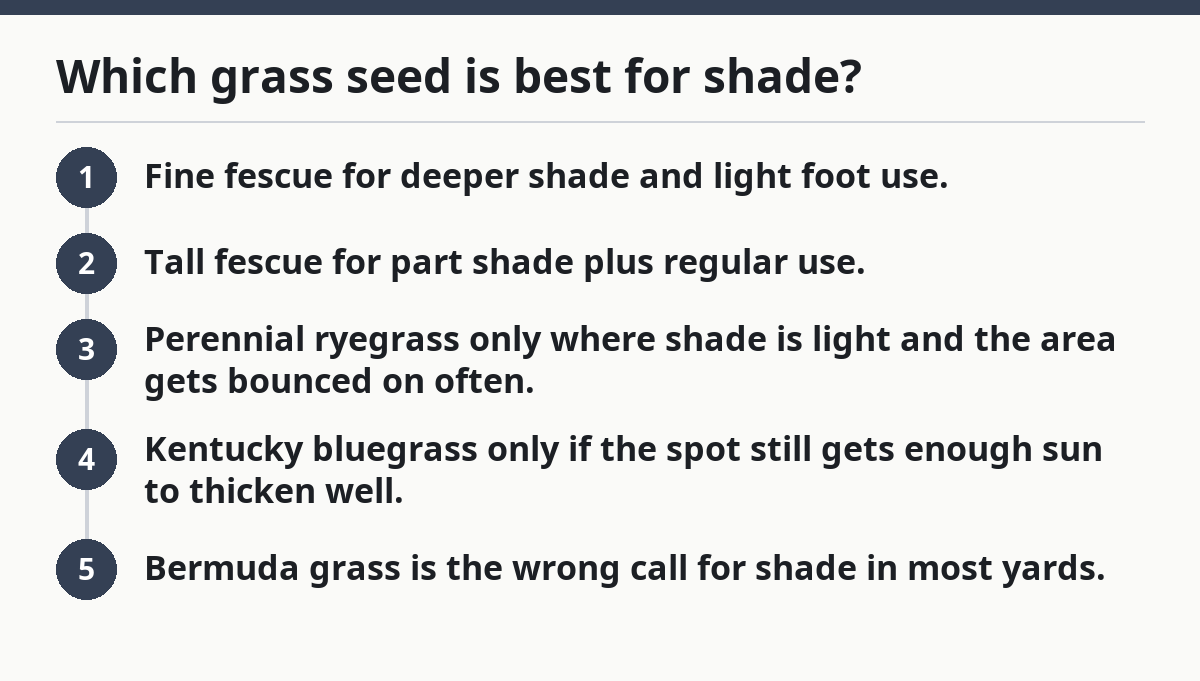
The shade hierarchy is simple:
- Fine fescue for deeper shade and light foot use.
- Tall fescue for part shade plus regular use.
- Perennial ryegrass only where shade is light and the area gets bounced on often.
- Kentucky bluegrass only if the spot still gets enough sun to thicken well.
- Bermuda grass is the wrong call for shade in most yards.
Fine fescue has a real trade-off. It tolerates lower light, but it does not like heavy wear. If kids cut across the same strip every day, it will thin out faster than a tougher grass.
Which grass seed handles foot traffic best?

Perennial ryegrass and tall fescue handle foot traffic best for most home lawns, with Kentucky bluegrass helping when the lawn gets enough sun to recover. Traffic resistance is about how fast the grass bounces back after being pressed down, not how pretty the seed packet looks.
Because traffic wears grass down fast, this part matters as much as light. A yard can have the right sun exposure and still fail if the seed cannot recover from use.
Picture this: the path from the patio to the gate gets hit a dozen times a day. That strip needs wear tolerance first, then color and texture.
For traffic, think in this order:
- Perennial ryegrass: fast germination, quick coverage, useful for worn lanes and family yards.
- Tall fescue: strong roots and good wear resistance, especially in larger lawns.
- Kentucky bluegrass: good self-repair in sunny areas, but slower to establish.
- Fine fescue: not a traffic grass.
- Bermuda grass: excellent in full sun and warm climates, but not the answer for shade.
The mistake here is buying a “shade mix” for a dog run. You may get a lawn that survives the light level and still disappears under daily wear. That costs you reseeding time, starter fertilizer, and another bag of seed. A 1-pound or 5-pound bag does not change that mismatch.
How do I choose between a seed blend and a single grass type?
A blend is usually the better choice when your lawn has mixed sun, some shade, or different wear zones. A single grass type can work on a uniform site, but most home lawns are not uniform for long.
If you are choosing grass seed for sun, shade, and traffic, a blend can reduce risk. It gives one part of the lawn a backup when another part is stressed.
Picture this: the front lawn bakes in afternoon sun, the side yard sits under a maple, and the back path gets trampled. One seed type has to compromise somewhere.
Choose a blend when:
- One area gets full sun and another gets part shade.
- You want the lawn to look more even across changing conditions.
- You need both wear tolerance and decent shade performance.
Choose a single type when:
- The whole lawn gets the same light.
- The yard is built for one clear use, such as a sunny play lawn.
- You want a very specific texture or appearance.
Read the label closely. A good blend names the grasses on the bag, and the percentages should make sense for the site. If a shady yard is mostly sunny grass, you’re paying for a label, not a solution.
For more on setup and establishment, the lawn establishment guide sits above this page as the next stop in the process. The cool-season lawn guide and the warm-season lawn guide are useful next reads if you are narrowing the choice.
What should the label tell you before you buy?
The label should tell you the grass species, whether it’s a blend, and what condition it is meant to handle. If it only says “premium lawn seed” without naming the grasses, that bag is asking you to trust marketing instead of plant traits.
When you are choosing grass seed for sun, shade, and traffic, the label is the fastest way to spot a mismatch. A bag that names species is usually more useful than one that relies on broad claims.
Picture this: you’re in the store aisle, comparing two bags that both say “sun and shade.” One lists tall fescue and fine fescue. The other lists nothing useful. Only one of those tells you what you’re actually buying.
Check for these clues:
- Named species, such as tall fescue, fine fescue, perennial ryegrass, Kentucky bluegrass, or bermuda grass.
- A clear use case: sun, shade, traffic, or a mix.
- A blend that matches your yard’s weakest spot, not just its best spot.
- No unrealistic promise that one seed is perfect everywhere.
A useful label can still hide a compromise. A shade-tolerant mix may establish more slowly. A traffic-tough mix may need more sun. That trade-off is normal. The bad sign is when the bag pretends trade-offs do not exist. For label basics, see the seed label guide.
How do I match the seed to the yard conditions I actually have?
Use the worst part of the yard as your guide, because that’s where a bad match shows first. If the lawn has one shady strip and one beaten-down run, choose seed for the harder problem, or split the yard into sections and seed them differently.
If you are choosing grass seed for sun, shade, and traffic, this is the step that saves the most mistakes. The worst zone usually decides the right seed.
Picture this: a sunny lawn can survive a grass that hates shade, but a shaded lawn cannot fake full-sun conditions. The weak spot sets the standard.
A practical match-up looks like this:
- Measure the light for a day. Full sun areas are obvious; part shade changes through the day.
- Watch the traffic for a week. Mark the paths, play spots, and dog routes.
- Choose the grass type for the worst condition first.
- Use a blend if the site changes a lot from one zone to another.
- Skip the wrong grass if the site is a clear mismatch, such as bermuda grass in shade.
If you want the shortest answer: sunny yard plus traffic points toward perennial ryegrass or tall fescue; shade plus light use points toward fine fescue; full sun in a warm area points toward bermuda grass. For help with the first step, the lawn site prep guide explains how to measure conditions before seeding.
What mistakes make grass seed fail?
The biggest mistakes are buying for color instead of site conditions, picking a shade mix for a high-traffic path, and using a warm-season grass where the yard stays cool and shaded. Those errors waste a bag of seed and often lead to a second round of patching.
Since the site drives the result, the wrong seed can fail even when watering and timing are decent. A 10-pound bag cannot fix the wrong match.
Picture this: the lawn looks thin, you reseed, and nothing changes where the problem is worst. That usually means the seed choice fought the site instead of fitting it.
Common mistakes and what they cost:
- Wrong light match: thin growth, patchy spots, repeat seeding.
- Wrong traffic match: worn lanes that keep opening up.
- Wrong climate match: poor establishment or slow recovery.
- No blend in a mixed yard: one part of the lawn thrives while another struggles.
Avoid the idea that “more expensive” means “better for my yard.” A pricier bag of the wrong species is still the wrong seed. The better move is to buy the seed that fits the site, even if the bag looks less fancy.
FAQ
Which grass seed is best for shade?
Fine fescue is often the best pick for shade. It tolerates lower light better than many common lawn grasses, but it does not like heavy foot traffic. If the shaded area also gets regular use, tall fescue is often the better compromise.
Which grass seed handles foot traffic best?
Perennial ryegrass and tall fescue handle foot traffic best for most home lawns. Perennial ryegrass gives quicker coverage, while tall fescue brings stronger all-around durability. In sunny areas, Kentucky bluegrass can help the lawn recover, but it establishes more slowly.
Should I buy a seed mix or a single grass type?
A seed mix is usually the safer choice for a yard with mixed sun, shade, or wear. A single grass type works best only when the whole lawn gets similar conditions. If your yard changes a lot from one area to the next, a blend gives you more room to adapt.
What grass seed is best for full sun?
Bermuda grass is a strong choice for full sun in warm climates. For cool-season lawns, tall fescue, perennial ryegrass, and Kentucky bluegrass are common full-sun options, with tall fescue often the most forgiving across changing conditions.
Drafted with AI; not yet reviewed by a person.





Leave a Reply