Last updated: November 28, 2026
In short: pick a sprinkler with adjustable arcs, directional spray, and the right throw for your yard edge, then set it so the farthest water stops a little short of the sidewalk or driveway. A sprinkler that covers grass cleanly is usually a spray head with an adjustable nozzle for small to medium spaces, or a rotor sprinkler for larger lawns, as long as the arc can be trimmed to the boundary.
Key takeaways
- The best choice is the one that matches the size of the lawn edge, not the one that shoots farthest.
- Adjustable arcs matter more than brand names when the goal is to avoid hardscape.
- Fan spray works well for tight areas; rotor sprinkler heads fit bigger runs if the arc can be set cleanly.
- Wind drift and poor placement can waste water even when the nozzle is set correctly.
- A slight shortfall at the edge is better than spray hitting concrete and running into the street.
What should I look for first?
Choose a sprinkler head with adjustable arcs before you think about range. That one feature decides whether water lands on the lawn edge or keeps going onto the sidewalk, driveway, or curb. For this job, the useful parts are a sprinkler head, an adjustable nozzle, and a way to set the spray angle from a full circle down to a narrow slice.
The simplest rule is this: if the yard edge is close to hardscape, look for directional spray you can aim. A fixed-pattern head is a poor choice because it keeps throwing water in the same shape, even when the lawn ends 2 feet early. A model with a marked arc is easier to control because the spray can be trimmed to 90 degrees, 180 degrees, or another partial shape that matches the corner.
For small strips of lawn, a fan spray is often easier to control than a rotor sprinkler. Fan spray throws water in a flat pattern with less reach, which makes it better for boundary control. A rotor sprinkler throws farther and can cover larger sections, but it becomes a bad fit if the throw is too long for the space.
The main trade-off is coverage versus precision. A head that reaches farther is not automatically better. If the yard is narrow, long throw usually means more overspray control work and more waste on concrete.
Which sprinkler type fits a yard edge?
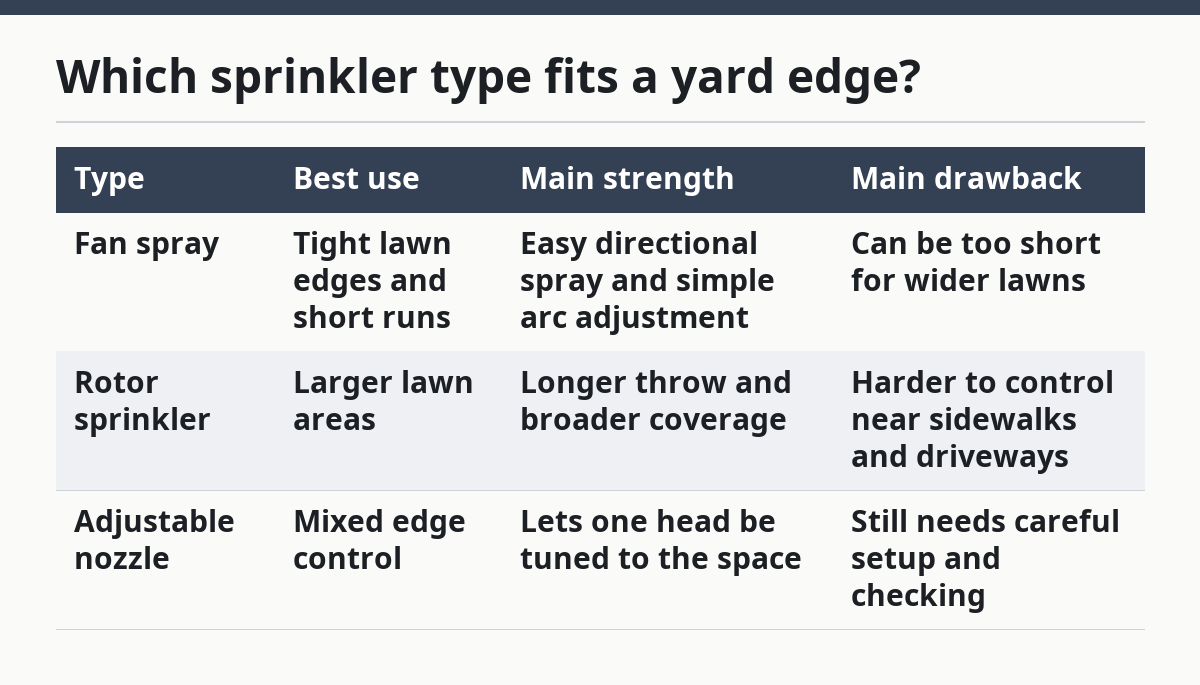
The right type depends on how much room sits between the turf and the hardscape. If the edge is tight, fan spray is usually easier to keep on target. If the lawn is broader and the heads sit farther from the boundary, a rotor sprinkler may fit better because it covers a larger radius with less overlap.
| Type | Best use | Main strength | Main drawback |
|---|---|---|---|
| Fan spray | Tight lawn edges and short runs | Easy directional spray and simple arc adjustment | Can be too short for wider lawns |
| Rotor sprinkler | Larger lawn areas | Longer throw and broader coverage | Harder to control near sidewalks and driveways |
| Adjustable nozzle | Mixed edge control | Lets one head be tuned to the space | Still needs careful setup and checking |
A lot of people buy the biggest head they can find, then fight the pattern later. That usually fails near hardscape because extra reach turns into overspray. A better approach is to size the head to the space first, then fine-tune the arc.
A good match also depends on how the sprinkler is installed. If the head sits too close to the pavement, even a well-aimed pattern may mist onto concrete when the wind picks up. If it sits too far back, the grass at the edge may stay dry. That is why boundary control matters as much as throw distance.
For this topic, the best choice is often the one that seems modest on paper. A smaller pattern with a clean edge usually beats a bigger pattern that constantly needs correction.
How do I set the arc without wasting water?
Set the arc so the outer edge of the spray ends just inside the grass line, not on the pavement. That is the basic move that keeps overspray off the sidewalk and driveway while still watering the full lawn edge.
Here is the practical setup process:
- Measure the distance from the head to the hard edge in simple steps, then choose a head whose throw can cover that space without shooting past it. The result should be spray that reaches the far turf, not the curb.
- Start with the smallest usable arc, such as a 90-degree corner or a half-circle near an edge, so the spray pattern stays tight. A narrower setting gives better boundary control than a wide circle.
- Adjust the nozzle or arc screw until the spray lands on the grass line, then stop before it crosses onto concrete. On many heads, a small turn makes a visible change.
- Run the zone for a short check and watch the edge from the side. If water beads on the sidewalk, reduce the arc or shorten the throw.
- Repeat for each head along the border, because one overreaching head can undo the work of the others.
The point is not to eliminate every drop near the edge. The point is to keep the main spray pattern on the lawn and leave only a light fringe at most. A little shortfall is better than water hitting the driveway and running off.
This is where adjustable nozzles earn their keep. They let one sprinkler head behave like several patterns without swapping the whole unit. For a reader who wants one simple answer, that flexibility is usually the safest place to start.
Why does wind drift matter so much?
Wind drift matters because a pattern that looks clean in still air can miss the lawn edge as soon as the air moves. Even a light breeze can push fan spray off course, and a stronger gust can turn the outer edge of a rotor sprinkler into wasted water on the sidewalk.
The common mistake is to judge the head only when the air is calm. That gives a false sense of control. A nozzle that barely stays off the pavement at still air will usually overshoot once the wind kicks in, especially if the throw is long.
The practical fix is to use shorter throw where possible and aim with a little safety margin. If the grass ends at a driveway, do not set the stream exactly on the line. Set it just inside the turf so the water still lands where roots can use it. EPA WaterSense guidance on outdoor water use makes the same basic point: water should go where plants can take it, not where it runs off.
This is also where rotor sprinkler heads can be the wrong choice. They work well for broader areas, but a long, rotating stream is more likely to drift than a tighter fan spray. If the site is exposed and windy, a shorter pattern usually wastes less water.
What mistakes cause overspray control problems?
The worst mistake is choosing too much reach for a space that is too small. That costs water, leaves wet concrete, and can create runoff into the street. The better move is to pick a smaller pattern and accept that a lawn edge may need more than one head to cover it cleanly.
Another common error is placing the head too close to a hard edge. That seems tidy at first, but the spray has less room to settle before it hits pavement. A head placed a little farther back often gives better edge watering because the spray can finish its pattern on grass instead of on the sidewalk.
A third mistake is using the same setting on every head. Corners, straight runs, and narrow strips do not behave the same way. A boundary corner may need a 90-degree setting, while a center run may need a wider pattern. One setting across the whole yard usually leads to overspray somewhere.
The last problem is ignoring overlap. A badly aimed head can leave dry stripes that tempt someone to open the arc wider than needed. That fix often creates a new overspray problem. The cleaner answer is to keep the throw short and let the next head fill the gap.
A good guide for this kind of setup is the American Society of Irrigation Consultants, which discusses matched precipitation and proper head spacing in irrigation design. That principle matters here because a clean boundary depends on how each head works with the next, not just on one nozzle alone. See also EPA WaterSense on outdoor water use: https://www.epa.gov/watersense/outdoor-water-use
When is a rotor sprinkler the wrong choice?
A rotor sprinkler is the wrong choice when the lawn edge sits close to concrete and the pattern cannot be shortened enough to stay inside the grass. It is also a poor fit when wind drift is common or when the space is narrow enough that a fan spray would give cleaner control.
That does not mean rotors are bad. They are useful for bigger lawns where the heads can sit back from the boundary and the throw has room to work. In that setting, the slower rotation and longer reach can reduce the number of heads needed. The trouble starts when the same head is pushed into a small side strip or a driveway edge.
A simple test is to ask whether the spray can be set shorter than the width of the lawn strip with a bit of margin left over. If the answer is no, the head is fighting the space. A fan spray or a smaller adjustable nozzle will usually do a better job.
This is also the place to be honest about who the advice is not for. If the yard has lots of irregular corners, the best answer may not be a single head type at all. It may be a mix of fan spray near edges and rotor sprinkler heads in the open lawn.
What is the best choice for boundary edges?
The best choice for boundary edges is usually an adjustable nozzle on a sprinkler head that can be aimed and trimmed to the exact edge. That gives the most control for a sidewalk, driveway, or curb line, especially when the lawn is narrow or the wind is a factor.
For a clean boundary, choose the pattern by shape first, then by reach. A 90-degree setting is useful for corners, a half-circle for edges along a wall or path, and a full circle only when grass surrounds the head. If the edge is especially tight, fan spray often gives the cleanest result because it keeps the throw compact.
The honest drawback is that this approach takes more setup time. A fixed nozzle is faster to install, but it is much less forgiving. The extra few minutes spent adjusting arc and direction usually save more water later.
The best answer for this whole topic is simple: pick the sprinkler that matches the yard edge, not the biggest one on the shelf. Adjustable arcs, directional spray, and shorter throw are what keep water on the lawn and off the pavement.
How do I stop sprinklers watering the pavement?
Start by reducing the arc until the outer edge of the spray lands inside the grass line. If the pattern still reaches the sidewalk or driveway, shorten the throw or switch to a smaller fan spray. A head that is too powerful for the space will keep wasting water no matter how often it is run.
Can I aim a sprinkler away from hardscape?
Yes, a sprinkler head with an adjustable nozzle can usually be aimed away from hardscape. The key is to set the arc so the spray ends before the pavement starts, then check it while the zone is running. If the wind shifts the pattern, reduce the throw or use a tighter pattern.
What sprinkler is best for boundary edges?
A fan spray or an adjustable nozzle is usually best for boundary edges because it gives the tightest control. A rotor sprinkler can work only when the lawn area is wide enough to absorb the longer throw without overspray. If the edge is close to concrete, a smaller pattern is the safer choice.
Drafted with AI; not yet reviewed by a person.

Leave a Reply