Last updated: November 28, 2026
Quick answer: choose a sprinkler with adjustable pattern controls for mixed spaces when one area needs more than one arc; in practice, 90°, 180°, and 360° settings cover the shapes most mixed yards need. How to choose a sprinkler with adjustable pattern controls for mixed spaces starts with matching arc, throw distance, and spray width to the shape you are watering.
Key takeaways
- Adjustable pattern controls matter most when one yard has more than one shape.
- The right head should let you change arc, throw distance, and spray width without replacing the whole unit.
- Partial-circle and full-circle coverage solve different parts of the same yard.
- A fan spray nozzle, rotary nozzle, and impact sprinkler do not behave the same way.
- The wrong choice usually wastes water at the edges or leaves dry patches in the middle.
What does adjustable spray pattern mean?
Adjustable spray pattern means the head can change the shape and reach of the water stream without moving the base. In general, a fixed spray head may be limited to a few common arcs, while an adjustable pattern lets you shift the coverage to suit a bed corner, a path edge, or a round patch of lawn.
This matters because mixed spaces rarely need one uniform setting. A square bed may need a 90° corner pattern, a walkway edge may need a 180° side spray, and a circular patch may need a 360° circle. A good adjustable sprinkler head gives you that range from one unit instead of forcing you to buy a different head for every zone.
The key terms are simple. Partial-circle watering means less than a full circle, often 90° or 180°. Full-circle watering means 360° coverage, which suits open areas better. A part-circle nozzle is the part you set to that smaller arc, while the body under it may stay the same.
However, this is not always the right choice for every yard. If a space only needs one pattern all season, a fixed head can be simpler. Adjustable controls help most when the layout changes from one zone to the next, or when the same zone includes both open and tight areas. For broader watering guidance, EPA WaterSense and the Irrigation Association both discuss water-smart outdoor irrigation.
Which head type fits mixed spaces?
Therefore, the best head for mixed spaces is usually the one that lets you tune arc and reach, not the one with the strongest spray. A rotary nozzle often suits mixed spaces better than a plain fan spray nozzle because it can throw water in moving streams and usually gives more control over distance. An impact sprinkler works well for larger open zones, but it is usually less precise at edges.
Here is the useful split:
| Type | Best for | What it does well | Main drawback |
|---|---|---|---|
| Fan spray nozzle | Beds, edges, tight corners | Simple partial-circle watering | Can mist and overwater nearby hardscape |
| Rotary nozzle | Mixed spaces with changing shapes | Distance control and width control | Slower application than a fixed fan spray |
| Impact sprinkler | Open lawns and larger circles | Broad full-circle coverage | Less suited to small, detailed shapes |
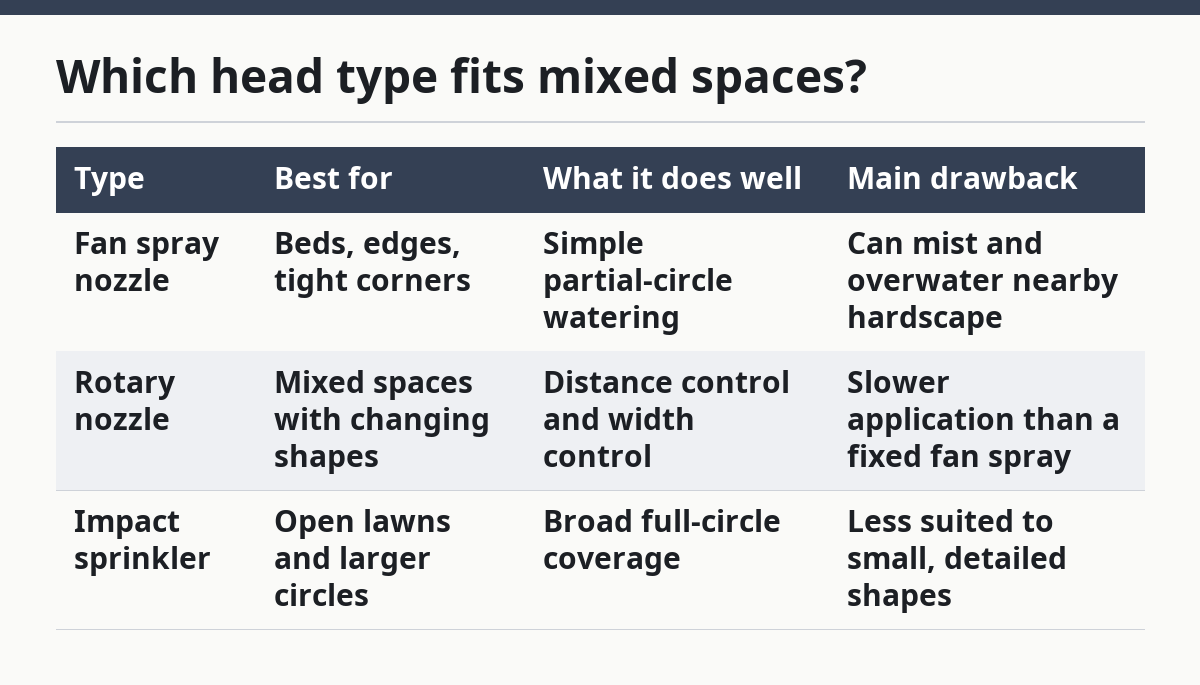
A fan spray nozzle is the plainest option. It can work for 90° and 180° patterns and is easy to understand, but it can be too blunt for a yard that has both narrow corners and open sections. A rotary nozzle is often the better middle ground because it can keep coverage steadier across different shapes. An impact sprinkler is useful when a zone is mostly open and needs 360° coverage, but it is not the first pick for tight mixed spaces.
The wrong choice here is a head that covers only one job. A fixed 360° impact unit in a mixed space can throw water into paving or fences. A tiny fan spray nozzle in a broad lawn can leave the middle dry. If the space changes shape every few feet, prioritize adjustability over raw spray distance. For related guidance, see sprinkler head types and how to choose a sprinkler.
How do I set the arc and reach?
Because arc and reach work together, set the arc first, then set the reach. The shape of the coverage matters more than the distance at the start. The simple rule is to match the arc to the shape, then trim the throw so water lands inside the target area, not past it.
Use this sequence:
- Pick the zone shape and choose the arc: 90° for a corner, 180° for a side edge, 360° for open coverage. The result should be a cleaner outline before you touch distance.
- Turn the pattern control until the spray stops crossing onto pavement, fences, or walls. That usually means the outer edge sits just inside the boundary.
- Reduce or increase throw distance with the nozzle or head setting until the water lands near the edge of the intended area. On many heads, this is the difference between a short fan and a longer stream.
- Check the spray width. A wider pattern should cover more ground, while a narrower one should protect a tight strip or corner.
- Stand back and look at the overlap with the next head. The water should meet the next zone without leaving a gap or doubling up too hard.
Distance control and width control do different jobs. Distance changes how far the water travels. Width changes how broad the wet area looks on the ground. A reader choosing one head for a mixed space should care about both, because a perfect arc with the wrong throw still wastes water.
For example, a common mistake is using the longest throw available because it looks impressive. That often sends water past the plant root zone and onto hard surfaces. Another mistake is setting a short arc and assuming the job is done. If the reach is too short, the middle of the zone stays dry even though the edges look wet.
How to match the sprinkler to each shape
Because each zone behaves differently, match the sprinkler to the shape by treating each zone as a separate task, even if the heads share the same body style. A square bed, a round patch, and an awkward edge do not need the same arc, but they can often use the same family of head with different settings. If the layout is complex, consult a local irrigation professional or follow manufacturer guidance.
Use this simple guide:
- Square or corner bed: Choose a part-circle nozzle that can hold a clean 90° or 180° shape. The point is to hit the corners without soaking the path beside them.
- Round lawn patch: Choose full-circle watering, usually 360°, so the center and outer ring receive water evenly.
- Mixed edge with both open and tight sections: Choose a rotary nozzle or adjustable head that can narrow or widen the pattern without swapping the whole sprinkler.
- Small transition zone between two surfaces: Use the shortest useful throw and keep the spray off the adjoining surface.
This is where many generic guides go wrong: they tell you to buy one “all-purpose” head and stop there. Mixed spaces need fit, not slogans. A 180° setting may work on one side of a bed, but that same setting can be wrong in a round patch where 360° makes more sense.
Therefore, the best choice is the one that lets you change the pattern inside the same zone when the layout changes. That makes adjustable controls useful in a place with mixed surfaces, not because the sprinkler is fancy, but because the space keeps changing shape under the same hose or valve.
What should I check before buying?
Next, check the adjustment range, the head style, and how easy it is to change settings before buying. A good control set should let you move between partial-circle watering and full-circle watering without needing special tools or a long setup.
Look for these points:
- Arc range: Can it handle 90°, 180°, and 360° as needed?
- Distance control: Can you shorten or lengthen throw without changing the whole head?
- Width control: Can you tighten the spray for an edge or widen it for open ground?
- Head type: Is it a fan spray nozzle, rotary nozzle, or impact sprinkler?
- Compatibility: Does it match the sprinkler body or connector you already have?
A simple test in the store is to look for clear markings on the head or nozzle. If the settings are hard to read, the field adjustment may be annoying later. A design that needs repeated guessing can lead to misaligned arcs, especially when the same zone has a 90° corner on one side and a 360° open section nearby.
One honest limitation: adjustable controls usually trade simplicity for flexibility. A fixed head is quicker to understand. An adjustable one takes a little more setup and a little more care. That trade-off is worth it when the space is mixed; it is not worth it if the zone never changes shape. For product comparisons, see sprinkler coverage patterns.
Which choice is wrong for mixed spaces?
However, the wrong choice for mixed spaces is a sprinkler that only does one pattern well and nothing else. A 360° impact sprinkler is a poor fit if the same zone includes a fence line, a driveway edge, or a tight corner that needs a 90° or 180° setting.
A fixed fan spray nozzle can also be the wrong call if the area has both open ground and narrow strips. It may wet the edge cleanly, then overshoot the open section or fail to reach the middle. A rotary nozzle is often the better middle option, but even that is not ideal if the whole zone is one clean, simple shape.
Ultimately, the best choice depends on what the space asks for most often. If most of the area is open, a full-circle setting may matter more than fine edge control. If the area changes from square to round to awkward, the ability to adjust pattern, distance, and width matters more than raw output. This is why the page on how to choose a sprinkler should sit beside the broader hub on irrigation basics, but not replace it.
For a deeper general irrigation reference, EPA WaterSense has outdoor water-use guidance on its site, and irrigation standards are also discussed by the Irrigation Association. Those sources help frame water-smart choices, but the real decision here is still shape, arc, and reach.
What sprinkler pattern is best for corners?
Because corners are tight, a 90° pattern is usually the cleanest starting point. It keeps the water inside the boundary and reduces spray onto paths, fences, or siding.
If the corner is not a sharp corner, a slightly wider partial-circle setting may still work, but the goal stays the same: cover the planting area without pushing water outside it.
Can I change sprinkler shape after buying it?
Yes, many adjustable heads let you change the pattern after purchase. The change usually involves adjusting the arc, changing the nozzle, or shifting the throw distance.
That said, not every model changes in the same way. A fan spray nozzle, rotary nozzle, and impact sprinkler each adjust differently, so the packaging or product sheet should tell you what range of settings it actually supports.
What does adjustable spray pattern mean?
Adjustable spray pattern means the head can change its watering shape instead of staying fixed. It may move from a 90° corner spray to a 180° side spray or a 360° full-circle spray, depending on the model.
That flexibility is useful when one space includes more than one kind of shape. It helps the same sprinkler fit a mixed area without replacing the whole head every time the layout changes.
Drafted with AI; not yet reviewed by a person.



Leave a Reply