Last updated: November 19, 2026
Key Takeaways
- Balanced root-zone conditions help grass root deeply, recover from wear, and compete better with weeds.
- Turf soil tests most often focus on pH, phosphorus, potassium, organic matter, and sometimes sodium, salinity, and bulk density.
- Compacted, weak, or tired turf often responds best to aeration, proper mowing height, adjusted irrigation, and targeted nutrient correction.
- The biggest costs usually come from overwatering, overfertilizing, mowing too short, and fixing the wrong problem first.
- What soil and turf health actually means
- How do I know if my soil is hurting my turf?
- The soil tests that matter most
- What fixes compacted, weak, or tired turf?
- The mistakes that cost the most
- Which turf species and sites need different care?
- How do I build a year-round turf health plan?
- FAQ
Soil and turf health is the combined condition of the ground and the grass growing on it: the soil has to hold water, air, and nutrients, and the turf has to produce dense, resilient growth without thinning out or inviting weeds and disease. In Soil and turf health — The Complete Guide, the core answer is that the right diagnosis matters more than the right product. If one side fails, the other usually follows.
What soil and turf health actually means
Soil and turf health means the root zone is balanced enough for grass to root deeply, recover from wear, and outcompete weeds. The practical signs are simple: water infiltrates instead of puddling, roots extend several inches down, the surface resists compaction, and the grass maintains color and density through heat or traffic.
That sounds broad because it is broad. Turf is not healthy just because it looks green on a mower pass. A dense stand of grass can still be sitting on compacted soil with a shallow root system, a pH outside the usable range, or a thatch layer that blocks air and water. The University of Massachusetts Extension notes that thatch becomes a problem when it exceeds roughly 1/2 inch in cool-season turf, because it can interfere with rooting and water movement. That one figure matters because many people chase fertilizer when the real issue is the layer beneath the blades.
A good way to think about turf health is as a chain. Soil structure affects roots. Roots affect drought tolerance. Drought tolerance affects mowing stress and recovery. Recovery affects density. Density affects weed pressure. Break one link, and the whole stand becomes harder to maintain.
The best starting question is often not “What fertilizer should I buy?” It is “What is preventing this grass from rooting and spreading?” In many lawns and sports fields, the answer is a mix of compaction, shallow irrigation, poor pH, low organic matter, and mowing too low for the grass species in place. Kentucky bluegrass, perennial ryegrass, tall fescue, bermudagrass, zoysiagrass, and creeping bentgrass all tolerate different mowing heights, moisture patterns, and traffic levels. A generic program that ignores species is where many turf problems begin.
How do I know if my soil is hurting my turf?
Your soil is hurting your turf if the grass stays thin after fertilizing, the ground feels hard underfoot, water beads or runs off, or roots stop in the top 1 to 2 inches. Those signs point to compaction, poor infiltration, nutrient lockup, or a shallow root zone.
A simple probe test tells a lot. Push a screwdriver or soil probe into moist ground. If it resists hard at a shallow depth across large areas, compaction is likely part of the problem. Turf with compacted soil often shows patchy growth where footsteps, carts, pets, or mowing routes repeat the same pressure. On athletic fields and high-traffic lawns, the worn zones are usually not random. They map the traffic pattern.
Color can mislead you. Dark green turf can still be weak turf if it needs constant watering or if roots are near the surface. A soil test is more useful than a visual guess. Most extension services recommend testing pH and nutrient status before making major corrections. That matters because pH controls whether nutrients are available at all. A soil pH of 6.0 to 7.0 is often a workable range for many turf species, though the best target depends on the grass type and the local soil. If pH is off, added fertilizer can become expensive decoration.
Thatch is another common trap. A thin thatch layer can be normal, but a dense, spongy layer between soil and green tissue can hold water at the surface and keep roots from moving down. It also creates a rough, bouncy surface that feels dry on top and wet underneath. That mismatch fools many owners into overwatering.
If the lawn has been topdressed heavily, treated with frequent light fertilizer, or mowed often without removing clippings in a dense stand, thatch can build faster than expected. If that pattern fits, consult a turf professional or local extension specialist, because the right correction depends on the site and grass species. The fix is not always more fertilizer. Sometimes it is core aeration, improved irrigation timing, and a more disciplined mowing height.
The soil tests that matter most
The most useful soil tests for turf are pH, phosphorus, potassium, organic matter, and sometimes sodium, salinity, and bulk density. Those numbers tell you more than a bag label does because they show what the soil can actually supply and what may be blocking growth.
A routine soil analysis usually starts with pH and the major nutrients. pH is the gatekeeper. Phosphorus supports rooting and establishment, potassium supports stress tolerance, and calcium and magnesium help with soil chemistry and structure. Organic matter matters because it influences aggregation, water holding, and nutrient exchange. In many turf settings, low organic matter means the soil dries and compacts too quickly.
For saline or irrigated sites, electrical conductivity becomes important. High salt levels can make turf look drought-stressed even when water is present, because roots cannot take up water normally. That problem is common near coasts, on roadsides treated with deicing salts, and on sites irrigated with marginal water. If a lawn or field is near one of those conditions, a standard fertilizer plan is incomplete without a salinity check, and a turf professional or extension service can help interpret the result. The USDA Natural Resources Conservation Service and university extension programs both discuss salinity as a turf constraint.
The most common mistake is reading a soil test as a shopping list instead of a diagnosis. A result that says “low potassium” does not mean every deficiency symptom on the turf comes from potassium. It may be compaction, poor drainage, or mowing stress showing up at the same time. The correction should match the constraint, not just the label.
This is where many generic guides get lazy: they jump from “do a soil test” to “apply fertilizer.” That skips the part where the test result changes the maintenance plan. A low pH can make phosphorus less available. A dense clay can hold nutrients but still starve roots of oxygen. A sandy soil can drain well and still lose nutrients too quickly. Different soils fail in different ways.
The most practical habit is to test at a consistent time of year and keep the results. A one-off number is useful; a trend across seasons is better. If potassium rises after application but turf still thins, the issue is probably not potassium alone.
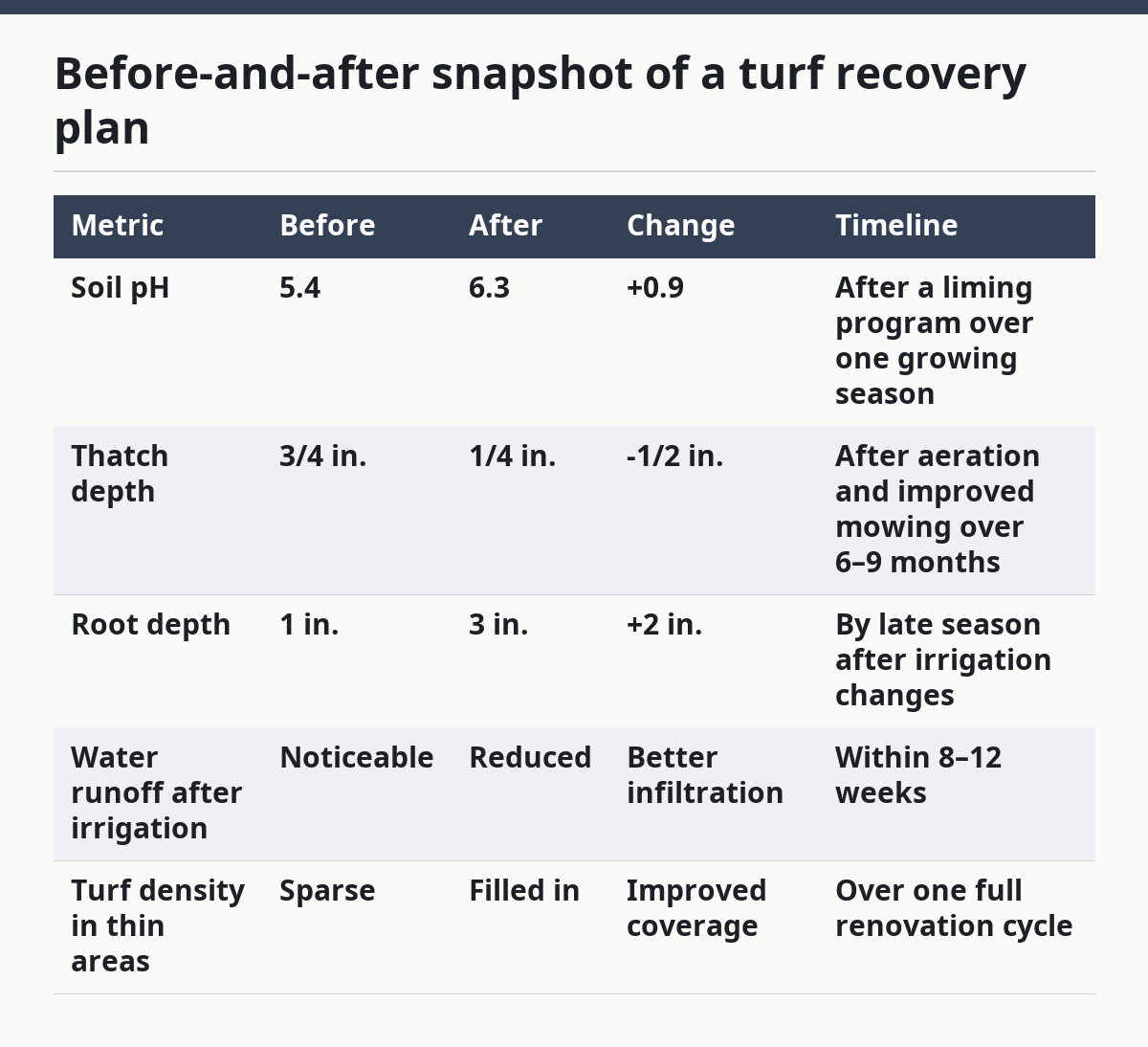
Before-and-after snapshot of a turf recovery plan
| Metric | Before | After | Change | Timeline |
|---|---|---|---|---|
| Soil pH | 5.4 | 6.3 | +0.9 | After a liming program over one growing season |
| Thatch depth | 3/4 in. | 1/4 in. | -1/2 in. | After aeration and improved mowing over 6–9 months |
| Root depth | 1 in. | 3 in. | +2 in. | By late season after irrigation changes |
| Water runoff after irrigation | Noticeable | Reduced | Better infiltration | Within 8–12 weeks |
| Turf density in thin areas | Sparse | Filled in | Improved coverage | Over one full renovation cycle |
What fixes compacted, weak, or tired turf?
Compacted, weak, or tired turf improves fastest with aeration, correct mowing height, adjusted irrigation, and targeted nutrient correction, not with one dramatic product. The quickest visible improvement is often tied to relieving compaction and restoring root space.
Core aeration is one of the most useful tools when the soil is sealed by traffic or has a dense surface layer. Hollow tines pull plugs and create channels for air, water, and roots. On established cool-season lawns, aeration is often paired with overseeding so new seed can contact mineral soil instead of sitting on thatch. On warm-season turf, timing matters because renovation windows are narrower and recovery depends on active growth.
Mowing height is not cosmetic. Cutting grass too short reduces leaf area, which lowers the plant’s ability to make energy. For many cool-season lawns, mowing around 3 inches is safer than scalping. The right height depends on species and use, but the principle stays the same: taller turf usually builds deeper roots and shades the soil surface better. That can lower moisture loss and reduce weed germination.
Irrigation should wet the root zone, not just the surface. Frequent shallow watering trains roots to stay shallow. In many home lawns, deeper and less frequent irrigation is more useful than daily sprinkling. A practical target is to water enough to moisten the top several inches, then let the surface dry slightly before the next cycle, while adjusting for soil texture, slope, and weather.
Fertilizer helps only after the soil can use it. A slow-release nitrogen source is often easier on turf than a quick flush that pushes top growth ahead of roots. But fertilizer alone does not solve poor drainage, compaction, or bad grading. If water sits for hours after rain, the problem is physical as much as nutritional.
This is also where turf health and soil health separate from ordinary lawn care. Lawn care often focuses on color and speed. Turf health asks whether the stand can withstand traffic, drought, and disease for months at a time. That difference matters on sports fields, parks, and high-value home lawns where patch repair is expensive.
The mistakes that cost the most
The most expensive mistakes are overwatering, overfertilizing, mowing too short, and fixing the wrong problem first. Those errors waste inputs, weaken roots, and create more weed and disease pressure than the original issue.
Overwatering is the one that hides best. Wet turf may look cared for, but constant moisture at the surface encourages shallow roots and can increase fungal pressure. In fine-textured soils, too much irrigation also worsens oxygen shortage in the root zone. The result is grass that looks stressed even though it is being “babied.” Once roots stay shallow, the turf becomes less able to handle heat and foot traffic.
Overfertilizing is another common failure. High nitrogen can force tender top growth that needs more mowing and is more vulnerable to disease. It can also mask a pH problem for a while, then fail abruptly when conditions turn hot or dry. The fix is not always less nutrition; it is more precisely timed nutrition.
Mowing too short is a direct stressor. A short cut removes stored energy and exposes soil to more heat and evaporation. On a lawn already fighting compaction, the mower can push it over the edge. Many turf failures start after a series of well-meant low cuts that seemed tidy at the time.
A less obvious mistake is skipping diagnosis and jumping to renovation. If drainage is poor, a reseed alone will not hold. If soil is acidic, added seed may emerge weakly and compete poorly with moss or weeds. If traffic is concentrated on a single path, the same thin strip will fail again unless access changes.
The setback most people regret is ignoring the soil until the grass collapses. At that point, recovery may still be possible, but it takes longer and costs more. A turf area that could have been stabilized with aeration, topdressing, and pH correction often needs a full renovation later.
Who this approach is not for: it is not for anyone looking for a one-step “green-up” trick, and it is not for sites where irrigation, drainage, or traffic are fixed by design and cannot be changed. Those situations need a broader site plan, not a bag of product.
Which turf species and sites need different care?
Different turf species need different care because root depth, heat tolerance, mowing tolerance, and recovery speed vary by grass type and site use. A management plan that works on a shaded lawn can fail on a sun-baked athletic field or a roadside slope.
Cool-season grasses such as Kentucky bluegrass, perennial ryegrass, and tall fescue tend to perform best in cooler regions and during spring and fall growth. Tall fescue is often favored where drought tolerance matters because it can maintain quality under less-than-ideal moisture once established. Kentucky bluegrass spreads by rhizomes and can recover well from wear, but it typically asks for more water and fertility than the hardest-use low-input sites can provide.
Warm-season grasses such as bermudagrass and zoysiagrass perform differently. They thrive in heat, recover aggressively in the right season, and can tolerate close mowing in managed settings. But they also need a proper growth window. A renovation started too late in the season can stall when growth slows. That timing issue is one reason many turf projects fail: the work is sound, but the calendar is wrong.
Shaded sites add another layer of difficulty. Turf under tree cover often competes with roots, receives less direct light, and dries unevenly. The best response may not be “more fertilizer.” It may be pruning the canopy, changing the grass species, or accepting that turf density will always be lower there than in full sun.
Heavy-use sites need the right wear tolerance, not the prettiest seed mix. Sports fields, playgrounds, and dog runs need soil structure that can survive repeated compaction. That often means aeration, topdressing, and traffic management as maintenance, not as occasional rescue work.
A generic recommendation becomes wrong when it ignores the site. Sandy soils need different watering habits than clay soils. North-facing slopes dry differently than flat ground. A lawn built for curb appeal does not need the same renovation standard as a field built for repeated play.
How do I build a year-round turf health plan?
A year-round turf health plan starts with a soil test, then sets mowing, watering, feeding, and renovation work around the grass species and climate. The goal is to keep the root zone stable enough that the turf does not spend the season recovering from avoidable stress.
In early season, the job is to check pH, clean up winter damage, and correct compaction before growth takes off. If the site needs overseeding, that window is usually better when temperatures support germination and the soil can stay evenly moist. That is why timing matters so much. A good seed mix planted in the wrong month often underperforms a decent mix planted at the right time.
During active growth, mowing height and frequency matter more than almost anything else a homeowner controls. Removing too much leaf tissue at once forces the turf to spend energy regrowing blades instead of rooting. Clippings can usually be left in place if they are not clumping, since they return some nutrients to the system and do not meaningfully smother healthy turf when mowing is done correctly.
Midseason care should focus on stress management. That means watering deeply when needed, not reflexively. It also means watching for traffic wear, disease patches, and localized dry spots. If one area consistently dries out faster, the cause may be soil texture, slope, shade, or hydrophobic soil rather than “the lawn as a whole.”
Late season is the best time in many regions to evaluate what failed. Thin spots, run-off lines, and repeated wear zones tell the truth about the site. Those patterns should drive next year’s corrections. A site map is more useful than a guess.
The best turf programs are boring in the right way. They are consistent, measured, and tied to the actual soil rather than to a calendar full of guesses. That is what separates a healthy stand from a merely green one.
FAQ
How often should I test soil for turf health?
A soil test every 2 to 3 years is a common baseline for established turf, and more often if you are renovating, correcting pH, or seeing repeated decline. The exact interval depends on soil type, fertilization history, and how intensively the turf is used.
Is aeration always necessary?
No, aeration is most useful when compaction, poor infiltration, or traffic wear are part of the problem. If the soil is loose, the site is low-traffic, and roots already penetrate well, aeration may have limited payoff. It is a tool for a constraint, not a routine ritual.
Why does my grass look healthy but feel spongy?
That spongy feel usually points to thatch, a shallow root zone, or saturated surface soil. The grass blades may still look green while the root environment is weak. A soil probe and a look at thatch depth can tell you more than color alone.
Can fertilizer fix thin turf by itself?
Fertilizer can help thin turf recover, but it rarely solves the whole problem alone. If compaction, poor drainage, bad mowing height, or low pH are the real limits, fertilizer only pushes growth against the same barrier. The turf may green up briefly and then thin again.
What is the single biggest mistake in turf care?
The biggest mistake is treating the symptom instead of the soil. People often add water, fertilizer, or seed before checking compaction, pH, drainage, and mowing height. That usually wastes time and money and can make the underlying problem harder to correct.
Drafted with AI; not yet reviewed by a person.





Leave a Reply