Last updated: November 19, 2026
Quick answer: for most lawns, the highest-impact seasonal work happens in fall, and the most useful feeding often falls in a 6- to 8-week window before dormancy. Seasonal lawn maintenance — The Complete Guide is the year-round routine that keeps grass dense, resilient, and easier to mow: water correctly in spring and summer, feed at the right time, control weeds before they spread, and prepare the turf for heat, cold, and dormancy. The exact schedule depends on your grass type, but the core jobs are the same: mow smart, water deeply, aerate when the soil is compacted, and avoid pushing growth at the wrong time.
I write on turf care with a focus on practical maintenance, not glossy advice that ignores climate, grass species, or soil compaction. This guide to Seasonal Lawn Maintenance: The Complete Guide gives you the seasonal schedule, the why behind each task, and the places where common advice goes wrong.
Key takeaways
- Spring is for cleanup, soil correction, and setting up the season, not for forcing explosive top growth too early.
- Summer maintenance is mostly about heat stress: mow higher, water less often but more deeply, and stop aggressive fertilizing in hot weather.
- Fall is often the best window for renovation work in cool-season lawns, including overseeding and core aeration.
- Winter prep is about reducing disease and physical damage, especially on dormant or frozen turf.
- The right schedule changes by grass type, climate, and whether the lawn is cool-season or warm-season turf.
What seasonal lawn maintenance actually means
Seasonal lawn maintenance is the set of jobs that change with temperature, growth rate, and daylight. A lawn in Minnesota does not need the same calendar as a lawn in Georgia, and a Kentucky bluegrass yard does not behave like bermudagrass.
The useful way to think about it is by turf behavior:
- Cool-season grasses such as Kentucky bluegrass, perennial ryegrass, and tall fescue grow most actively in spring and fall.
- Warm-season grasses such as bermudagrass, zoysiagrass, St. Augustinegrass, and centipedegrass peak in late spring and summer.
That difference changes almost everything. A cool-season lawn can usually tolerate overseeding and recovery work in autumn. A warm-season lawn often wants renovation after it has fully greened up and is actively spreading, usually from late spring into summer.
A generic checklist that says “fertilize in spring, fertilize in fall” leaves out the most important part: timing around active growth. Fertilizer only helps when the grass can use it. The same is true for aeration, weed control, and seeding. Put those jobs in the wrong season and you get poor results or unnecessary stress.
The strongest rule is simple: match the task to the grass’s growth cycle. If you do only one thing after reading this guide, learn whether your lawn is cool-season or warm-season turf. That one detail determines when to mow higher, when to seed, and when to stop feeding.
For a general turf reference, the University of Maryland Extension has a useful lawn care calendar and grass-type guidance, and the Penn State Extension turf pages are also worth a look for region-specific timing. The USDA Natural Resources Conservation Service also provides soil information tools that help explain drainage, texture, and compaction.
How do I set up spring lawn care without causing more problems?
Spring lawn care should wake the lawn up, not shock it into weak, top-heavy growth. The right spring work is cleanup, assessment, and selective feeding — not a full overhaul.
Because spring growth starts unevenly, begin with a clean reset once the soil is workable and the turf is no longer saturated:
- Rake out sticks, leaves, and matting from winter.
- Assess snow mold, matted areas, vole tracks, or winterkill where they appear.
- Test the soil if you have not done so in the last 2 to 3 years.
- Sharpen mower blades before the first regular mow.
- Fix drainage problems before they become summer scorch points.
If you have a cool-season lawn, spring is the time to mow regularly, but not aggressively. Keep the cut high enough that the grass can hold moisture and shade the soil. For many home lawns, that means around 3 to 4 inches, depending on species and mower capability. Cutting too short in spring invites crabgrass, dries the crown, and weakens the root system.
Fertilizer in spring is useful, but it is also where people overdo it. A heavy spring nitrogen push can make grass grow fast above ground while roots lag behind. That leads to more mowing, more water demand, and more disease pressure later. For cool-season turf, many extension services prefer a moderate spring application and a stronger fall feeding strategy. For warm-season turf, spring fertilization makes more sense once the grass is fully green and the soil has warmed.
One spring task that gets skipped too often is pre-emergent weed control. If crabgrass is a recurring issue, the application window matters more than the product label alone. Pre-emergents have to go down before weed seeds germinate. Miss the timing by a few weeks and the lawn becomes a season-long repair project.
Spring is not the time for major seeding in warm-season turf unless you are repairing damage and your climate supports fast establishment. It is also not the time to dethatch lightly “just because.” Thatch is not always a problem, and unnecessary dethatching can tear living turf that is trying to recover.
Summer lawn care: how to keep grass alive in heat

Summer lawn care is about survival and stress control, not perfection. If you try to keep the lawn looking like April in July, you usually end up with burned tips, shallow roots, and more weed pressure.
The two biggest summer jobs are mowing and watering.
Mowing: Raise the cutting height during hot weather. Taller grass shades the soil, slows evaporation, and protects the crown from direct sun. Never remove more than about one-third of the leaf blade in a single mow; that rule is one of the few turf practices that holds up across grass types. If the lawn is growing fast, mow more often instead of cutting more off at once.
Watering: Water deeply and less often, not with frequent shallow sprinkles. Shallow irrigation trains roots to stay near the surface, which makes the lawn more vulnerable when temperatures climb. Early morning is a strong watering window because it reduces evaporation and gives the canopy time to dry.
The trade-off is that summer care is not about maximizing growth. In heat, fertilizer can do more harm than good if the lawn is already stressed. A strong nitrogen dose in high heat can make cool-season grass more vulnerable to drought and disease. That is why many turf schedules back off fertilizer in midsummer unless there is a specific deficiency or a slow-release product timed carefully to the grass type.
Summer is also the season when diseases show up fast. Brown patch, dollar spot, and summer patch can move quickly when nights stay warm and humidity hangs around the canopy. A lawn that is overwatered, overfertilized, or cut too short is far more likely to suffer.
Warm-season lawns usually look better in summer than cool-season lawns, but they still need restraint. Bermudagrass can take lower mowing than most lawns, but it also tolerates aggressive growth habits that can turn into scalping if the mower height is set too low. St. Augustinegrass generally wants a higher cut and is more sensitive to undercutting.
If your summer lawn is thinning, do not assume it needs more fertilizer first. Check for compaction, insect activity, irrigation coverage, and mower height. A compacted lawn with poor infiltration can look drought-stressed even after watering.
Why fall is often the most important season for many lawns
Fall is the recovery season for many lawns because temperatures drop, rain often becomes more reliable, and grass can put energy into roots instead of fighting heat. For cool-season lawns, this is the season that usually pays back the most.
This is the time for the heavy-duty jobs:
- Core aeration if the soil is compacted or the lawn sees foot traffic.
- Overseeding to thicken thin turf and improve variety mix.
- Fertilizing to support root growth and carbohydrate storage.
- Leaf management so the turf does not smother under debris.
- Weed control for broadleaf weeds that are actively moving nutrients to their roots.
Fall aeration helps when soil is dense, but it is not a magic fix. Hollow tines can relieve compaction and create seed-to-soil contact, yet they do not replace good soil structure or drainage. If a yard stays wet for days after rain, aeration may help a little, but the underlying problem may be grade, clay content, or runoff patterns.
Overseeding in fall is especially valuable for cool-season lawns because seedlings are not battling peak heat. That is a practical advantage, not a theory. The seed has a better chance of establishing before winter and entering spring with a stronger base. In many regions, the best overseeding window is late summer to early fall, roughly 6 to 8 weeks before the first expected hard freeze.
Fall fertilization is where many lawns improve most dramatically. For cool-season turf, this is often the most efficient feeding window because the grass can store energy and recover damage without the stress of summer heat. Warm-season lawns may also benefit from an early fall feeding in warmer regions, but that needs to stop well before the first freeze so the grass can harden off.
Do not skip leaf removal. A thick blanket of leaves blocks light, holds moisture against the crown, and can create dead patches. A light leaf layer can be mulched with a mower, but once leaves are deep enough to mat, they need to be removed.
If you want one season that deserves attention, it is fall. Spring sets up the year. Fall changes the lawn’s actual condition.
What winter lawn prep should look like
Winter lawn prep should reduce injury, disease, and unnecessary traffic. The goal is to leave the turf stable before freeze-up, not to force one last burst of growth.
The main winter tasks are straightforward:
- Give the lawn a final mow at the right height for your grass type.
- Stop fertilizer before the grass can no longer use it.
- Clear leaves and heavy debris.
- Drain or shut down irrigation where freezing is a risk.
- Keep traffic off frozen or saturated turf.
A final mow matters because grass that goes into winter too tall can mat down under snow, trap moisture, and create disease pressure. Grass that is cut too low, on the other hand, loses too much leaf area and may not store enough energy.
Winter watering is usually unnecessary in cold climates unless the soil is unusually dry and the ground is not frozen. In mild climates, occasional irrigation may still be needed if there is a prolonged dry spell. The key is to avoid waterlogged soil going into a freeze, because saturated ground is more easily damaged.
Winter is also the season when salt and plow damage appear. If a driveway or sidewalk borders the lawn, de-icing salt can scorch grass in strips along the edge. Snow piles can do the same by compacting turf and concentrating runoff. If this is a recurring issue, edge protection and runoff management matter more than any fertilizer.
Do not treat winter as a recovery season. It is a damage-control season, and if you think a lawn needs major repair in winter, consult a local extension office or turf professional before acting. If a lawn needs major repair, schedule that for the proper growing window in spring or fall, not when the grass is dormant.
Which seasonal jobs matter most by grass type?
The right seasonal priorities depend on whether the lawn is cool-season or warm-season turf. That distinction changes the timing of mowing, feeding, and renovation more than any other factor.
| Criteria | Cool-season lawns | Warm-season lawns | Winner for the condition |
|---|---|---|---|
| Best growth season | Spring and fall | Late spring through summer | Use the active growth season for renovation |
| Best overseeding window | Early fall | Usually limited; renovation is species-specific | Cool-season lawns needing thickness |
| Heat tolerance | Lower | Higher | Warm-season lawns in hot climates |
| Best fertilizer timing | More effective in fall than late spring push | After full green-up, during active growth | Depends on grass type and soil temperature |
| Typical mowing height strategy | Moderate to high cut for shade and recovery | Species-specific, often lower for bermuda and higher for St. Augustine | Species-specific cut height |
| Best aeration timing | Fall for recovery and seeding | Late spring to summer when actively growing | When the lawn can heal fastest |
| Stress risk in midsummer | Higher | Lower, but not zero | Warm-season lawns in hot regions |
| Winter vulnerability | Freeze-thaw, snow mold, desiccation | Dormancy and cold injury in fringe climates | Climate-appropriate species |
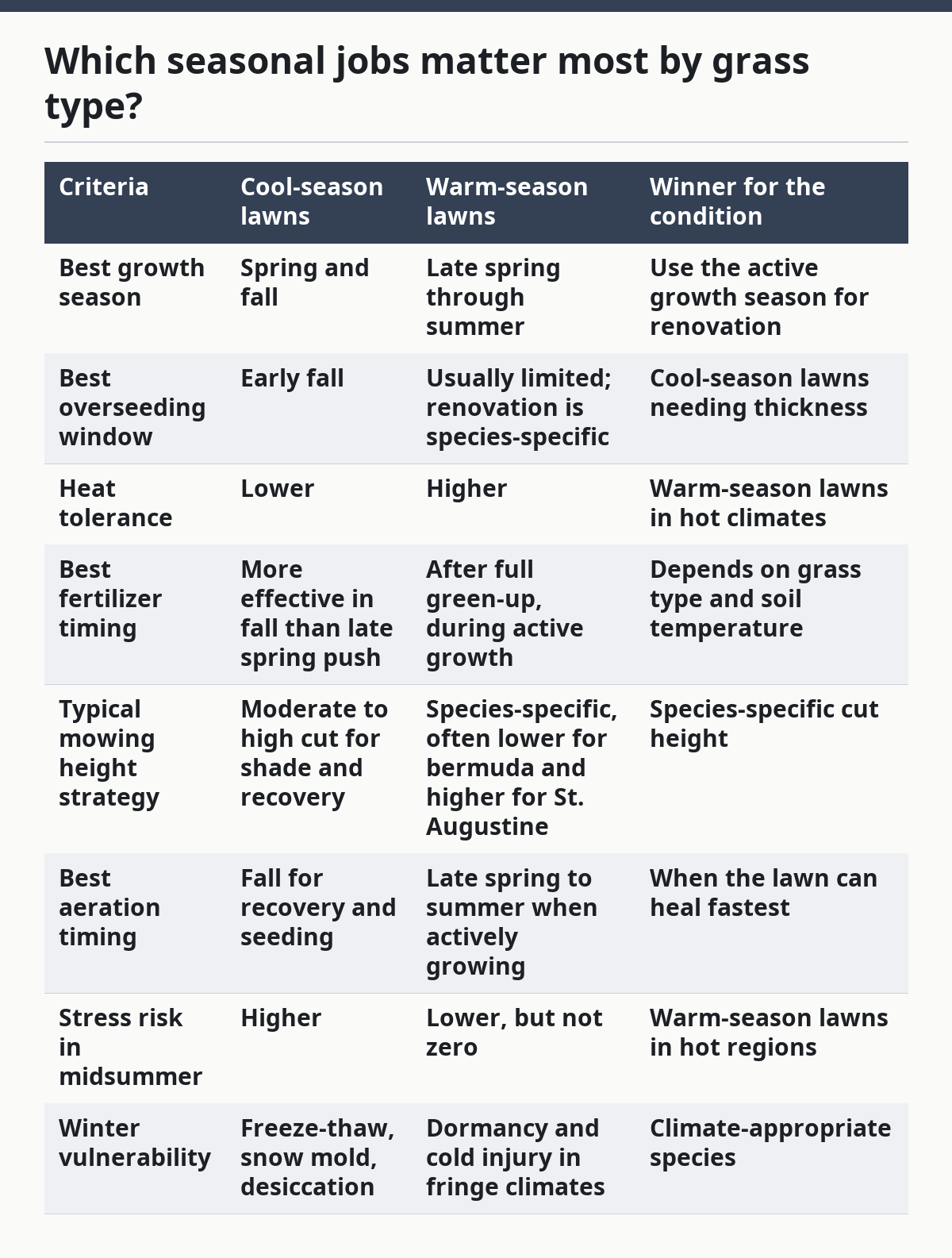
The chart makes one thing clear: no single calendar works everywhere. A cool-season lawn in the Upper Midwest and a warm-season lawn in the Southeast need different priorities even if the yard size is the same. The mistake to avoid is copying advice from the wrong grass type because it sounds tidy.
The seasonal lawn care calendar you can actually follow
A practical lawn calendar is better than a rigid checklist because weather shifts earlier or later every year. Use the season as a guide, then adjust for your local frost date, soil temperature, and grass type.
- Remove debris.
- Mow once the grass starts growing.
- Test soil if needed.
- Spot-treat weeds only when the label and temperature window fit.
- Apply pre-emergent for crabgrass if your region needs it.
Late spring
- Transition into regular mowing.
- Water only if rainfall is short.
- For warm-season lawns, fertilize after green-up.
- Repair bare spots when the grass is actively growing.
Summer
- Raise mowing height.
- Water deeply and infrequently.
- Reduce fertilizer pressure.
- Watch for disease, grubs, and irrigation gaps.
- Avoid heavy renovation work in hot, dry weather.
Early fall
- Aerate compacted soil.
- Overseed cool-season turf.
- Fertilize to support recovery.
- Keep leaves off the grass.
Late fall
- Continue mowing until growth slows.
- Finish leaf cleanup.
- Apply a final, climate-appropriate fertilizer only if it fits your turf and region.
- Drain irrigation where freezing is expected.
Winter
- Limit traffic.
- Keep heavy debris off the turf.
- Watch for salt damage near paved surfaces.
- Plan next year’s soil test, seed, and equipment needs.
The calendar is useful only if it respects local conditions. If your first frost comes early, shift the fall jobs earlier. If you live in a mild climate, some “winter” work may still happen while turf stays active.
For more detailed timing by region, state extension services are the best source because they reflect local climate and turf species more accurately than generic national advice. The USDA Natural Resources Conservation Service also offers soil information tools that help explain drainage, texture, and compaction.
When common lawn advice is wrong
Common lawn advice is wrong when it treats the lawn like a single, universal crop. A few phrases cause most of the damage.
“Feed the lawn heavily in spring.” That can create fast, weak growth, especially in cool-season turf. Spring feeding should support the plant, not force a growth spurt that the root system cannot match.
“Water a little every day.” This usually trains shallow roots and makes the lawn more dependent on frequent irrigation. Deep, less frequent watering is generally better for root development.
“More seed and more fertilizer will fix thinning.” Not if the cause is shade, compaction, poor drainage, or the wrong grass for the site. Those problems need a site fix, not just more inputs.
“Dethatch every year.” Thatch is a real issue only when it becomes a dense layer that blocks water and air. Routine dethatching on a healthy lawn can do more harm than good.
“Short grass means less mowing later.” Short mowing often backfires. The lawn loses leaf area, dries out faster, and becomes easier for weeds to invade.
The honest limitation is that lawn care has diminishing returns. A homeowner can improve a lawn dramatically with the right seasonal routine, but some yards are fighting shade, traffic, clay soil, or poor drainage. In those cases, the best answer may be partial renovation, turf-type change, or accepting a lower-input lawn rather than chasing a perfect carpet.
What should you do first if your lawn is already in bad shape?
Start with diagnosis, not products. If the lawn is patchy, thin, or yellow, the first step is to identify the main cause, because the wrong fix wastes an entire season.
Look at four things:
- Grass type — cool-season or warm-season turf.
- Soil condition — compacted, sandy, clay-heavy, or well-drained.
- Light — full sun, part shade, or dense shade.
- Water pattern — dry spots, runoff, puddling, or uneven coverage.
If the yard is compacted and thin, core aeration plus overseeding in the correct season is usually more effective than fertilizer alone. If it is brown in summer but recovers in cooler weather, the issue may be heat stress rather than disease. If the lawn never looks good under a tree canopy, the problem may be too little light for the grass you have.
This is the point where people often want a fast product answer. There is no honest one-size-fits-all bottle for a lawn with poor structure. A soil test, a mower adjustment, and the right seasonal timing often do more than another trip to the garden center.
If you need a single starting move, do this: mow at the right height, water correctly, and schedule your next major task for the season when your grass is actively growing. That will solve more lawn problems than any one-time treatment.
The verdict: which seasonal plan should you follow?
Choose a cool-season calendar if your lawn is Kentucky bluegrass, perennial ryegrass, tall fescue, or a similar turf in a region with cold winters and strong fall growth. Choose a warm-season calendar if your lawn is bermudagrass, zoysiagrass, St. Augustinegrass, or centipedegrass in a region with long, hot summers. Neither calendar fits well if the site is mostly shade, chronically flooded, or planted with the wrong grass for the climate; in that case, fix the site first or change the turf type.
Seasonal lawn maintenance works when it follows growth, not a generic month-by-month script. That is the rule that separates a lawn that recovers every year from one that slowly thins out.
FAQ
When should I fertilize my lawn?
The best time depends on grass type, but the most useful feeding usually happens when the grass is actively growing. Cool-season lawns generally benefit more from fall fertilizer than from a heavy spring push, while warm-season lawns should be fertilized after full green-up and during active summer growth.
Is spring or fall better for overseeding?
Fall is better for cool-season lawns because cooler temperatures and shorter days reduce stress on seedlings. Spring overseeding can work, but young grass then has to fight summer heat before it is fully rooted. Warm-season lawns are different and usually need species-specific renovation timing.
How often should I mow?
Mow often enough that you remove no more than about one-third of the grass blade at a time. In fast growth periods, that can mean once a week or more; in slower periods, less often. The right mowing interval depends on grass type, rain, and how fast the lawn is growing.
Do I need to aerate every year?
Not always. Aeration is most useful when soil is compacted, the lawn gets heavy foot traffic, or you are trying to improve seed-to-soil contact during overseeding. If the soil is already open and the lawn is healthy, annual aeration may not be necessary.
What is the biggest mistake people make with seasonal lawn care?
The biggest mistake is using the wrong season for the job. Fertilizing too hard in spring, watering shallowly in summer, or missing the fall renovation window does more damage than most single pests do. Timing usually matters more than buying a different product.
Drafted with AI; not yet reviewed by a person.





Leave a Reply